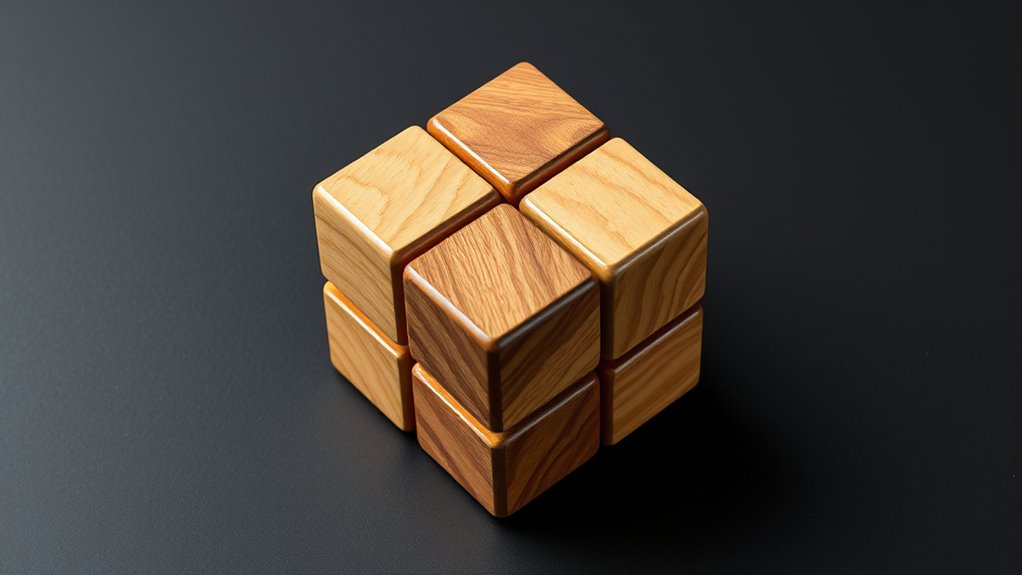

The Soma Cube is a classic 3D puzzle that challenges you to assemble seven uniquely shaped pieces into a perfect cube using geometric principles. You rotate and fit these pieces, which are made from smaller cubes, requiring strong spatial visualization and understanding of three-dimensional relationships. By exploring how shapes connect, you develop problem-solving skills and deepen your grasp of geometry. Keep exploring to discover how this timeless puzzle sharpens your mind and geometric insight.
Key Takeaways
- The Soma Cube consists of seven uniquely shaped pieces made of unit cubes, assembled into a solid cube through geometric reasoning.
- Solving the puzzle involves understanding three-dimensional spatial relationships and manipulating the pieces via rotation and flipping.
- Geometric concepts like shape recognition, spatial visualization, and logical pattern recognition are essential to assemble the cube correctly.
- The puzzle enhances problem-solving skills by requiring the solver to recognize underlying spatial patterns beyond trial and error.
- It serves as an educational tool that illustrates principles of 3D geometry and visualization, blending recreational play with geometric exploration.

Have you ever wondered how a simple puzzle can challenge your spatial reasoning and problem-solving skills? The Soma Cube is a perfect example. Created in the late 1930s by Dutch mathematician Piet Hein, this intriguing three-dimensional puzzle has a rich history importance rooted in both recreational mathematics and educational value. It was initially designed as a tool to stimulate mathematical thinking and explore geometric properties, making it more than just a game—it’s a gateway to understanding complex spatial relationships. The puzzle’s origins are linked to a desire to combine play with scientific inquiry, which has helped it endure over decades as a classic brain-teaser.
The Soma Cube, created by Piet Hein in the 1930s, combines play and science to challenge spatial reasoning and geometric understanding.
What truly sets the Soma Cube apart is its geometric complexity. It consists of seven unique pieces, each made from three or four unit cubes, which can be assembled in numerous ways to form a solid cube. Your challenge is to figure out how these pieces fit together, and it’s not as straightforward as it seems. The pieces can be rotated and flipped in space, and understanding their geometric relationships is key to solving the puzzle. This complexity isn’t just about trial and error; it’s about recognizing the underlying spatial patterns and applying logical reasoning. As you manipulate the pieces, you develop a deeper sense of three-dimensional geometry, which enhances your problem-solving skills.
The geometric complexity of the Soma Cube also illustrates fundamental principles of spatial visualization, a vital skill in many fields like engineering, architecture, and mathematics. When you work through the puzzle, you’re essentially practicing mental rotation and spatial perception, skills that are highly valuable beyond the game itself. Each successful configuration you create reinforces your understanding of how shapes interact in three-dimensional space, sharpening your ability to visualize structures mentally. This makes the Soma Cube not only a fun pastime but also a valuable educational tool that bridges recreational play with serious cognitive development. Moreover, understanding 3D spatial relationships can improve your ability to work with complex geometric models in various technical disciplines.
In short, the historical significance of the Soma Cube highlights its role in stimulating mathematical curiosity, while its geometric complexity challenges you to think in three dimensions. It pushes your reasoning beyond simple puzzles and encourages you to explore the spatial relationships that govern the physical world. By engaging with this puzzle, you’re not just solving an intriguing problem—you’re training your mind to see the world from new, more complex perspectives. That’s what makes the Soma Cube timeless and truly fascinating.
As an affiliate, we earn on qualifying purchases.
Frequently Asked Questions
What Is the History Behind the Soma Cube’s Invention?
You discover that the history origins of the Soma Cube trace back to 1933, created by Danish psychologist and puzzle enthusiast Piet Hein. His background in mathematics and problem-solving inspired him to design this challenging 3D puzzle. Hein’s goal was to develop an engaging activity that combines geometry with spatial reasoning, and he later shared it with others, sparking widespread interest and inspiring countless puzzle enthusiasts worldwide.
Are There Digital Versions or Virtual Soma Cubes Available?
Sure, you can find virtual replicas of the Soma Cube on digital platforms, making it easier than ever to enjoy this classic puzzle. Ironically, while the physical cube challenges your spatial reasoning, digital versions let you solve it with just a click or swipe. These virtual Soma cubes offer interactive experiences, perfect for testing your skills anywhere, anytime—proving that even timeless puzzles adapt to modern tech.
How Does the Soma Cube Relate to Modern 3D Printing?
You can see the Soma Cube’s influence on modern 3D printing through material innovation and design customization. 3D printing allows you to create intricate, puzzle-like pieces in various materials, mimicking the cube’s geometric challenge. This technology enables you to experiment with different textures, shapes, and colors, making the Soma Cube a perfect example of how classic puzzles inspire innovative design and customization in today’s manufacturing and creative projects.
Can the Soma Cube Be Used for Educational Purposes in Schools?
Imagine you’re in a 1920s classroom with a vintage puzzle—like the Soma Cube—you can use it for educational benefits today. It promotes spatial reasoning, problem-solving, and critical thinking through engaging classroom activities. The puzzle’s hands-on nature helps students grasp geometric concepts and develop fine motor skills. Incorporating it into lessons makes learning interactive and fun, making the Soma Cube a timeless tool for fostering creativity and cognitive skills in students.
Are There Advanced or Complex Variations of the Soma Cube Puzzles?
Yes, there are advanced variations of the Soma Cube that involve complex configurations and multi-layer puzzles. You can challenge yourself by trying to assemble larger or more intricate shapes, which require a deeper understanding of spatial relationships and geometry. These complex puzzles push your problem-solving skills further, making the experience more engaging and educational. Exploring these variations helps develop your spatial reasoning and creativity in new and exciting ways.
As an affiliate, we earn on qualifying purchases.
Conclusion
Just like Da Vinci’s sketches hint at infinite creativity, the Soma Cube invites you to unlock your spatial imagination. As you manipulate its pieces, remember that every twist and turn echoes back to the timeless dance of geometry and ingenuity. With patience and a keen eye, you’ll discover that solving this puzzle isn’t just about fitting blocks—it’s about unleashing your inner architect, echoing the endless possibilities that lie within the shape of your mind.
As an affiliate, we earn on qualifying purchases.
educational 3D puzzle for adults
As an affiliate, we earn on qualifying purchases.
As an affiliate, we earn on qualifying purchases.