You can often spot that impossible geometry puzzles hide a simple trick because they rely on visual illusions and perceptual biases. Your brain prefers familiar patterns and often fills in gaps or assumes connections that don’t exist, tricking you into seeing impossible shapes. These puzzles manipulate shading, perspective, and lines to create confusion. If you keep exploring, you’ll uncover how these illusions exploit your perception and reveal the straightforward solutions behind the illusion.

Prime made for students and young adults
- Fast, free delivery for dorm and study essentials
- Prime Video and Amazon Music included
- Member-only deals
Key Takeaways
- They exploit optical illusions and perspective cues to create confusion, masking simple tricks behind complex visual appearances.
- Our brain’s tendency to fill gaps and assume continuity helps hide the straightforward trick.
- Manipulated shading, lines, and angles deceive perception, making shapes seem impossible when they are not.
- Recognizing that illusions rely on visual biases reveals the underlying simple trick.
- The “impossible” appearance results from perceptual tricks, not actual complex or impossible geometry.
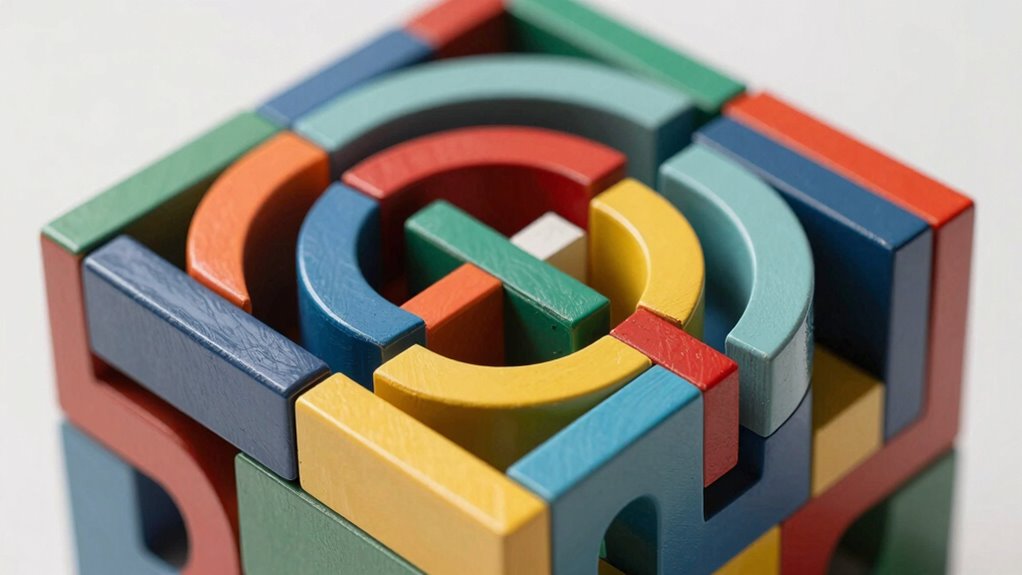
Many puzzles that seem impossible at first glance often hide a simple trick once you look closely. ‘Impossible’ geometry puzzles are no different. They appear perplexing, defying logic and challenging your perception, but in reality, they rely heavily on optical illusions and cognitive biases to create confusion. These puzzles exploit how your brain processes visual information, making you see things that aren’t actually there or interpret shapes in ways that distort reality.
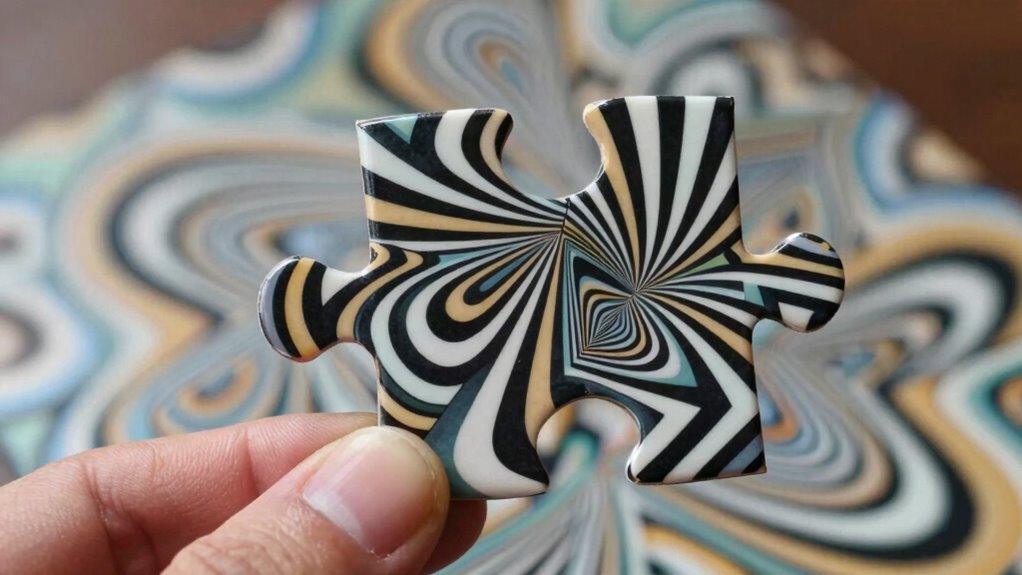
Impossible puzzles deceive the eye by exploiting visual tricks and mental shortcuts, revealing how perception can distort reality.
When you first encounter an impossible geometry puzzle, your mind automatically tries to make sense of the shapes and lines based on everyday experiences. This is where cognitive biases come into play. Your brain tends to favor familiar patterns and assumptions, often filling in gaps or assuming continuity where there isn’t any. For example, you might interpret a line as continuing behind an object or assume perspective cues are consistent when they’re intentionally misleading. These mental shortcuts can lead you astray, making the puzzle seem surreal or unsolvable.
Optical illusions are a key tool in these puzzles’ design. They manipulate visual cues, such as shading, line thickness, or perspective, to create conflicting interpretations within your visual system. They also often use perceptual cues to mislead the viewer, which can heighten the sense of impossibility. For instance, the classic “impossible triangle” appears to be a three-dimensional object, but closer inspection reveals that the way its edges connect defies the rules of Euclidean geometry. Your brain attempts to reconcile these conflicting cues, but it’s unable to do so because the image is constructed to exploit these inconsistencies. The illusion tricks your mind into perceiving a continuous, stable shape when no such shape can exist in three-dimensional space.
Most of these puzzles rely on your brain’s natural tendency to interpret 2D images as 3D objects or to perceive depth and perspective where none exist. By doing so, they create a sense of impossibility, which is actually just an illusion of perspective or an optical trick. Recognizing how visual processing works in your brain can help you understand the illusion better. Sometimes, understanding the psychological mechanisms involved can reveal why certain cues are misleading and how your perception is being manipulated. This awareness of visual perception can develop through practice, making it easier to spot the trick behind the illusion. Once you understand the underlying principle—that the image is designed to exploit your visual and cognitive biases—the puzzle becomes much easier to solve. You realize that the “impossibility” lies in the way your brain interprets the image, not in the actual geometry.
In essence, these puzzles are clever demonstrations of how your perception can be fooled. Recognizing that optical illusions and cognitive biases are at play helps you see through the illusion. Instead of being overwhelmed by what looks like an impossible shape, you learn to look beyond your initial perception, realizing that the puzzle’s trick is rooted in how your brain processes visual information. Once you grasp that, the mystery of impossible geometry begins to unravel.
As an affiliate, we earn on qualifying purchases.
Frequently Asked Questions
How Do Puzzle Creators Intentionally Mislead Solvers?
Puzzle creators intentionally mislead you by exploiting your mindset biases and cognitive shortcuts. They craft misleading diagrams or wording that trigger assumptions, causing you to overlook simple solutions. By playing on your automatic thought patterns, they steer you away from straightforward answers. This clever manipulation makes the puzzle seem impossible, encouraging you to overthink while the trick remains hidden in plain sight, waiting for you to recognize the bias and see the solution.
What Common Visual Illusions Are Used in These Puzzles?
You’ll notice that these puzzles often use visual illusions like color contrast and perspective tricks to deceive your eyes. Bright or contrasting colors can make shapes seem larger or smaller than they really are, while clever perspective tricks create impossible angles or depth, making the puzzle appear unsolvable. These illusions manipulate perception, leading you to overlook simple solutions, revealing that what seems impossible is often just a matter of perspective.
Are There Specific Geometric Principles Often Overlooked?
Think of these puzzles as a house of mirrors, where hidden angles and proportions create illusions. You often overlook basic geometric principles like congruence, symmetry, or parallel lines, because visual misdirection and conceptual shortcuts distract you. These tricks hide simple truths, making complex shapes appear impossible. By focusing on fundamental properties, you can see through the illusion and uncover the straightforward solution behind the apparent complexity.
How Can One Train to Spot the Hidden Tricks?
To spot the hidden tricks, you should train your visual pattern recognition and boost your cognitive flexibility. Practice solving various puzzles that challenge your perception, and pay close attention to unusual shapes or arrangements. Break down complex diagrams into smaller parts, and try viewing them from different angles. Over time, your ability to recognize subtle cues improves, helping you identify the simple tricks behind seemingly impossible geometry puzzles.
Do These Tricks Vary Across Different Cultures or Regions?
These tricks do vary across different cultures and regions, influenced by cultural influences and regional variations. You might notice that puzzles from one area emphasize certain visual cues or logic styles unfamiliar elsewhere. By studying puzzles from diverse backgrounds, you’ll become more adept at recognizing unique tricks and patterns, broadening your problem-solving skills. Embracing these differences helps you see beyond your usual approach, making it easier to spot hidden tricks everywhere.
As an affiliate, we earn on qualifying purchases.
Conclusion
So, next time you face an impossible-looking puzzle, remember—it’s often a mirage hiding a simple trick. Like a magician’s illusion, what seems complex dissolves once you spot the hidden clue. Don’t be fooled by the illusion of impossibility; instead, see it as a doorway to clever simplicity. With a keen eye and a little curiosity, you’ll find that behind every impossible façade lies a straightforward solution waiting to be uncovered.
As an affiliate, we earn on qualifying purchases.
As an affiliate, we earn on qualifying purchases.
Halloween Picks
halloween
As an affiliate, we earn on qualifying purchases.