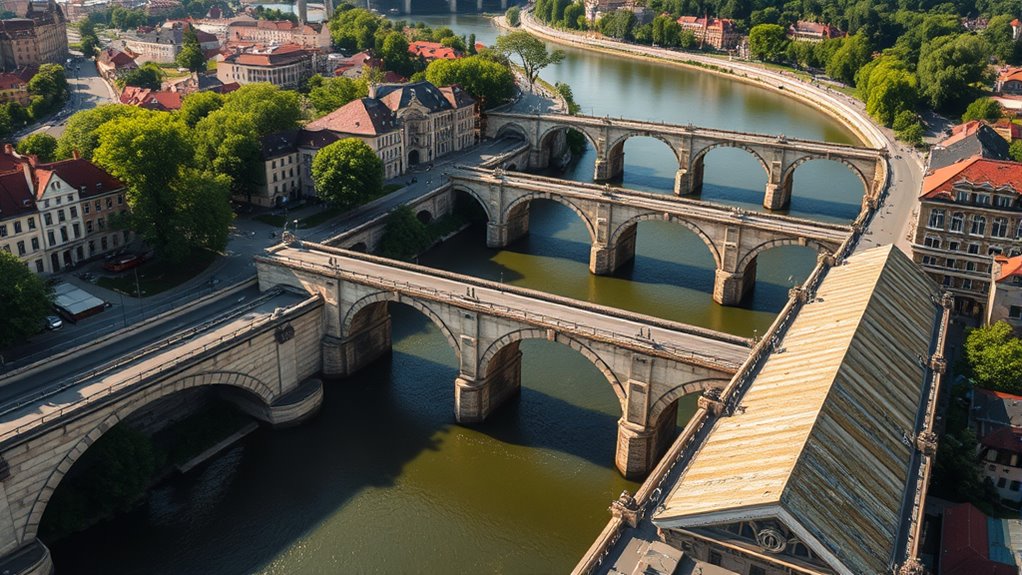

The Seven Bridges of Königsberg puzzle challenges you to find a path crossing each bridge once without retracing steps. Mathematician Euler transformed the problem into an abstract graph, representing landmasses as points and bridges as lines. By analyzing the degrees of each point, he proved such a path was impossible. This breakthrough laid the foundation for graph theory, showing how simple puzzles can inspire major advances—discover the details to see how this all happened.
Key Takeaways
- The problem involves finding a path crossing each bridge exactly once without retracing steps, challenging intuitive navigation.
- Euler modeled landmasses as nodes and bridges as edges, transforming the physical layout into an abstract graph.
- His analysis of vertex degrees showed that no such path exists because all landmasses had an odd number of bridges.
- Euler’s work introduced the concept of graph theory, focusing on network structure rather than geographic details.
- This problem’s solution and analysis laid the foundation for modern graph theory and network analysis across various fields.

The Seven Bridges of Königsberg is a famous problem in mathematics and graph theory that challenges you to find a path crossing each bridge exactly once without retracing your steps. To understand how this problem was approached, you need to know about Euler’s analysis and how he transformed the physical layout into a more manageable form. Euler’s analysis was groundbreaking because it shifted the focus from the map itself to an abstract representation called a graph. Instead of thinking about the rivers and bridges as physical entities, Euler saw them as points and lines, which made the problem much easier to analyze systematically.
In the case of Königsberg, Euler represented each landmass as a node (or vertex) and each bridge as an edge connecting these nodes. This graph representation allowed him to visualize the problem as a network of points connected by lines, making it clear where the difficulties lay. By doing this, Euler moved away from the complexity of geography and focused on the relationships between the landmasses, which is the core idea behind graph theory today. This approach was revolutionary because it demonstrated how a physical problem could be simplified into a mathematical model, allowing for logical analysis of the path.
Once you create this graph, Euler examined the degrees of each vertex—that is, how many edges connect to each point. He discovered that for the path to exist, each vertex must have an even number of connections, except for at most two vertices, which can have an odd number. In Königsberg’s case, each landmass had an odd number of bridges leading to it, which meant that no single path could cross all bridges exactly once. Euler’s insight was that the problem was not just about finding a route but about understanding the underlying structure. His analysis proved that a solution was impossible, and this conclusion marked a turning point in mathematics. Furthermore, the principles derived from this analysis underpin modern graph algorithms, demonstrating the enduring relevance of Euler’s work.
This graph representation and Euler’s analysis not only solved the Königsberg problem but also laid the foundation for graph theory as a formal discipline. It provided a systematic way to analyze network connectivity and paths, influencing countless fields from computer science to logistics. So, when you look at the Königsberg map now, it’s easier to see it as a web of nodes and links—an elegant model that transformed a simple puzzle into a cornerstone of modern mathematics. Euler’s work shows how abstract thinking and clever modeling can unseal solutions to real-world problems, inspiring generations of mathematicians and scientists.
As an affiliate, we earn on qualifying purchases.
Frequently Asked Questions
How Does Graph Theory Apply to Modern Computer Networks?
You use graph theory in modern computer networks to improve network routing and topology optimization. By representing devices as nodes and connections as edges, you can analyze the most efficient paths for data flow, reduce latency, and enhance reliability. This approach helps you design scalable, resilient networks that optimize resource use and troubleshoot issues quickly, ensuring smooth communication across all connected devices.
What Other Famous Puzzles Influenced Graph Theory’s Development?
Imagine walking through a tangled web of streets and connections, trying to find the quickest path. That’s what the Königsberg puzzle sparked—developing graph theory. Other famous puzzles, like the traveling salesman problem and the friendship networks in social network analysis, also pushed the field forward. These puzzles help optimize network routing, improve logistics, and reveal hidden patterns in social connections, shaping how we comprehend complex systems today.
How Did the Königsberg Problem Impact Urban Planning?
You see, the Königsberg problem influenced urban development by highlighting the importance of efficient bridge and road design. It encouraged city planners to think about connectivity and flow, leading to better bridge design that minimizes congestion. This puzzle’s insights helped shape strategies for creating more navigable, balanced urban layouts, ensuring that infrastructure supports movement and growth. Consequently, it played a key role in modern urban planning and sustainable development.
Are There Real-World Problems Similar to the Königsberg Puzzle Today?
Yes, you’ll find real-world problems similar to the Königsberg puzzle today. In transportation logistics, you optimize routes and connections to reduce travel time and costs, much like balancing bridges. Social network analysis also resembles the puzzle, as you study connections and influence within groups. Both fields use graph theory principles to solve complex problems, helping you manage networks efficiently and improve overall system performance.
Who Were the Key Mathematicians Involved in Solving the Königsberg Problem?
They say “two heads are better than one,” and Euler’s contributions prove it. You learn that Leonhard Euler and the Bridges’ analysis played key roles in solving the Königsberg problem. Euler, in particular, formulated the foundational principles of graph theory, analyzing the city’s bridges and landmasses. His work transformed the puzzle into a mathematical framework, laying the groundwork for modern network analysis.
As an affiliate, we earn on qualifying purchases.
Conclusion
So, next time you’re stuck crossing seven bridges and feeling like a genius, just remember—this puzzle sparked graph theory, not a magical way to avoid traffic. Instead of solving problems, you might just end up inventing whole new branches of mathematics. Who knew that a simple walk through Königsberg’s streets could lead to such a legendary headache? Maybe it’s time to stick to less complicated routes… or at least enjoy the chaos.
As an affiliate, we earn on qualifying purchases.
Euler's graph theory educational kit
As an affiliate, we earn on qualifying purchases.
As an affiliate, we earn on qualifying purchases.