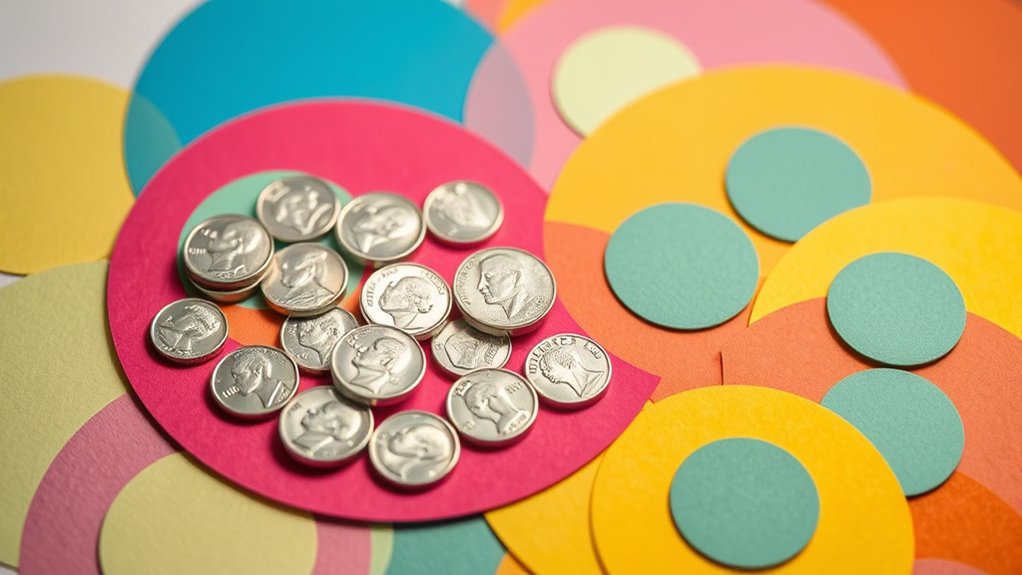

Circle packing puzzles challenge you to arrange coins or circles efficiently within a confined space. Using geometric patterns like the hexagonal or honeycomb arrangement helps maximize space and stability, especially with equal-sized circles. Placing larger circles first and filling gaps with smaller ones improves the fit. Experimenting with different arrangements teaches you how to optimize overlaps and gaps. Keep exploring these principles, and you’ll discover more strategies for solving circle packing puzzles effectively.

Prime made for students and young adults
- Fast, free delivery for dorm and study essentials
- Prime Video and Amazon Music included
- Member-only deals
Key Takeaways
- Hexagonal (honeycomb) patterns maximize space efficiency when fitting identical circles or coins together.
- Placing larger circles first and filling gaps with smaller ones optimizes overall packing density.
- Adjusting row staggering and shifting enhances stability and minimizes wasted space in circle arrangements.
- Practice and geometric analysis help develop effective strategies for solving circle packing puzzles.
- Understanding tessellation patterns and geometric principles aids in creating stable, space-efficient circle and coin packings.

Have you ever wondered how to fit multiple circles perfectly within a confined space without overlaps? If so, you’re delving into the fascinating world of geometric arrangements, where the goal is to maximize packing efficiency. When arranging circles, especially in puzzles or practical applications like coin stacking or design, understanding how to maximize space usage becomes essential. The key challenge is to find arrangements that allow you to pack the most circles into a given area while maintaining equal spacing, avoiding overlaps, and ensuring stability.
Different geometric arrangements influence packing efficiency profoundly. For example, the simplest pattern is a grid, where circles are aligned in straight rows and columns. This arrangement is straightforward but not always the most space-efficient. In tight spaces, the hexagonal or honeycomb pattern often outperforms the grid because each circle touches six neighbors, minimizing wasted space. This configuration allows for a denser packing, fitting more circles into the same area. When you’re working on a circle packing puzzle, experimenting with these arrangements helps you discover the most effective pattern for your specific shape and size constraints.
Hexagonal patterns maximize space and minimize wasted gaps in circle arrangements.
To achieve maximum packing efficiency, you need to think about how the circles tessellate. In a perfect hexagonal pattern, each circle touches six others, creating a compact, stable structure. This arrangement is especially effective when dealing with identical circles of the same size. However, if your circles vary in size, the challenge becomes more complex. You might need to adjust the pattern, sometimes placing larger circles first and filling gaps with smaller ones. This process involves strategic planning and a keen eye for geometric relationships. By analyzing these arrangements, you can often find innovative solutions that maximize the number of circles fitting into a limited space.
Practicing with different configurations sharpens your understanding of geometric principles. As you experiment, you’ll notice how shifting a row slightly or staggering the circles can improve packing efficiency. This trial-and-error approach is essential in puzzle-solving, helping you develop intuition for optimal arrangements. Whether you’re stacking coins, designing a mosaic, or solving a mathematical puzzle, mastering these geometric arrangements improves your ability to use space wisely. Remember, the goal is to reduce gaps and overlaps while maintaining stability, which often involves balancing symmetry and irregularity.
In essence, understanding geometric arrangements and packing efficiency is fundamental to solving circle packing puzzles. By exploring different patterns and recognizing how they tessellate, you can efficiently fit multiple circles into confined spaces. This knowledge not only enhances your problem-solving skills but also deepens your appreciation for the elegant mathematics behind seemingly simple tasks. Recognizing the importance of geometric principles can help you approach packing challenges with greater insight and precision. So next time you’re faced with a packing challenge, consider how arrangements influence efficiency, and you’ll be well on your way to mastering the art of circle packing.
As an affiliate, we earn on qualifying purchases.
Frequently Asked Questions
What Are the Best Strategies for Solving Circle Packing Puzzles?
To solve circle packing puzzles, you should analyze tangential art patterns and study historical examples like the Apollonian gasket. Start by placing the largest circles first, then fit smaller ones into gaps. Experiment with symmetry and iterative adjustments, and visualize how circles interact. Learning from past designs helps you develop intuition, making it easier to find efficient arrangements and maximize space, just like in classic geometric art.
How Do Symmetry and Pattern Recognition Aid in Circle Packing?
Think of symmetry and pattern recognition as your secret superpowers, like having Google Lens in the 1800s. These tools help you spot repeating shapes and balanced arrangements, making it easier to fit circles together efficiently. Symmetry analysis reveals how circles mirror each other, guiding placement. Pattern recognition lets you identify recurring configurations, reducing trial and error. Mastering these skills boosts your ability to solve circle packing puzzles quickly and elegantly.
Are There Digital Tools or Apps to Assist With Circle Packing Puzzles?
Yes, there are digital tools and apps that can help you with circle packing puzzles. These tools often feature interactive interfaces that let you experiment with different arrangements and sizes of circles. By using digital tools for circle packing, you can quickly test ideas, visualize complex patterns, and optimize your designs. They’re perfect for both beginners and experts aiming to improve their skills and solve packing puzzles more efficiently.
How Does Circle Packing Relate to Real-World Applications?
Circle packing relates to real-world applications by helping you improve industrial design and packing efficiency. When designing products or packaging, you can use circle packing principles to maximize space and reduce material waste. This approach guarantees that items fit together ideally, whether in containers, circuit boards, or storage solutions. By understanding circle packing, you make smarter decisions that enhance functionality and cost-effectiveness in practical situations.
What Are the Most Common Mistakes Beginners Make in These Puzzles?
You might think these puzzles are straightforward, but common pitfalls trip up beginners. They often overlook optimizing space, leading to wasted gaps, or make errors in measuring circle sizes, causing overlaps. Don’t rush; take your time to assess how each circle fits. Recognize beginner errors like misplacing circles or assuming incorrect sizes. Paying attention to detail and practicing patience helps you master circle packing and avoid these common mistakes.
coin stacking and arrangement puzzles
As an affiliate, we earn on qualifying purchases.
As an affiliate, we earn on qualifying purchases.
Conclusion
As you explore circle packing puzzles, you’ll discover how fascinating and challenging it can be to fit coins and circles perfectly together. Did you know that mathematicians have calculated that the densest circle packing in a plane covers about 90.69% of the surface? This intriguing fact shows just how efficient these arrangements can be. Keep experimenting with different shapes and sizes—you’ll discover new patterns and insights while sharpening your problem-solving skills. Happy puzzling!
As an affiliate, we earn on qualifying purchases.
As an affiliate, we earn on qualifying purchases.
Fall Picks
fall essentials
As an affiliate, we earn on qualifying purchases.