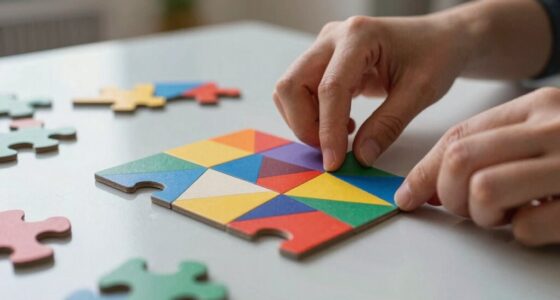

Dissection puzzles involve carefully cutting and rearranging shapes using geometric transformations like rotations, reflections, and translations. These transformations preserve key properties such as area, angles, and shape integrity, allowing you to piece parts together in new ways. By understanding the underlying principles of symmetry, congruence, and similarity, you can discover surprising configurations and solutions. If you want to uncover the secrets behind these elegant puzzles, exploring the core mathematical ideas will reveal more about shape manipulation and invariance.
Prime for Young Adults — start your free trial
Fast free delivery, streaming and member deals for eligible 18–24 year olds.
As an affiliate, we earn on qualifying purchases.
Key Takeaways
- Dissection puzzles involve cutting complex shapes into smaller pieces to rearrange into new designs seamlessly.
- Geometric transformations such as rotations, reflections, and translations preserve shape properties during reassembly.
- Understanding invariance and symmetry explains how pieces fit together and why certain dissections are possible.
- Shapes are divided based on geometric principles like congruence and similarity, enabling logical reconstruction.
- These puzzles illustrate fundamental geometry concepts, highlighting the role of transformations and shape properties in shape manipulation.

Have you ever wondered how a complex shape can be transformed into simpler, smaller pieces that fit together perfectly? That’s the core idea behind dissection puzzles. These puzzles challenge you to cut a shape into a few pieces, then rearrange those pieces to form a different shape—often with surprising accuracy. The magic lies in understanding the geometric transformations involved and recognizing the mathematical properties that make these rearrangements possible. When you dissect a shape, you’re essentially applying a series of geometric transformations—like rotations, reflections, translations, or scalings—that preserve the fundamental properties of the original figure. These transformations maintain the shape’s area, angles, and other critical mathematical properties, ensuring the pieces fit together perfectly once rearranged. Recognizing the importance of invariance helps explain why these transformations work so effectively in dissection puzzles.
By exploring dissection puzzles, you get to see how mathematical properties underpin these transformations. For example, when a shape is cut into pieces that can be rearranged to form a new shape, it’s because the pieces are related through specific transformations. This might mean flipping a piece over (reflection) or sliding it across a plane (translation). Sometimes, the pieces are rotated to align with their new positions. These actions are all geometric transformations, and they’re governed by mathematical properties that ensure the pieces retain their size and shape after being moved. It’s these properties that make dissection puzzles so intriguing—they show how shapes can be manipulated without losing their essential characteristics.
Understanding these geometric transformations helps you see the elegance behind dissection puzzles. When you cut a shape into parts, you’re not just randomly chopping it up—you’re strategically applying transformations that leverage symmetry, congruence, and similarity. For instance, many puzzles rely on the fact that certain shapes can be divided into parts that are mirror images or congruent segments, which then fit together to create a new figure. This deliberate use of mathematical properties highlights the beauty of geometry: that shapes can be broken down and reconstructed in ways that are both logical and surprising.
As you work through these puzzles, you develop a deeper appreciation for the mathematical principles that make them possible. Recognizing how geometric transformations preserve key properties helps you understand why certain dissections work and others don’t. It’s not just about cutting shapes—it’s about understanding the underlying properties that allow those pieces to fit together seamlessly. This insight transforms a simple puzzle into an exploration of the fundamental concepts of geometry, revealing how mathematical properties and transformations come together to create elegant solutions.
As an affiliate, we earn on qualifying purchases.
Frequently Asked Questions
What Are the Origins of Dissection Puzzles?
You might be surprised to learn that the historical origins of dissection puzzles trace back to ancient China and India, where they held cultural significance in teaching geometry and problem-solving. These puzzles gained popularity in Europe during the 18th century, reflecting a fascination with mathematical ingenuity. Their cultural significance lies in promoting logical thinking and spatial awareness, making them both educational tools and entertaining challenges that have endured through centuries.
How Can Dissection Puzzles Improve Spatial Reasoning?
Dissection puzzles definitely boost your spatial reasoning by sharpening your ability to mentally rotate and visualize shapes. When you cut and rearrange pieces, you challenge your brain to see how parts fit together, improving mental rotation skills. This mental practice strengthens your capacity to understand spatial relationships, making it easier to solve complex problems, navigate environments, or even excel in fields like engineering or architecture.
Are There Digital Tools to Create Custom Dissection Puzzles?
Yes, you can find digital tools to create custom dissection puzzles easily. These tools allow you to design shapes, cut them into pieces, and then rearrange or share your custom puzzles online. Platforms like GeoGebra, Craftsy, and specific puzzle maker apps give you the flexibility to personalize puzzles for different skill levels. Using these digital tools, you can quickly create engaging, tailored dissection puzzles that enhance spatial reasoning and problem-solving skills.
What Are the Most Famous Historical Dissection Puzzles?
You’ll find that the most famous historical dissection puzzles, like the Wallace’s Puzzle and the Haberdasher’s Puzzle, showcase clever geometric transformations and innovative puzzle design techniques. These puzzles challenge you to cut and rearrange shapes to form new figures, highlighting how shape dissection can teach spatial reasoning. Their enduring popularity underscores their role in the evolution of puzzle design, inspiring both mathematicians and puzzle enthusiasts worldwide.
How Do Dissection Puzzles Relate to Mathematical Concepts?
Dissection puzzles are like keys opening mathematical mysteries. They relate to concepts such as geometric transformations and mathematical proofs, helping you see how shapes can be rearranged without losing area. By cutting and reassembling pieces, you explore properties like congruence and similarity, which are fundamental in understanding shape relationships. These puzzles make complex math ideas tangible, deepening your comprehension of shape behavior and supporting logical reasoning through visual proof.
As an affiliate, we earn on qualifying purchases.
Conclusion
As you master dissection puzzles, you realize that shapes hold secrets beyond their edges. Every cut reveals a new possibility, a hidden connection waiting to be uncovered. But what if the greatest puzzle isn’t just in the pieces, but in how you see the world itself? Keep cutting, rearranging, and questioning—because sometimes, the most profound truths are hidden where you least expect them. Are you ready to unseal what lies beneath the surface?
shape cutting and rearranging puzzle
As an affiliate, we earn on qualifying purchases.
As an affiliate, we earn on qualifying purchases.
mathematical dissection puzzle game
As an affiliate, we earn on qualifying purchases.
As an affiliate, we earn on qualifying purchases.
Fall Picks
fall essentials
As an affiliate, we earn on qualifying purchases.