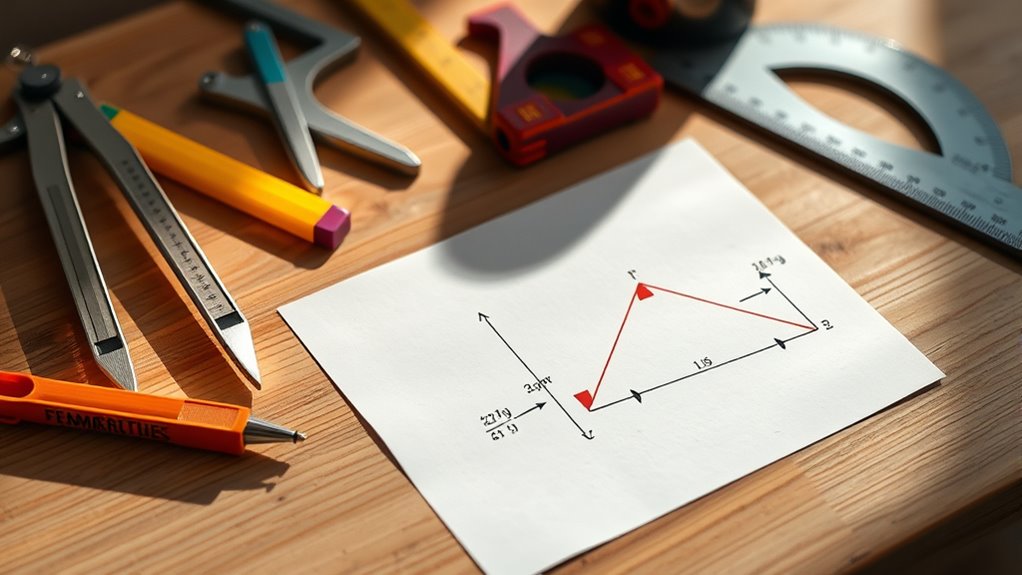

To master geometric proofs, focus on understanding their purpose: establishing truth logically and visually. Learn the basic elements, such as given information, what you need to prove, and using angles and theorems. Practice constructing proofs step-by-step, organizing your statements clearly, and supporting each with reasons like definitions or postulates. Using accurate diagrams is key to clarity. Keep practicing, and you’ll find it easier to develop strong, confident arguments that make sense.
Key Takeaways
- Understand the purpose of geometric proofs: establishing truth through logical, step-by-step reasoning supported by diagrams.
- Familiarize yourself with common proof types, such as two-column and paragraph proofs, and their structured approaches.
- Use accurate, clear diagrams with labels and colors to enhance visualization and clarify geometric relationships.
- Justify each step with definitions, postulates, or theorems, ensuring logical flow and correctness throughout the proof.
- Practice systematically by planning, visualizing, and verifying each step to build confidence and improve proof-writing skills.
Understanding the Purpose of Geometric Proofs
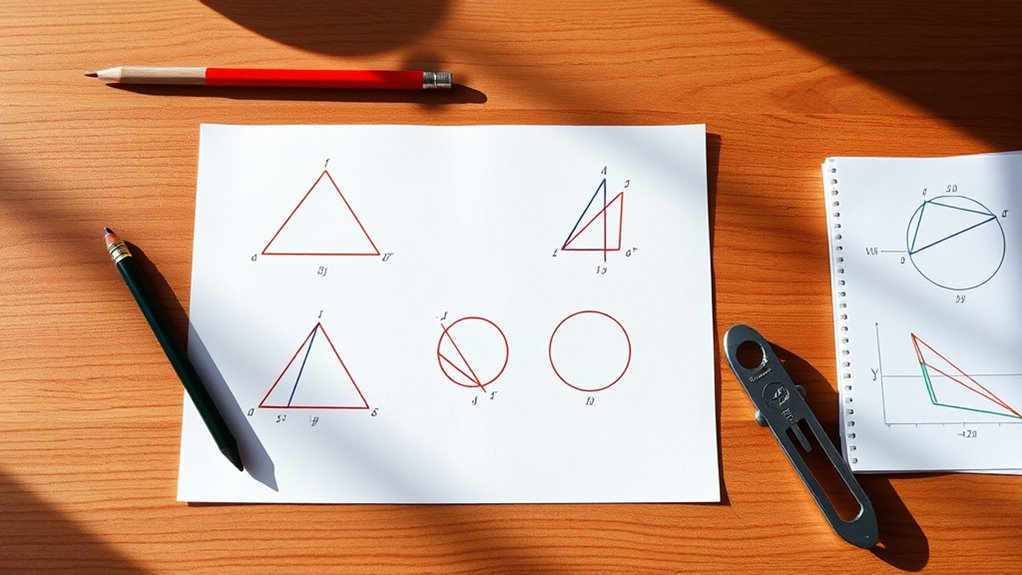
Have you ever wondered why geometric proofs are essential in mathematics? They develop your visual reasoning skills, helping you see relationships and patterns clearly. Geometric proofs aren’t just about confirming facts; they demonstrate the proof significance by establishing truth through logical steps. When you construct a proof, you connect ideas visually and logically, strengthening your understanding of geometric concepts. This process enhances critical thinking, allowing you to analyze problems systematically. By mastering geometric proofs, you learn to justify your conclusions confidently, which is *crucial* in advanced mathematics. Understanding the role of visual accuracy in geometric proofs helps reinforce why these methods are effective. Ultimately, the purpose of these proofs is to clarify why geometric statements are true, reinforcing your comprehension and proving that your reasoning is sound. This foundation is *vital* for deeper mathematical learning.
Basic Elements of a Geometric Proof

To construct a clear and convincing geometric proof, you need to understand its basic elements. First, you start with given information and what you need to prove. Next, you identify relevant angle relationships, such as supplementary, complementary, or vertical angles, which help connect different parts of the diagram. Using proof strategies like direct proof or indirect proof guides your logical flow. You carefully state your assumptions and justify each step with definitions, postulates, or theorems. Clear diagrams support your reasoning, making relationships easier to see. Remember, a good geometric proof builds on these elements systematically, ensuring each conclusion follows logically from previous statements. Mastering these basic elements sharpens your ability to develop strong, persuasive proofs. Additionally, understanding the elements of a geometric proof is essential for grasping how to connect different geometric concepts effectively.
Common Types of Geometric Proofs

What are the most common types of geometric proofs you’ll encounter? You’ll mainly see two: two-column proofs and paragraph proofs. Two-column proofs organize statements and reasons side-by-side, making logical flow clear. Paragraph proofs, on the other hand, present the reasoning in paragraph form, offering a more narrative style. Both often involve properties of parallel lines and congruence criteria, like ASA, SSS, and SAS, to prove angles or side relationships. Here’s a quick comparison:
| Type of Proof | Key Feature |
|---|---|
| Two-column proof | Clear, organized step-by-step reasoning |
| Paragraph proof | Continuous, narrative explanation |
Understanding these types helps you choose the best approach for different geometric problems involving parallel lines and congruence.
Step-by-Step Approach to Constructing a Proof
To construct a clear geometric proof, you need to start by planning your approach carefully. Think about which theorems and properties will support your argument, and outline the key steps. Then, follow your plan systematically to execute each step with precision.
Planning the Proof
Planning a proof is a crucial step that sets the foundation for a clear and logical argument. To do this effectively, you should use visualization techniques, such as drawing diagrams or sketches, to see the relationships between elements. These visuals help you identify key points and possible approaches. Reviewing historical examples of geometric proofs can also inspire your planning, showing proven strategies and common patterns. By understanding the structure of similar proofs, you can anticipate potential challenges and organize your ideas systematically. This preparation ensures your proof has a solid plan, making the actual construction easier and more coherent. Additionally, considering sustainable approaches to problem-solving ensures your methods are efficient and adaptable. Remember, a well-planned proof saves time and reduces confusion during execution.
Executing the Steps
Have you ever wondered how to turn your proof plan into a reality? Executing the steps involves applying your proof strategies carefully while ensuring diagram accuracy. To stay organized, follow a clear sequence: identify knowns and unknowns, then proceed step-by-step. Use the diagram as a visual aid but avoid relying solely on it; verify each step logically. Here’s a simple guide:
| Step | Action |
|---|---|
| 1 | Review your proof plan |
| 2 | Mark relevant points and lines |
| 3 | Apply geometric postulates |
| 4 | Justify each step explicitly |
| 5 | Cross-check for accuracy |
In addition, maintaining content quality by clearly justifying each step enhances the overall credibility of your proof.
Tips for Writing Clear and Effective Proofs

To write clear and effective geometric proofs, you need to focus on using precise language that leaves no room for ambiguity. Structuring your arguments logically helps your proof flow smoothly and makes it easier to follow. Including clear diagrams supports your reasoning and helps visualize key points. Additionally, practicing problem-solving strategies like exploring different approaches can strengthen your understanding of geometric concepts.
Use Precise Language
Using precise language is essential for crafting clear and convincing proofs. When you use accurate terminology and geometric notation, your argument becomes easier to follow and less prone to errors. This clarity helps you communicate your proof effectively and demonstrates your understanding of key proof techniques. To improve your precision, focus on specific terms like “parallel,” “perpendicular,” or “bisect,” and avoid vague language. Remember, accuracy in describing angles, segments, and relationships is vital. Additionally, understanding fundamental geometric concepts can greatly enhance the clarity of your arguments.
- Use consistent geometric notation throughout your proof
- Define any unfamiliar symbols or terms clearly
- Avoid ambiguous words like “almost” or “about”
- Select strong, specific proof techniques suited for your argument
- Double-check that your statements align precisely with geometric principles
Structure Logical Arguments
Organizing your proof around a clear logical structure makes your argument easier to follow and more convincing. Begin by stating your goal clearly and outlining the steps you’ll take, such as using coordinate geometry to analyze points or applying geometric transformations to prove congruence. When presenting your reasoning, guarantee each step follows logically from the previous one, avoiding leaps or gaps. Use precise language to describe your geometric objects and transformations. Incorporate coordinate geometry to convert geometric problems into algebraic ones, making your arguments more straightforward. When applying geometric transformations, clearly explain how they preserve or change properties. A well-structured proof guides your reader through your logic seamlessly, making your conclusions both compelling and easy to verify. Additionally, understanding the symbolism in geometric figures can help clarify your reasoning and strengthen your argument.
Include Clear Diagrams
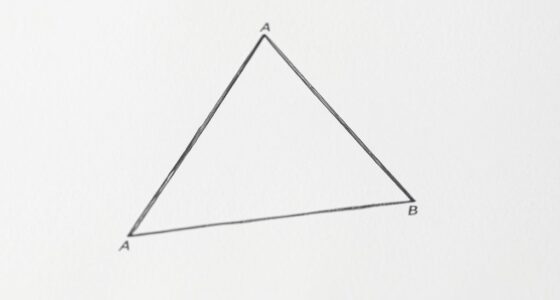
Have you ever found it challenging to follow a geometric proof because the diagrams were unclear or confusing? Clear diagrams are essential for effective proofs. Use visualization techniques to simplify complex figures, making relationships obvious. Incorporate precise labels and consistent notation for clarity. Study historical examples where well-drawn diagrams clarified arguments, like Euclid’s works. Remember, a good diagram guides your understanding and highlights key points. Additionally, understanding visualization techniques from fields like ethical hacking can help in creating more effective and intuitive diagrams.
- Keep diagrams simple and uncluttered
- Use distinct colors for different elements
- Label all points, lines, and angles clearly
- Highlight important areas or segments
- Make sure diagrams match the proof’s logic precisely
Practice Problems to Build Confidence
Are you ready to strengthen your understanding of geometric proofs? Practice problems are essential for building confidence. Start with problems that encourage visualization techniques; sketching and visualizing relationships help make abstract concepts concrete. As you work through each problem, focus on notation simplicity—use clear, straightforward symbols to avoid confusion. Consistent notation keeps your proofs organized and easier to follow. Tackling a variety of problems will reveal patterns and deepen your intuition. Don’t rush; instead, analyze each step carefully, checking your logic along the way. Over time, these practice sessions will boost your confidence and make geometric proofs feel more manageable. Remember, regular practice is key to mastering the art of clear, convincing proofs. Incorporating visualization techniques into your study can significantly enhance understanding and retention.
Frequently Asked Questions
How Do I Choose the Right Proof Method for a Problem?
When choosing the right proof method, start with problem analysis to understand what’s given and what you need to prove. Consider various proof strategies like direct, indirect, or by contradiction, based on the problem’s nature. If the problem involves angles or side lengths, a direct proof might work best. For more complex issues, an indirect or contradiction approach can help clarify your reasoning. Always adapt your method to fit the problem’s specifics.
What Are Common Mistakes to Avoid in Geometric Proofs?
Think of creating a geometric proof as building a sturdy bridge; if you skip steps or rush, it might collapse. Avoid common mistakes like neglecting proof clarity or disrupting logical flow. You should clearly state each step, connect ideas seamlessly, and not assume what needs to be proven. When your proof is organized and transparent, it’s like a well-constructed bridge—strong, reliable, and easy to follow.
Can Geometric Proofs Be Used to Solve Real-World Problems?
Yes, geometric proofs can be used to solve real-world problems by applying principles like angles, measurements, and shapes. For example, you might use geometric reasoning to design a building, optimize space, or analyze structures for safety. Practical examples include determining the shortest path between points or calculating areas. These proofs provide a logical foundation that helps you make informed decisions in various fields, from engineering to architecture.
How Does Symmetry Assist in Constructing Geometric Proofs?
Symmetry helps you construct geometric proofs by revealing hidden relationships. Reflection symmetry shows how figures mirror each other across a line, making it easier to prove equal angles or segments. Rotational symmetry indicates figures look the same after rotation, helping you identify congruent parts. Using symmetry, you can simplify complex problems, justify equalities, and establish key properties, making your proofs clearer and more efficient.
Are There Shortcuts or Tricks to Simplify Complex Proofs?
They say “there’s more than one way to skin a cat,” and the same applies to proofs. You can use proof shortcuts and trick strategies to simplify complex proofs, saving time and effort. Look for patterns, use known theorems, and leverage symmetry to reduce steps. These techniques help you focus on key ideas, making challenging proofs manageable and more straightforward without sacrificing rigor.
Conclusion
Mastering geometric proofs might seem like decoding a secret language, but with patience, you’ll find it’s more about revealing the beauty hidden in logical reasoning. As you practice, each proof becomes a brushstroke on your mathematical canvas, revealing clarity and confidence. Remember, every challenge is a stepping stone—embrace them as the keys to unlocking your geometric potential. So, keep practicing, and soon you’ll see—the elegance of proofs is within your reach.