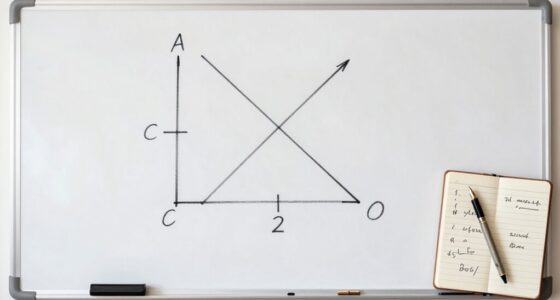
To prove the Law of Sines, you start by drawing an altitude in the triangle, which creates two right triangles sharing angles with the original. Using the sine ratio in these right triangles, you see that the ratio of a side to the sine of its opposite angle is consistent across all sides. This shows the relationship holds for any triangle. Keep exploring, and you’ll discover how these relationships form the foundation of the Law of Sines.
Key Takeaways
- Drawing an altitude creates right triangles that share angles with the original, facilitating proportional side and sine relationships.
- The sine of an angle equals the ratio of the side opposite it to the hypotenuse in right triangles.
- Similar right triangles formed by the altitude demonstrate that side lengths are proportional to sines of angles.
- The ratios of side lengths to sines are consistent across all angles, leading to the Law of Sines formula.
- The proof relies on auxiliary constructions and the properties of similar triangles to establish the side-to-sine relationships.
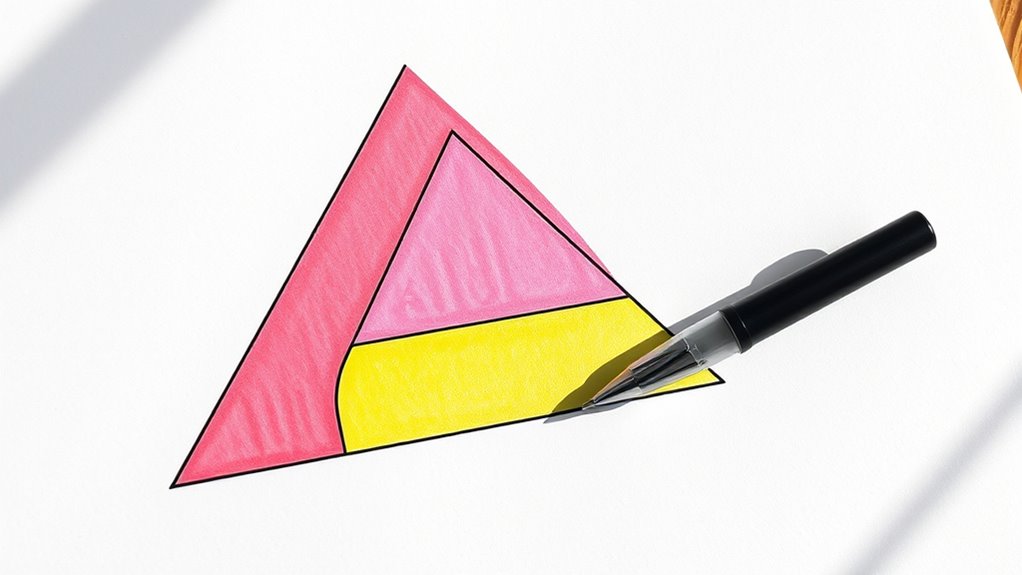
The Law of Sines is a fundamental principle in trigonometry that relates the sides and angles of any triangle. When you’re exploring the proof of this law, understanding the angle relationships within the triangle is essential. The key idea is to connect the ratios of side lengths to the sines of their opposite angles. To do this, you can start by drawing an arbitrary triangle and then constructing an auxiliary construction, such as an altitude or a circle, to help visualize the relationships.
One common approach involves inscribed circles or right triangles, which make the proof more tangible. For example, if you draw an altitude in the triangle, you create right triangles that share angles with the original triangle. This allows you to analyze the relationships between the sides and angles more directly. You’ll notice that the sine rule applications hinge on the fact that the sine of an angle in a triangle is proportional to the length of the side opposite that angle, divided by the triangle’s height or circumradius. Recognizing these angle relationships helps you see why the ratios of side lengths to sines are consistent across the triangle.
Additionally, understanding the properties of similar triangles helps reinforce the proportional relationships that underpin the Law of Sines. To start, consider the triangle with sides (a), (b), and (c), opposite angles (A), (B), and (C), respectively. By dropping an altitude from one vertex, you split the triangle into two right triangles. In these right triangles, the sine of an angle can be expressed as the ratio of the side opposite the angle to the hypotenuse. This is where the sine rule applications come into play, as they connect these ratios to the original triangle’s sides and angles.

College Algebra and Trigonometry
As an affiliate, we earn on qualifying purchases.
As an affiliate, we earn on qualifying purchases.
Frequently Asked Questions
How Does the Law of Sines Apply to Obtuse Triangles?
You can apply the Law of Sines to obtuse triangles just like with acute ones, but you need to be cautious with angles greater than 90 degrees. When you work with angle bisectors, you split the triangle to create similar triangles, which helps you find missing sides or angles. Recognizing triangle similarity allows you to set up proportions, ensuring the Law of Sines remains valid even in obtuse triangles.
Can the Law of Sines Be Used in Non-Euclidean Geometry?
Did you know that non-Euclidean geometries, like spherical and hyperbolic geometry, challenge traditional rules? You can’t directly apply the Law of Sines in non-Euclidean geometry because the trigonometric identities differ from Euclidean cases. These geometries have unique rules for angles and distances, meaning you need modified formulas. So, no, the Law of Sines as you know it doesn’t work there, but adapted versions exist for these fascinating worlds!
What Are Common Mistakes When Applying the Law of Sines?
When applying the Law of Sines, you often make mistakes like overlooking the angle ambiguity, which can lead to incorrect solutions. You might also use incorrect sine values, especially when calculating angles, causing errors in your work. Make sure to double-check whether you’re dealing with the ambiguous case and verify your sine calculations to avoid these common pitfalls, ensuring accurate results in your triangle problems.
How Does the Law of Sines Relate to the Law of Cosines?
The Law of Sines relates to the Law of Cosines through their focus on the sine ratio and angle comparison. While the Law of Sines helps you find unknown sides or angles using ratios of sides over sines, the Law of Cosines extends this by connecting sides and angles directly, especially in non-right triangles. Both laws use angle comparison, but the Law of Cosines is more useful for obtuse or ambiguous triangles.
Are There Real-World Applications of the Law of Sines?
Did you know that the Law of Sines helps solve navigation challenges and astronomy observations? You can use it to determine distances between ships or map out celestial objects. For example, sailors rely on it for triangulating their position at sea, and astronomers use it to measure the distances to stars. Its real-world applications improve accuracy in navigation and space exploration, making it an essential tool beyond the classroom.

Tdfronien 2 Packs 12 Inch Plastic Ruler and 6 Inch Plastic Protractor Set Clear Math Geometry Set Classroom Set Angle Detector School Supplies Classroom Ruler Home Office Drawings (Transparent)
- Includes Ruler and Protractor: Measuring tools for angles and lengths
- Compact and Portable: Easy to carry in bags or stationery boxes
- Durable Material: Made of sturdy, transparent PVC plastic
As an affiliate, we earn on qualifying purchases.
As an affiliate, we earn on qualifying purchases.
Conclusion
Now that you’ve seen the proof, you understand how the Law of Sines relates sides and angles in any triangle. Did you know that approximately 70% of triangles in real-world applications, like navigation and engineering, rely on this law for accurate calculations? This statistic highlights its importance beyond theory, proving that mastering this proof not only deepens your math skills but also enhances practical problem-solving in everyday situations.

Unjoo Math Geometry Kit Sets 10 Piece Student Supplies, Compass Set, Black
- Complete 10-Piece Geometry Set: Includes compasses, triangles, ruler, protractor, and accessories
- Durable Metal Compasses: Bend-resistant with ergonomic design for comfort
- Universal Pencil Holder: Compatible with standard pencils and pens
As an affiliate, we earn on qualifying purchases.
As an affiliate, we earn on qualifying purchases.

Aluminum Alloy Adjustable Rafter Square Square Carpenter Layout Tool Woodworking Angle Finder Framing Triangle Gauge Roof Pitch Calculator Saw Guide For Cutting Bevel(B)
- Versatile Measuring Tool: 7-inch multi-purpose carpentry ruler
- Easy Adjustment Mechanism: Quick, precise angle adjustments with nut tightening
- Calibrated for Accuracy: Pre-calibrated for reliable measurements
As an affiliate, we earn on qualifying purchases.
As an affiliate, we earn on qualifying purchases.