
Mass warps the fabric of space-time, creating curves that guide how objects and light move through the universe. Instead of pulling objects directly, gravity results from this curvature, causing planets to orbit stars and light to bend around massive bodies. Stronger mass causes more intense warping, forming phenomena like black holes. Understanding this geometric view of gravity reveals how the cosmos operates on a fundamental level—continue exploring to uncover more about this fascinating connection.
Key Takeaways
- Mass deforms space-time, creating curvature that guides the motion of objects and light.
- Gravity is viewed as the bending of space-time, not a force pulling objects together.
- Massive objects like stars and black holes cause significant space-time warping.
- The shape of space-time determines celestial paths, such as planetary orbits.
- Changes in mass distribution alter the geometry of the universe, affecting gravitational phenomena.
Have you ever wondered how space and time are connected? It’s a question that has fascinated scientists for centuries, but it took Einstein’s groundbreaking insights to reveal the true nature of their relationship. At the core of his work lie the relativity principles, which revolutionized how we understand gravity and motion. Instead of seeing gravity as a force pulling objects toward each other, Einstein described it as a consequence of how mass influences the fabric of space-time itself. This idea means that massive objects, like stars and planets, don’t just attract each other through a force; they actually deform the geometry of the universe around them.
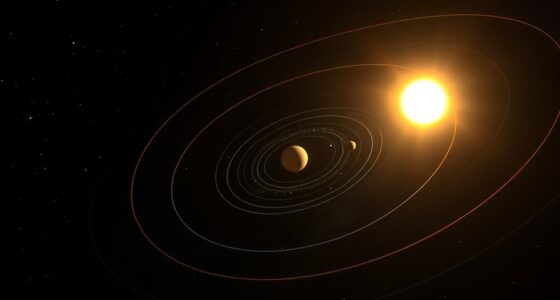
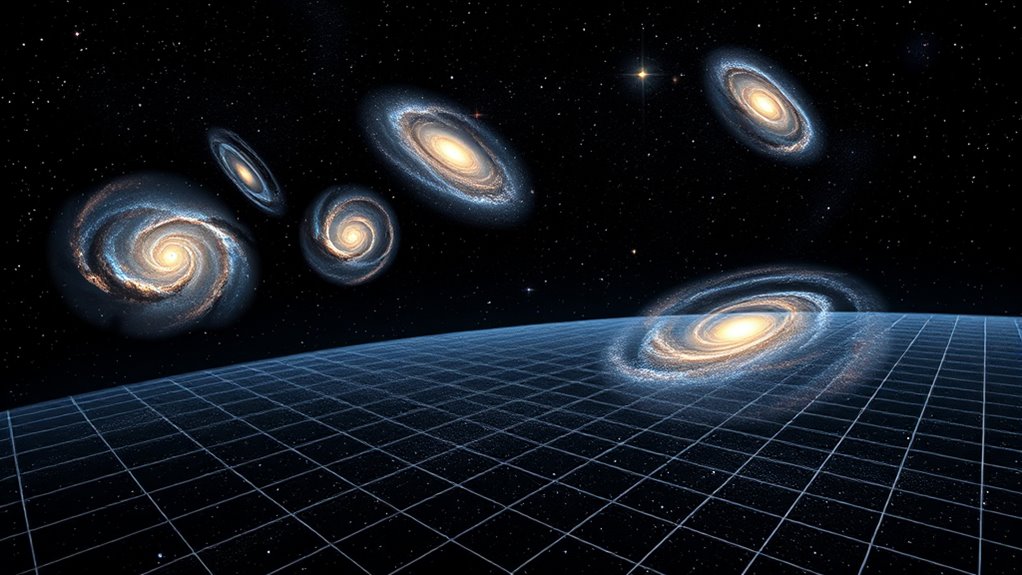
This deformation is what causes gravitational effects. When you’re near a massive body, the space-time around it curves, and this curvature guides the path of objects and light alike. Imagine placing a heavy ball on a stretched rubber sheet—its weight causes the sheet to dip. Smaller balls placed on the sheet will roll toward the heavy ball, not because there’s a mysterious force pulling them, but because the sheet’s shape directs their movement. Similarly, planets orbit stars because they’re following the curved paths in the warped space-time caused by the star’s mass. This shift in understanding replaces the older Newtonian view of gravity as a force acting across empty space, replacing it with a geometric picture that links mass, space, and time into a single, dynamic fabric.
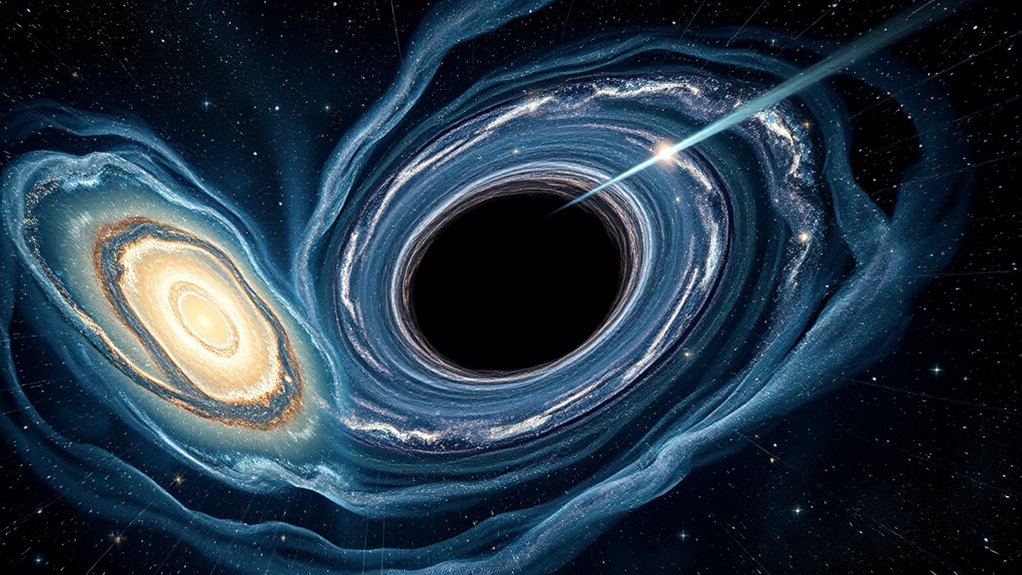
Furthermore, the curvature of space-time explains phenomena such as black holes, where gravity becomes extremely intense, warping space and time to the point of creating regions from which nothing can escape.
The relativity principles underpin this new perspective, asserting that the laws of physics are the same for all observers, regardless of their motion. This means that the way you perceive space and time depends on your frame of reference, especially when you’re moving at speeds close to light or near massive objects. In such situations, gravitational effects become more pronounced. For example, time itself slows down in strong gravitational fields—a phenomenon called gravitational time dilation. This isn’t just a theoretical idea; it has practical implications, like the need to account for gravitational effects in GPS satellites to ensure accurate navigation.
Frequently Asked Questions
How Does Dark Matter Influence Space-Time Curvature?
Dark matter influences space-time curvature by adding extra mass that you can’t see directly, but you can detect through its gravitational effects. It causes gravitational lensing, bending light from distant objects and revealing its presence. You observe this by noting distortions in the light paths, which confirms that dark matter appreciably shapes the geometry of the cosmos, contributing to the overall curvature of space-time around galaxies and clusters.
Can Space-Time Be Warped Without Mass or Energy?
In hypothetical scenarios, space-time can be warped without mass or energy, according to certain theoretical models. For example, some models suggest that gravitational waves—ripples in space-time—can propagate in otherwise empty space. You might imagine a universe where quantum fluctuations create tiny warps. While these models are fascinating, current scientific understanding holds that mass and energy are essential for significant space-time curvature, making warping without them unlikely in real-world physics.
How Do Gravitational Waves Travel Through Curved Space-Time?
You see that gravitational waves travel through curved spacetime by wave propagation, moving at the speed of light. These waves are spacetime distortions caused by massive accelerating objects, like merging black holes or neutron stars. As they propagate, they stretch and squeeze spacetime itself, transferring energy across the universe. You can detect these spacetime distortions with instruments like LIGO, revealing the dynamic and interconnected nature of our universe.
What Role Does Quantum Mechanics Play in Space-Time Geometry?
Quantum mechanics acts like a mischievous artist, painting tiny ripples on space-time’s fabric. You see, phenomena like quantum entanglement and fluctuations influence the geometry at incredibly small scales, creating a jittery, probabilistic landscape. This interplay suggests that, at the universe’s tiniest level, quantum effects shape the very structure of space-time, hinting at a deeper connection between the quantum world and the cosmic geometry you observe on grand scales.
Is It Possible to Manipulate Space-Time for Faster-Than-Light Travel?
You can’t currently manipulate space-time for faster-than-light travel, but theoretically, wormhole creation could allow shortcuts through space-time. If you could stabilize a wormhole, it might enable instant travel between distant points. However, time dilation effects could complicate this, as moving through such a tunnel might cause unpredictable time shifts. While fascinating, these concepts remain speculative and face enormous scientific and technological hurdles.
Conclusion
Remember, you’re a part of this cosmic fabric where mass shapes space and time. Einstein showed us that gravity isn’t just a force but the curvature of space itself. By understanding this, you see how the universe’s grand design unfolds around you. As the saying goes, “What goes around, comes around.” So, keep exploring and appreciating the intricate dance of matter and geometry—you’re connected to the universe’s beautiful, dynamic tapestry.