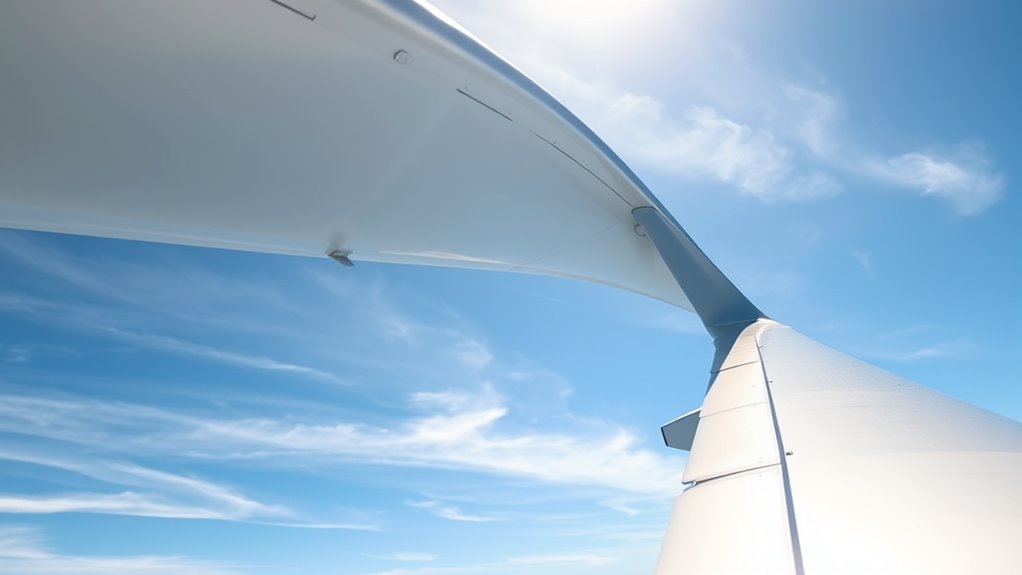

Understanding the physics of flight involves examining how airfoil geometry, including camber and angle of attack, influences lift. Cambered wings have curved surfaces that accelerate airflow over the top, creating lower pressure and generating lift through Bernoulli’s principle. Adjusting the angle of attack changes how airflow interacts with the wing, increasing lift until a stall occurs. Exploring these concepts reveals the critical balance that keeps an airplane in the air—continue exploring to see how these factors work together.
Play games included with Prime
Start a Prime free trial and play with Amazon Luna on your devices.
As an affiliate, we earn on qualifying purchases.
Key Takeaways
- Airfoil shape affects airflow, with curved upper surfaces increasing speed and pressure differences to produce lift.
- The angle of attack determines how airflow interacts with the wing, influencing lift and stall risk.
- Camber creates a pressure differential by accelerating airflow over the top surface, generating lift via Bernoulli’s principle.
- Increasing camber and angle of attack enhances lift but can also increase drag and risk airflow separation.
- Proper wing design balances camber and angle of attack to optimize lift, stability, and flight efficiency.

The physics of flight explains how airplanes and other flying objects stay aloft by manipulating forces like lift, weight, thrust, and drag. One of the key factors in this process is the design of the airfoil, specifically how its shape influences airflow and lift production. When you understand the role of the angle of attack, along with the camber effect, you gain insight into how lift is generated and controlled.
The angle of attack is the angle between the chord line of the wing and the oncoming airflow. By adjusting this angle, you change how the air flows over the wing’s surface, directly impacting lift. Increasing the angle of attack generally increases lift up to a certain point, known as the critical angle, beyond which airflow separates from the wing surface and causes a stall. As a result, maintaining the correct angle of attack is essential for steady flight and maneuverability. You’ll find that pilots and aircraft systems constantly monitor and adjust this angle to optimize lift and prevent stalls.
The camber effect also plays an important role in lift generation. Camber refers to the curvature of the airfoil’s upper and lower surfaces. A cambered airfoil has a curved upper surface and a flatter lower surface, which causes the airflow to speed up over the top and slow down underneath. This speed difference results in a pressure difference, creating lift according to Bernoulli’s principle. The camber effect enhances lift at lower speeds and allows for more efficient flight, especially during takeoff and climb. When designing wings, engineers consider camber to balance lift requirements with drag and stability.
The interplay between the angle of attack and camber determines how effectively your aircraft can generate lift under various conditions. For example, a highly cambered wing produces more lift at lower speeds but may also generate more drag. Adjusting the angle of attack allows you to fine-tune lift production without changing the wing’s shape, giving you control over the aircraft’s attitude and performance. As you increase the angle of attack, the camber effect works together to generate additional lift, but pushing too far risks airflow separation and a stall.
Understanding these concepts helps you appreciate how wing design and pilot input influence flight. The combination of the angle of attack and camber effect allows aircraft to adapt to different flight regimes, ensuring safe and efficient operation. Whether you’re flying or designing wings, recognizing how these factors work together is essential for mastering the physics of flight and keeping your aircraft aloft with precision. Additionally, hackathons can be a valuable platform for developing innovative solutions related to aerodynamics and flight technology, fostering collaboration among diverse teams.
As an affiliate, we earn on qualifying purchases.
Frequently Asked Questions
How Do Temperature Changes Affect Airfoil Lift?
Temperature effects can markedly influence airfoil lift by changing air density. When temperatures rise, air becomes less dense, reducing lift because there’s less air pressure over the wing. Conversely, colder temperatures increase air density, which boosts lift. As a pilot, you’ll notice that in warmer weather, your aircraft might need more speed or angle of attack to generate the same lift, so adjusting your flying techniques is essential.
Can Unconventional Airfoil Shapes Generate More Lift?
Unconventional airfoil shapes can indeed generate more lift, and it’s like unleashing a storm of aerodynamic genius. By optimizing the boundary layer flow and controlling vortex shedding, these shapes can produce higher lift coefficients. You might create a design that delays flow separation, harnessing vortices to boost lift even further. So, thinking outside the traditional box can unlock hidden potential and give your aircraft a remarkable edge.
How Does Wing Aspect Ratio Influence Flight Efficiency?
You’ll find that a higher wing aspect ratio, which means a longer wingspan relative to chord length, boosts flight efficiency. It reduces induced drag and increases the lift coefficient, so your aircraft uses less energy to stay aloft. Conversely, a low aspect ratio creates more drag but offers better maneuverability. To optimize performance, balance wing span and shape, considering your aircraft’s purpose and desired efficiency.
What Role Does Wing Flexibility Play in Lift Generation?
Wing flexibility acts like a superhero’s cape, dramatically boosting lift enhancement. When you allow your wings to bend and flex, they adapt to airflow, creating a better pressure difference and more lift. This dynamic flexibility reduces drag and improves overall efficiency, especially during turbulent conditions. So, by embracing wing flexibility, you release superior lift generation and a smoother, more responsive flight experience—making your aircraft feel almost alive and unstoppable.
How Do Icing Conditions Impact Airfoil Performance?
Icing conditions negatively impact your airfoil performance by causing ice accumulation, which disrupts airflow and reduces lift. When ice forms on the wing, it changes the airfoil shape, increasing drag and decreasing efficiency. To combat this, de-icing systems are essential—they remove or prevent ice buildup, ensuring your wing maintains ideal aerodynamic shape and lift, especially during cold, moist conditions. Always rely on proper de-icing measures for safe flight.
RC airplane wing with adjustable camber
As an affiliate, we earn on qualifying purchases.
As an affiliate, we earn on qualifying purchases.
Conclusion
Now that you’ve uncovered the secrets of airfoil geometry and lift, the true mystery lies in how these principles shape flight itself. Every twist, every curve, holds the potential to open new heights or bring you crashing down. Imagine what’s possible when you master these forces—will you harness them to soar beyond limits or let them slip away? The sky’s the limit, but only if you understand what truly makes flight possible.
flight simulation aircraft wings
As an affiliate, we earn on qualifying purchases.
As an affiliate, we earn on qualifying purchases.
As an affiliate, we earn on qualifying purchases.
Fall yard work Picks
leaf blowers
As an affiliate, we earn on qualifying purchases.