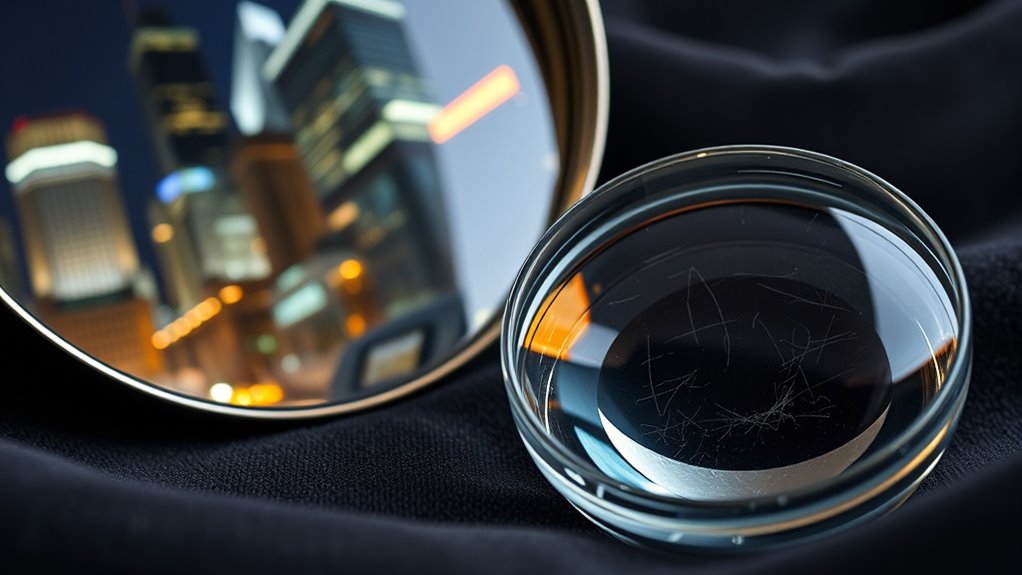

In optics, the geometry of mirrors and lenses explains how light bends and forms images. Curved surfaces like convex and concave shapes influence whether light converges or diverges, affecting focus, magnification, and image clarity. Lenses manipulate light paths for vision correction and cameras, relying on precise surface curves to minimize distortions. Understanding these geometric principles helps you see how optical devices work and reveals the science behind clear images—if you keep exploring, you’ll uncover even more fascinating details.

Prime made for students and young adults
- Fast, free delivery for dorm and study essentials
- Prime Video and Amazon Music included
- Member-only deals
Key Takeaways
- The shape and curvature of mirrors and lenses determine how they reflect or refract light, shaping the image formed.
- Convex and concave surfaces influence whether light converges or diverges, affecting magnification and focus.
- The geometry of lenses, including focal length and surface curvature, controls how they bend light to focus images sharply.
- Mirrors typically use reflective surfaces with specific geometries (flat, concave, convex) to redirect light paths.
- Precise lens and mirror design minimizes distortions and aberrations, ensuring clear, accurate images.

Have you ever wondered how glasses correct your vision or how a camera captures a clear picture? It all comes down to the fascinating principles of optics, especially how light behaves when it interacts with different materials. One of the core concepts is refraction principles, which explain how light bends as it passes from one medium to another. When light moves from air into your eyeglasses or a camera lens, it slows down and changes direction. This bending allows lenses to focus light precisely onto your retina or the camera’s sensor, creating sharp images. Understanding refraction is essential because it underpins the design of optical devices that help us see better or record clearer photographs.
Light dispersion is another critical aspect of optics that plays a significant role in how lenses work. Dispersion occurs because different wavelengths of light bend by slightly different amounts when passing through a material. This effect causes the separation of white light into its constituent colors, much like how a prism creates a rainbow. In glasses, dispersion can sometimes lead to chromatic aberration, where colors fray at the edges of images. To counter this, lens manufacturers use special materials or coatings that minimize dispersion, ensuring your vision remains crisp and colors stay vivid. The interplay of refraction principles and light dispersion allows scientists and engineers to craft lenses that correct vision flaws or enhance image clarity.
Imagine looking through a magnifying glass or a camera lens—you’re witnessing these principles in action. Every lens, whether simple or complex, is designed with the geometry that manipulates light paths to achieve a specific purpose. Curved surfaces, like convex or concave shapes, influence how light converges or diverges, shaping the final image. The precise geometry of these surfaces determines focal length, magnification, and image quality. With a solid grasp of these concepts, you can appreciate why some lenses produce sharp, focused images while others might introduce distortions or color fringing.
Ultimately, understanding the principles of refraction and light dispersion helps you see the world more clearly—whether you’re wearing corrective glasses or taking photos. These fundamental ideas reveal how light’s behavior can be harnessed through geometry to create the optical devices that improve our vision and capture moments in stunning detail. By mastering these principles, you gain insight into the elegant science behind everyday optics, making it easier to appreciate the technology that surrounds you daily.
As an affiliate, we earn on qualifying purchases.
Frequently Asked Questions
How Do Curved Mirrors Create Virtual Images?
Curved mirrors, like parabolic reflectors, create virtual images by reflecting light rays in a way that they appear to originate from a point behind the mirror. When you look into the mirror, your brain traces the reflected rays back, forming a virtual image. This process, called virtual image formation, happens because the mirror’s shape causes the rays to diverge, making it seem like the image is behind the surface.
What Determines the Focal Length of a Lens?
Did you know that the average camera lens has a focal length between 18mm and 55mm? The focal length of a lens depends mainly on its lens curvature. When you perform a focal length calculation, you consider the curvature of the lens surfaces; more curved lenses have shorter focal lengths. So, the steeper the curvature, the more light bends, creating a shorter focal length and affecting your image’s magnification and field of view.
How Does Lens Shape Affect Image Distortion?
You’ll notice that lens shape markedly impacts image distortion. A curved lens can cause barrel or pincushion distortion, especially with wide-angle shapes. Using high-quality lens material helps reduce distortion and improves image clarity. For better correction, opt for lenses designed with aspherical elements, which minimize shape-related distortions. By choosing the right lens shape and material, you can achieve clearer, more accurate images with minimal distortion.
Can Mirrors Be Designed to Correct Optical Aberrations?
Yes, mirrors can be designed to correct optical aberrations. For example, a telescope mirror might use specialized coatings and precise shaping to minimize distortions like spherical aberration. By applying mirror coatings that enhance reflectivity and implementing aberration correction techniques, designers improve image quality. This approach guarantees clearer, sharper images, making it essential for high-precision instruments like astronomical telescopes.
What Materials Are Best for High-Precision Optical Lenses?
You should choose materials like high-quality glass, fused silica, or calcium fluoride for high-precision optical lenses because they offer excellent transparency and minimal distortion. Your material selection depends on the specific wavelength and application. Use advanced manufacturing techniques such as precision grinding and polishing to guarantee accuracy. These methods help achieve smooth surfaces and correct aberrations, resulting in lenses that deliver sharp, reliable images in high-precision optical systems.
As an affiliate, we earn on qualifying purchases.
Conclusion
Understanding the geometry of mirrors and lenses helps you grasp how images form and why they appear different. Did you know that over 70% of modern optical devices, from cameras to microscopes, rely on these principles? By mastering these basics, you can better appreciate the technology around you and even improve your own designs. Keep exploring optics—it’s fascinating how simple shapes create such complex, real-world effects!
As an affiliate, we earn on qualifying purchases.
chromatic aberration lens coating
As an affiliate, we earn on qualifying purchases.
As an affiliate, we earn on qualifying purchases.
Fall Picks
fall essentials
As an affiliate, we earn on qualifying purchases.