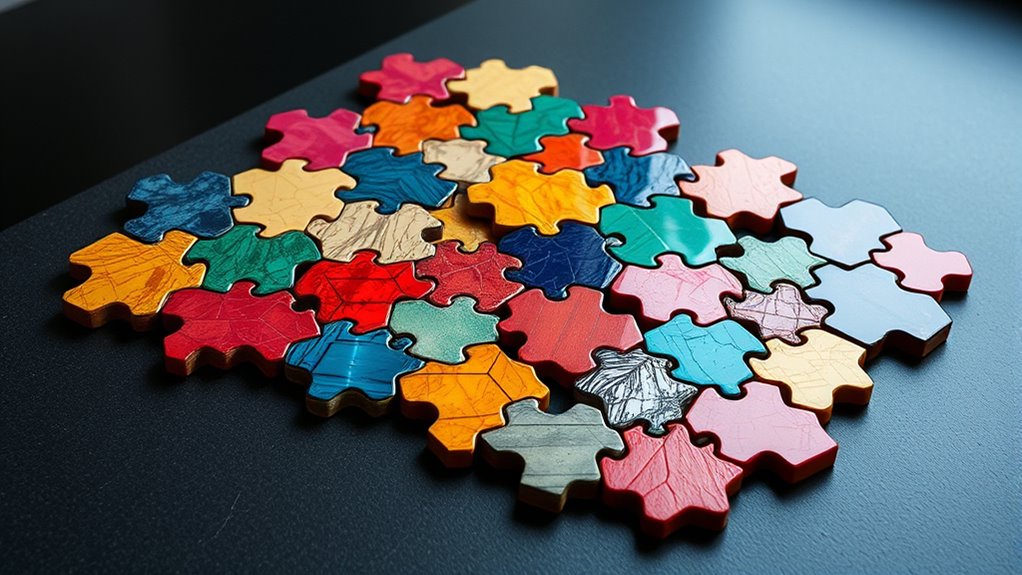

Mathematicians have discovered the “Einstein” tile, a unique 13-sided shape that tiles the plane without repeating patterns. This groundbreaking shape challenges previous assumptions, showing that a single shape can create complex, non-repeating patterns known as aperiodic tilings. Its carefully designed edges prevent regular repetition, opening new possibilities in mathematics and design. If you want to explore how this shape transforms our understanding of patterns, there’s more to uncover ahead.
Key Takeaways
- The “Einstein” tile is a 13-sided geometric shape that tiles the plane aperiodically, never repeating exactly.
- It challenges previous assumptions by achieving non-repetitive tilings with a single shape.
- Its design features specific edges and angles that prevent periodic patterns from forming.
- This discovery broadens understanding of tessellation patterns, impacting mathematics, architecture, and materials science.
- The shape represents a significant breakthrough in the study of non-repeating, aperiodic tiling structures.
Mathematicians have recently discovered a new type of tile, dubbed the “Einstein” tile, that challenges long-held assumptions about tiling patterns. This breakthrough introduces a 13-sided, aperiodic shape that defies traditional expectations about how tiles can cover a plane without repeating. As you explore tessellation patterns, you’ll realize that this geometric discovery reshapes what you thought was possible in the domain of tiling. Unlike regular tiles that fit together in predictable, repeating arrangements, the Einstein tile produces a pattern that never repeats exactly, no matter how far you extend it. This property, known as aperiodicity, has fascinated mathematicians for decades, and now, with this new shape, it becomes even more intriguing.
The Einstein tile’s aperiodic shape transforms our understanding of non-repeating tessellations.
You might think that all tiling patterns are either periodic or random, but the Einstein tile introduces a third option—an aperiodic tiling, which is both orderly and non-repeating. When you examine the geometric discovery behind this shape, you’ll notice how its design cleverly prevents the formation of a repeating pattern. Its 13 sides are carefully crafted so that it can only tessellate the plane in a non-repetitive way, challenging the idea that tiles must form predictable, repeating patterns to cover a surface completely. This discovery demonstrates that the sphere of tessellation patterns is more diverse than previously believed, opening up new possibilities for both theoretical mathematics and practical applications like materials science.
Additionally, the shape’s unique properties are related to concepts in mathematical tiling, which explore how complex shapes can generate intricate and non-repetitive arrangements. By understanding the geometric properties of this tile, you also gain insight into how complex shapes can generate intricate and unique tiling patterns. The shape’s edges and angles are designed to fit together seamlessly, yet never produce a repeating sequence. It’s a perfect example of how geometric discovery can push the boundaries of what’s considered possible in tiling design. This insight might influence future research into non-repetitive structures, inspiring architects, artists, and scientists to explore innovative ways to cover surfaces without the constraints of repetition.
In essence, the Einstein tile not only expands your understanding of tessellation patterns but also embodies a significant leap forward in geometric discovery. It shows that the mathematical universe still holds surprises, and by studying such shapes, you can uncover new principles that could influence everything from theoretical mathematics to real-world design. As you continue to explore, remember that this shape stands as a tribute to how curiosity and innovative thinking can reshape our understanding of the fundamental patterns that underlie the world around us.
Frequently Asked Questions
Can the “Einstein” Tile Cover an Infinite Plane Without Gaps?
Yes, the “Einstein” tile can cover an infinite plane without gaps, thanks to tessellation theory. You can create a non-repeating pattern, demonstrating how geometric complexity allows for aperiodic tilings. This shape’s unique properties enable it to tessellate endlessly, showcasing the fascinating relationship between simple rules and complex patterns. It’s a powerful example of how mathematical principles can produce intricate, gapless coverings of the plane.
How Does the “Einstein” Tile Compare to Other Aperiodic Tiles?
You’ll find that the “Einstein” tile stands out because it’s the first known shape with 13 sides to create non-repeating tiling patterns. Unlike other aperiodic tiles, which often have complex symmetry patterns, this tile showcases remarkable mathematical elegance through its simple, yet non-repetitive design. Its uniqueness highlights a breakthrough in understanding how geometry can produce intricate, aperiodic patterns with minimal symmetry, making it a fascinating addition to the world of tiling.
What Practical Applications Might Arise From This Discovery?
You might see this discovery lead to cryptography innovations, as its unique tiling patterns can enhance data security. In architectural designs, the “Einstein” tile could inspire innovative, non-repetitive structures that are both beautiful and functional. Its mathematical properties could also influence materials science, creating new, durable materials. Overall, this shape opens up exciting possibilities for secure communication, creative architecture, and advanced manufacturing techniques.
Is the “Einstein” Tile Related to Quantum Physics or Materials Science?
Think of the “Einstein” tile as a key opening new worlds in quantum physics and materials science. It’s not directly related to quantum correlations, but its unique aperiodic nature influences how materials might behave at microscopic levels. This discovery helps scientists understand complex material properties and can inspire innovations in quantum computing, where irregular patterns play a vital role. Far from just mathematical art, it holds potential for real-world technological leaps.
Could There Be Other Undiscovered Aperiodic Shapes Similar to the “Einstein” Tile?
Yes, there could be other undiscovered aperiodic shapes like the “einstein” tile. You might find shapes that produce unique quasicrystal structures, which challenge traditional tiling symmetry. Researchers continue exploring geometric possibilities, so new aperiodic tiles could emerge, revealing fascinating patterns and properties. Your curiosity drives the search for more shapes that break symmetry norms, expanding our understanding of tiling and quasicrystal phenomena.
Conclusion
This discovery isn’t just about a 13-sided tile; it’s a reminder that even in mathematics, the simplest shapes can hold the most complex secrets. As you reflect on how this “Einstein” tile defies periodicity, you realize that nature often mirrors this mystery—patterns hiding in plain sight. In uncovering such a shape, mathematicians remind us that the universe’s true beauty lies in its endless, intricate surprises, waiting for you to find them.