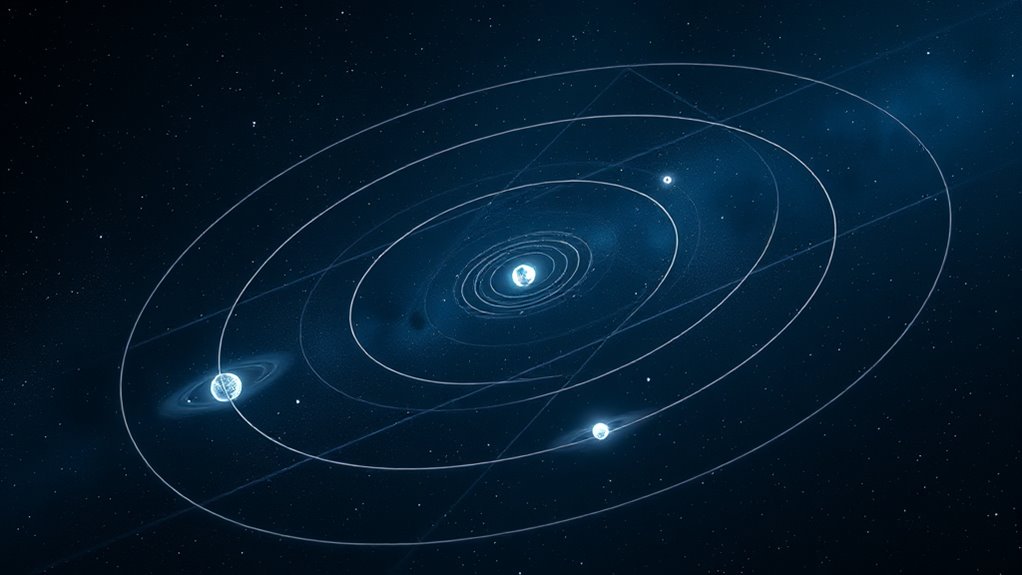

Celestial geometry shows how planets and stars move along elliptical orbits shaped by gravity. These paths aren’t perfect circles, and their shapes influence how objects appear and align in the sky. Understanding the angles and distances helps explain phenomena like eclipses and transits. By exploring these cosmic shapes, you’ll grasp how the universe’s structure guides celestial motion. If you keep exploring, you’ll discover even more about the intricate dance of celestial bodies.
Key Takeaways
- Celestial orbits are elliptical, with the Sun at one focus, influencing planetary distances and seasonal changes.
- Coordinate systems like equatorial and ecliptic help locate celestial objects based on shapes and angles.
- Kepler’s laws describe planetary motion along elliptical paths, governed by gravitational forces and orbital geometry.
- The geometry of orbital shapes and angles determines the timing and visibility of eclipses and transits.
- Understanding cosmic shapes and paths is essential for navigation, observation, and space exploration.

Celestial geometry explores the fascinating relationships between shapes, angles, and positions of objects in the night sky. When you look up, you’re observing a complex dance of celestial bodies following precise paths dictated by their orbital mechanics. Understanding planetary orbits is vital to grasping how planets move around the Sun. These orbits are not perfect circles but ellipses, with the Sun occupying one focus of the ellipse. This means that as a planet travels along its orbit, its distance from the Sun varies, affecting seasons and climate. By studying these elliptical paths, astronomers can predict planetary positions with remarkable accuracy.
Celestial orbits are elliptical, causing planets’ varying distances from the Sun and influencing seasons and climate.
To navigate and pinpoint objects in the sky, you rely on celestial coordinate systems. Think of these systems as cosmic grids that map the universe, much like latitude and longitude on Earth. The most common for astronomers are the equatorial coordinate system, which uses right ascension and declination, and the ecliptic coordinate system, aligned with the plane of Earth’s orbit. These systems help you specify the exact position of stars, planets, and other celestial objects, regardless of the time or your location on Earth. When you set out to observe a particular planet or star, understanding these coordinate systems allows you to locate them precisely in the vastness of space.
Planetary orbits also follow specific rules that are explained by celestial geometry. Kepler’s laws describe how planets move in elliptical orbits, sweep out equal areas in equal times, and have a relation between their orbital periods and distances from the Sun. These laws reveal that planetary motion isn’t random but governed by the gravitational forces between bodies. The geometry of these orbits influences phenomena like eclipses, transits, and planetary alignments. When a planet passes in front of the Sun or another celestial body, the geometry of the orbit determines the timing and visibility of such events.
In celestial geometry, understanding the geometric relationships between shapes, angles, and positions helps you interpret the night sky. Whether you’re tracking a planet’s elliptical orbit or using coordinate systems to locate a distant star, these principles make sense of the cosmic choreography. They provide the foundation for navigation, observation, and even space exploration. By mastering these relationships, you gain a clearer picture of how the universe operates, revealing the elegant structure behind the seemingly chaotic tapestry of stars and planets. Celestial geometry isn’t just about shapes and angles; it’s your key to revealing the universe’s secrets. Additionally, understanding foraging range can help contextualize how celestial bodies cover vast distances across space, similar to how animals expand their search areas for resources.
Frequently Asked Questions
How Do Gravitational Forces Influence Orbital Shape Changes Over Time?
Gravitational forces cause orbital shape changes through gravitational perturbations, which alter an object’s path over time. You might notice these effects as orbits become more elliptical or shift position. Additionally, orbital resonance can amplify these changes when celestial bodies exert regular gravitational pulls on each other, leading to synchronized shifts in their paths. Together, these forces continually influence and reshape the orbits of planets, moons, and other objects in space.
What Are Some Examples of Non-Elliptical Orbital Paths Observed in Space?
You’ll find that some orbits are irregular or follow hyperbolic trajectories, especially when objects pass close to massive bodies at high speeds. For example, comets often have highly elongated, non-elliptical paths, and interstellar objects like ‘Oumuamua follow hyperbolic trajectories as they exit our solar system. These non-elliptical orbits are fascinating because they reveal dynamic gravitational interactions and objects on escape or interstellar journeys.
How Do Cosmic Shapes Affect Planetary Climate and Habitability?
Cosmic shapes influence planetary climate and habitability by affecting climate variability and positioning within habitability zones. You see, the shape and tilt of a planet’s orbit can cause seasons to be more extreme or stable, impacting life prospects. If a planet’s orbit keeps it within its star’s habitable zone consistently, it enhances habitability. Conversely, irregular or highly eccentric paths lead to climate fluctuations, challenging the potential for sustaining life.
Can Celestial Geometry Help Predict Future Asteroid or Comet Trajectories?
In 1720, Newton’s laws laid the groundwork for understanding celestial movements. Today, celestial geometry can indeed help predict future asteroid or comet trajectories through orbital resonance and trajectory modeling. By analyzing gravitational influences and orbital patterns, you can forecast paths more accurately. This knowledge enables early detection and risk assessment, giving you valuable time to develop potential deflection strategies and protect Earth from future impacts.
What Role Does Celestial Geometry Play in the Formation of Galaxies?
Celestial geometry influences galaxy formation by shaping stellar patterns and maintaining cosmic symmetry. You see, the gravitational interactions and geometric arrangements of stars and gas clouds lead to the spiral, elliptical, or irregular shapes of galaxies. This cosmic symmetry helps organize matter across vast distances, guiding how galaxies evolve over time. Your understanding of these geometric principles reveals the beautiful, structured patterns that govern the universe’s grand design.
Conclusion
You can see how celestial geometry shapes our universe, from the perfect circles of planetary orbits to the intricate spirals of galaxies. Did you know that the Milky Way’s diameter is about 100,000 light-years? That’s like traveling from Earth to the Sun 1.3 million times! These cosmic shapes highlight the beauty and precision of the universe’s design, reminding you that even in the vastness, patterns and geometry guide everything we observe in space.