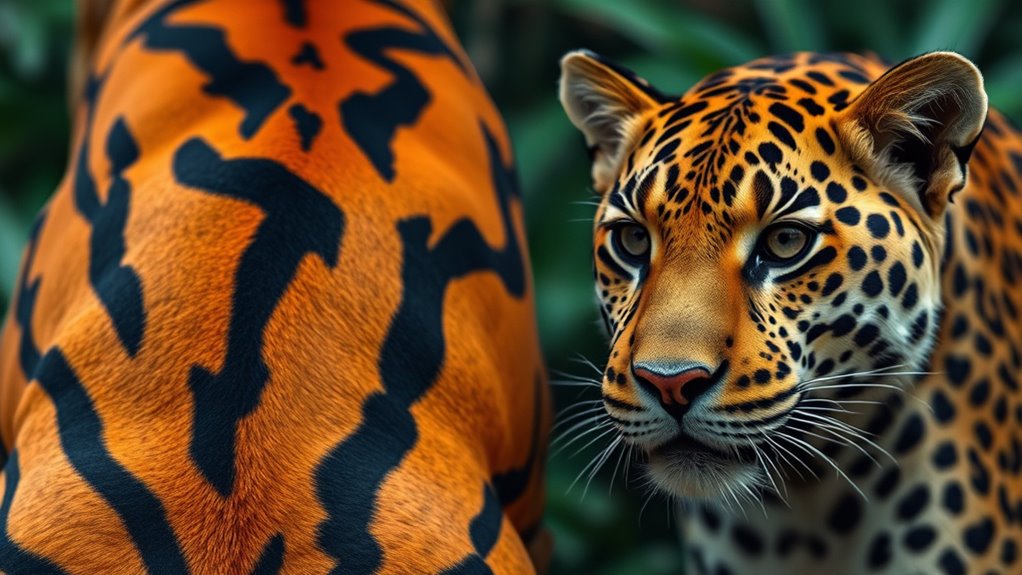

Patterns on animals, like stripes and spots, are shaped by genetic instructions that control pigment cell development and placement. Mathematical models, especially reaction-diffusion systems, help explain how simple interactions between substances lead to complex designs. These models show how cell behavior and chemical signals create stable patterns, and how small changes can cause pattern variations. To discover more about how math reveals the secrets behind animal markings, keep exploring the fascinating connections between genes, cells, and patterns.

Prime made for students and young adults
- Fast, free delivery for dorm and study essentials
- Prime Video and Amazon Music included
- Member-only deals
Key Takeaways
- Mathematical models like reaction-diffusion systems explain how cells coordinate to form stripes and spots.
- Genes regulate pigment cell placement, influencing pattern types such as spots or stripes.
- Variations in model parameters can simulate pattern transitions and individual differences.
- Cell interactions and migration, guided by genetic and environmental cues, shape final animal patterns.
- Modeling helps predict pattern stability, evolution, and how genetic and developmental factors interact.

Have you ever wondered why animals display such diverse and striking patterns on their bodies? The answer lies in a fascinating interplay of genetic mechanisms and mathematical modeling. These patterns are not random; instead, they result from complex biological processes that have evolved over millions of years. Your understanding of how these patterns form can be deepened through the study of genetics, which reveals the genes responsible for pigment production and distribution. But to fully grasp the intricate designs—like the stripes of a zebra or the spots of a leopard—scientists turn to mathematical modeling as a powerful tool. This approach allows researchers to simulate how cells and pigments interact during development, producing the specific patterns you see on animals today.
Genetic mechanisms provide the blueprint for pattern formation. Certain genes control pigment cells, their placement, and their density, ultimately dictating whether an animal sports spots, stripes, or patches. For example, variations within these genes can lead to different pattern types even within the same species. These genetic instructions lay the groundwork, but the actual physical arrangement is influenced by how cells communicate and migrate during development. That’s where mathematical modeling comes in. By creating equations that describe the behavior of cells and pigments, scientists can predict how simple rules lead to complex patterns. These models often involve reaction-diffusion systems, a concept introduced by Alan Turing, which show how two interacting substances can self-organize into spots or stripes. Mathematical modeling plays a crucial role in understanding how biological patterns are formed and maintained.
Mathematical modeling helps explain why certain patterns are stable and how they evolve over time. It demonstrates that small changes in initial conditions or parameters can produce a wide variety of designs. For example, tweaking the rate at which pigment cells migrate or how chemicals spread through tissue can result in a seamless transition from spots to stripes. These models also help scientists understand why some animals have consistent patterns across individuals, while others display more variability. Furthermore, they reveal how environmental factors may influence gene expression and pattern development, making the process even more dynamic.
animal pattern coloring books for kids
As an affiliate, we earn on qualifying purchases.
As an affiliate, we earn on qualifying purchases.
Frequently Asked Questions
How Do Animal Patterns Evolve Over Generations?
You see animal patterns evolve over generations through genetic drift and environmental influences. Genetic drift causes random changes in gene frequencies, leading to new patterns over time. Environmental influences select for certain patterns that help animals hide or regulate temperature. As a result, these factors shape the evolution of stripes, spots, and other markings, making each species uniquely adapted to its surroundings. Your observation of these patterns reflects their ongoing evolutionary journey.
What Role Do Predators Play in Pattern Development?
Predators influence pattern development by favoring camouflage strategies that help prey avoid detection. You can see this in predator-prey dynamics, where animals with patterns that blend into their environment are more likely to survive and reproduce. Over generations, these selective pressures encourage the evolution of specific markings—like stripes or spots—that enhance concealment, making it harder for predators to spot their prey and ensuring their continued survival.
Are There Genetic Differences Between Similar Patterns?
You might think similar patterns are identical, but genetic mutation and pattern inheritance show differences. These genetic variations influence how patterns like stripes or spots develop, even among animals with similar markings. Your genes carry the blueprint, but mutations can alter pattern specifics, creating subtle or striking differences. So, yes, there are genetic differences between animals with similar patterns, driven by the complex interplay of inheritance and mutation.
How Do Patterns Help Animals Communicate?
You notice that animal patterns help with camouflage strategies, making it harder for predators to spot them. These patterns also serve as social signaling, allowing animals to communicate their health, age, or dominance to others of their species. By recognizing these visual cues, you can understand an animal’s intentions or status. Patterns are essential tools that animals use to protect themselves and interact effectively within their social groups.
Can Patterns Change Within an Animal’s Lifetime?
Yes, patterns can change within an animal’s lifetime due to genetic mutation or environmental influence. You might notice a change if the animal experiences stress, injury, or specific environmental conditions that trigger pigment changes. These alterations are usually temporary but can sometimes be permanent if driven by genetic mutation. Environmental factors like sunlight or diet can also influence pattern visibility, making it seem like the animal’s pattern is evolving over time.
reaction-diffusion model science kit
As an affiliate, we earn on qualifying purchases.
As an affiliate, we earn on qualifying purchases.
Conclusion
You might think animal patterns are just for looks, but the truth is, they’re tied to survival and evolution. The famous Turing model suggests that these striking stripes and spots result from simple chemical reactions, proving nature’s elegance. Knowing this, you realize these patterns aren’t random—they’re a sophisticated language of nature, crafted over millennia. It’s amazing to see how math and biology unite, revealing the incredible complexity behind what seems like just beautiful animal markings.
genetics and animal patterns poster
As an affiliate, we earn on qualifying purchases.
As an affiliate, we earn on qualifying purchases.
animal pattern educational puzzle
As an affiliate, we earn on qualifying purchases.
As an affiliate, we earn on qualifying purchases.
Fall Picks
fall essentials
As an affiliate, we earn on qualifying purchases.