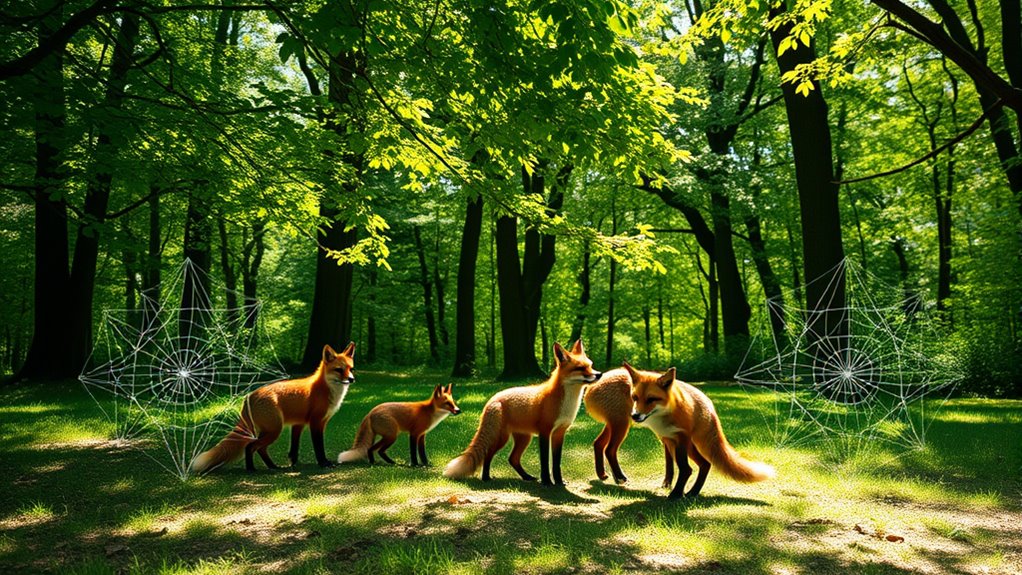

Animals naturally divide their space into territories that resemble Voronoi patterns, where boundaries form based on resource locations and proximity. They establish zones to access food, water, or shelter, often using behaviors like vocalizations and displays to reinforce boundaries and reduce conflict. These territorial divisions dynamically adapt to resource distribution and social interactions. By exploring how behavior and geometry intertwine in nature, you’ll gain a deeper understanding of how animals efficiently organize their shared environment.

Prime made for students and young adults
- Fast, free delivery for dorm and study essentials
- Prime Video and Amazon Music included
- Member-only deals
Key Takeaways
- Animals establish territories around resource sites, creating natural boundaries similar to Voronoi regions based on proximity.
- Voronoi diagrams model how animals partition space, with each zone centered on a resource or shelter.
- Resource distribution influences territory shape and size, leading to regular or irregular patterns.
- Behavioral signals like vocalizations and displays reinforce boundaries and prevent conflicts.
- The spatial organization of animal territories exemplifies how simple proximity rules produce efficient, stable divisions of space.
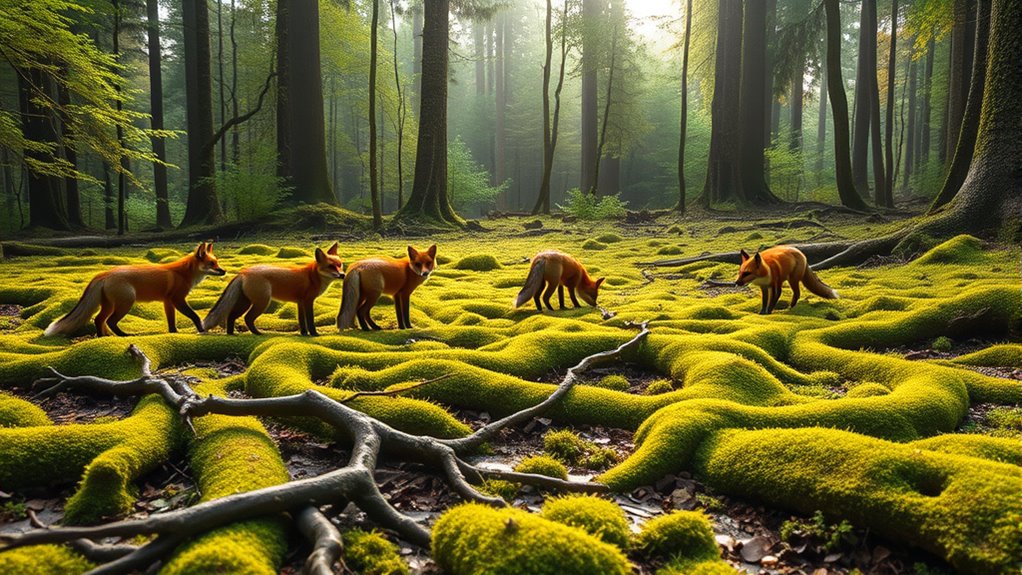
Have you ever wondered how to divide a space among multiple points so that each region belongs to its nearest point? This concept is fundamental in understanding how animals organize their territories, especially when resources are limited. Animals don’t randomly pick areas to defend; instead, their aggression patterns and resource distribution influence how they carve out their domains. When resources like food, water, or nesting sites are abundant but scattered, animals tend to establish territories that maximize access to these essentials while minimizing conflict with neighbors. This behavior naturally leads to a pattern where each animal’s territory is centered around a core area, often corresponding to the closest resource patch or shelter.
Animals organize territories around resources, forming natural Voronoi patterns based on proximity and resource distribution.
In this context, the idea of dividing space based on proximity resembles a Voronoi diagram, a mathematical model that partitions a plane into regions around a set of points. Each region contains all locations closer to its point than to any other. Animals effectively create these Voronoi-like boundaries through their aggression patterns. For instance, predators or territorial birds patrol borders to defend their zones and deter intruders, guaranteeing they retain priority access to vital resources. These borders aren’t fixed but are maintained by behaviors that reinforce each animal’s claim over its territory, like vocalizations, visual displays, or physical confrontations. By doing so, they guarantee that each individual’s area corresponds to its nearest resource or shelter, reducing overlap and potential conflicts.
Resource distribution plays a pivotal role here. When resources are evenly spread, territories tend to be more regular and compact, minimizing overlap. Conversely, if resources are patchy or clustered, animals adapt by adjusting their aggression patterns to defend the most lucrative areas, often resulting in irregular territory shapes. This dynamic ensures that each animal’s territory is optimized for resource acquisition while minimizing costly disputes. The interplay between aggression patterns and resource distribution leads to a natural, almost geometric division of space. The boundaries are negotiated through signals and behaviors, forming a stable pattern that resembles a Voronoi diagram, where each region is the animal’s personal zone of influence.
Understanding this spatial organization reveals how animals efficiently partition environments, balancing competition and cooperation. It’s a fascinating intersection of biology, behavior, and geometry—showing that even in the wild, natural patterns emerge from simple rules like proximity and resource needs. So, next time you observe animals defending their territory, remember that their aggression patterns and resource distribution shape the very boundaries they maintain, creating a natural Voronoi pattern in the wild.
As an affiliate, we earn on qualifying purchases.
Frequently Asked Questions
How Do Animals Decide the Size of Their Territory?
You decide the size of your territory based on factors like food availability, competition, and social hierarchies. You use territory markers, such as scent marks or visual signals, to communicate boundaries and deter others. If you’re dominant, your territory might be larger, while subordinates accept smaller areas. Environmental conditions and the presence of rivals influence your territorial decisions, helping you secure resources and avoid conflicts.
Do Voronoi Diagrams Apply to Underwater or Aerial Animals?
Sure, Voronoi diagrams are the underwater and aerial animals’ secret weapon for marine boundaries and bird nesting zones. You see, fish and birds don’t just pick random spots; they use these diagrams to carve out their space efficiently. So, next time you see a flock or school, remember—they’re practically mathematicians, dividing territory with Voronoi’s help, ensuring they get their fair share of the environment’s buffet.
How Do Territorial Boundaries Change With Population Density?
You’ll notice that as population density increases, territorial boundaries often become more fluid due to heightened territory conflicts. Animals may push boundaries or make them more permeable to reduce conflicts or share resources. Conversely, with lower density, boundaries tend to be more fixed. This dynamic adjustment helps animals balance their need for space with the risks of conflict, ensuring survival and resource access.
Can Voronoi Models Predict Future Territorial Disputes?
Like a crystal ball revealing the future, Voronoi models can help predict territorial disputes through behavioral modeling and spatial prediction. By analyzing current animal movements and interactions, you can identify potential conflict zones before they escalate. While not foolproof, these models offer valuable insights, allowing you to anticipate conflicts and manage territories proactively, ultimately reducing disputes and promoting coexistence among species.
What Role Does Resource Distribution Play in Territory Formation?
Resource distribution plays a vital role in territory formation because animals tend to establish areas where resources like food and water are abundant, a phenomenon driven by resource clustering. You’ll notice that habitat connectivity influences how territories overlap or stay separate, as animals prefer contiguous, resource-rich habitats. This spatial arrangement helps them maximize resource access, reduce conflicts, and maintain sustainable populations within their territories.
As an affiliate, we earn on qualifying purchases.
Conclusion
As you observe how animals claim their space, you see a natural map where boundaries are like invisible threads weaving their lives together. Just as Voronoi diagrams divide space logically, animals carve out territories to survive and thrive. Remember, in nature’s grand design, these boundaries are more than lines—they’re the silent conversations of life, shaping ecosystems like a painter’s brush strokes shaping a masterpiece. Space isn’t just divided; it’s a dance of balance and harmony.
As an affiliate, we earn on qualifying purchases.
animal behavior research equipment
As an affiliate, we earn on qualifying purchases.
As an affiliate, we earn on qualifying purchases.
Fall Picks
fall essentials
As an affiliate, we earn on qualifying purchases.