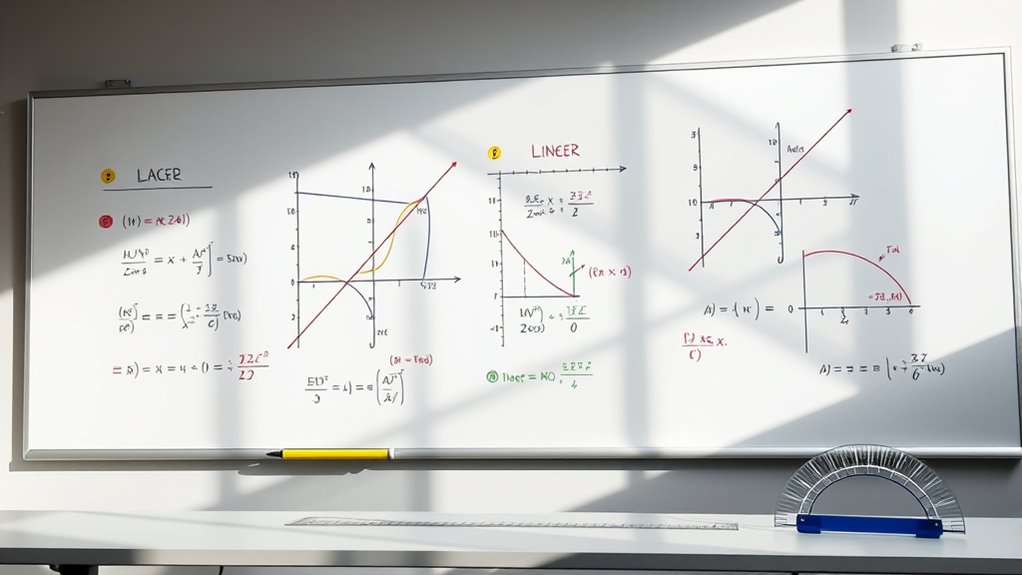

Connecting algebra to geometry through functions and graphs helps you visualize relationships between quantities. By graphing functions, you see how equations translate into shapes and understand how changes affect their appearance. Recognizing inverse functions as reflections across the line y = x further deepens this connection. Exploring transformations like shifts or stretches reveals how the graph’s position and shape change. Keep exploring, and you’ll uncover even more ways to interpret functions visually and enhance your understanding of their underlying math.
Key Takeaways
- Graphs visually depict how algebraic functions relate inputs to outputs, bridging abstract equations with geometric representations.
- Inverse functions are reflected across y = x, illustrating the geometric connection between original and reversed relationships.
- Domain and range determine the scope of functions and their inverses, influencing their graphs and transformations.
- Transformations like shifts, stretches, and reflections modify graphs, revealing their effects on both functions and their inverses.
- Understanding the link between algebraic formulas and graph shapes enhances comprehension of complex function behaviors.
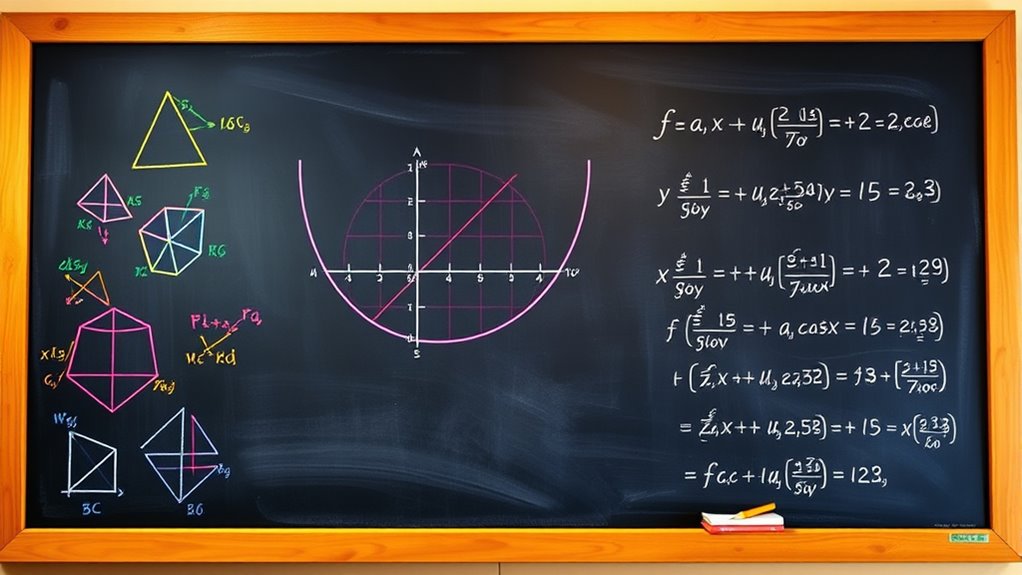
Have you ever wondered how mathematicians represent relationships between quantities? It’s fascinating because they often use graphs to visualize how one value depends on another, turning abstract equations into visual stories. When exploring functions, understanding inverse functions is key. An inverse function fundamentally flips the original, swapping inputs and outputs, which means if a function maps a value x to y, its inverse maps y back to x. Graphically, this relationship appears as the original and inverse functions being reflections of each other across the line y = x. Recognizing this symmetry helps you see the deep connection between algebra and geometry, making it easier to analyze functions’ behaviors. Additionally, domain and range are important concepts that influence how functions and their inverses behave. Graph transformations come into play when you want to see how a function’s graph changes in response to modifications in its formula. These transformations include shifting, stretching, compressing, and reflecting the graph. For example, adding a constant inside the function’s argument shifts the graph horizontally, while adding outside shifts it vertically. Multiplying by a constant stretches or compresses the graph vertically, and multiplying the entire function by a negative flips it across the x-axis. These transformations are visual tools that help you understand the relationship between algebraic changes and their geometric effects. They also make it easier to predict how a graph will look after a particular modification, without having to plot every point from scratch.
Inverse functions and graph transformations are closely linked because both allow you to manipulate and interpret graphs more effectively. When working with inverse functions, you might start with a basic graph and then apply transformations to see how the inverse relates to the original. For instance, if you have a function that shifts right, its inverse will shift left, reflecting the symmetry across y = x. Similarly, understanding how graph transformations affect the original function helps you anticipate changes in its inverse. When you combine these concepts, you gain a powerful toolkit for analyzing complex relationships visually and algebraically.
Frequently Asked Questions
How Can I Identify the Most Important Features of a Function’s Graph?
To identify the most important features of a function’s graph, look for key characteristics like intercepts, which show where the graph crosses axes. Notice the shape and direction of the graph to understand its increasing or decreasing behavior. Pay attention to turning points, asymptotes, and symmetry. These graph features reveal critical information about the function’s behavior and help you understand its overall pattern and key characteristics.
What Are Common Mistakes When Interpreting Function Transformations Visually?
You might totally misread axes or ignore domain restrictions, turning a simple transformation into chaos. Don’t assume the graph’s shifts are always obvious; sometimes, you overlook how axes are scaled or forget to check if the transformation is valid within the domain. These mistakes can make you see a graph that’s wildly distorted or incorrectly shifted, leading to wrong conclusions. Pay close attention to axes and restrictions to interpret transformations accurately.
How Do Different Types of Functions Relate to Real-World Applications?
You can see how different types of functions relate to real-world applications through practical modeling. For example, linear functions help you predict expenses or distance traveled, while quadratic functions model projectile motion or profit optimization. Exponential functions are key for population growth or radioactive decay. Understanding these relationships allows you to apply mathematical concepts directly to everyday situations, making problem-solving more intuitive and effective in real-world contexts.
What Tools Can Help Visualize Complex Functions More Easily?
Imagine holding a magic wand that reveals hidden patterns in complex functions. Interactive tools and graphing calculators act like that wand, transforming abstract equations into vivid, understandable visuals. They let you explore curves and relationships with just a few taps, making intricate functions feel more tangible. These tools turn formidable graphs into clear, colorful visuals, helping you see the math’s story and connect algebra to geometry seamlessly.
How Does Understanding Graphs Improve Problem-Solving Skills in Algebra?
Understanding graphs enhances your problem-solving skills in algebra by improving your graph interpretation and enabling visual problem solving. When you can see the shape and position of a graph, you quickly identify key features like intercepts, slopes, and maximum points. This visual approach helps you grasp relationships between variables, simplifies complex problems, and develops intuition, making algebraic concepts more tangible and manageable.
Conclusion
By now, you see how functions and graphs bridge algebra and geometry seamlessly. Did you know that over 80% of students find visualizing functions easier through graphs? This highlights the importance of connecting these concepts for better understanding. Mastering this connection helps you analyze real-world problems more effectively. Keep practicing, and you’ll find that visualizing algebraic functions becomes second nature, revealing new insights in math and beyond.