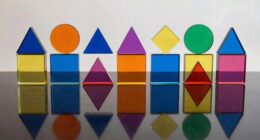

Understanding dimensions helps you see how objects occupy space. In 1D, objects are just lines with length only, so they have no width or height. Moving to 2D, objects become flat shapes like circles or squares, with length and width. In 3D, objects take up volume, adding height to length and width. If you explore further, you’ll discover how these differences shape the world around you.
Key Takeaways
- 1D objects are lines with only length, existing along a single axis without width or height.
- 2D objects are flat shapes with length and width but no depth, like drawings or surfaces.
- 3D objects have length, width, and height, giving them volume and physical presence.
- Geometric properties evolve from simple measurement in 1D to shape, area, and volume in higher dimensions.
- Understanding dimensions helps in visualizing, analyzing, and interacting with physical and mathematical objects.

Have you ever wondered what it really means for something to be one-dimensional, two-dimensional, or three-dimensional? These concepts are fundamental to understanding how objects exist and relate to each other in space. When you think about dimension, you’re essentially considering the number of directions in which an object can extend or move. This ties directly into spatial understanding—a skill that helps you visualize and interpret the world around you. The key lies in the geometric properties that define these dimensions: lines, surfaces, and volumes.
In one dimension, objects are represented as lines. They have length but no width or height, so they exist only along a single axis—like a straight road stretching into the distance. When you think about a number line or a simple path, you’re dealing with one-dimensional space. Here, the geometric property is quite straightforward: the object can only be measured in terms of length. Your spatial understanding in this realm is limited to knowing where an object is along that single line, but you can’t describe its shape or size beyond that.
Moving into two dimensions, objects become flat surfaces like a piece of paper or a drawing on a screen. They have both length and width but lack depth. As you develop your spatial understanding, you realize that two-dimensional shapes—such as circles, squares, and triangles—are defined by their geometric properties like angles, sides, and area. These properties allow you to analyze and manipulate shapes visually and mathematically. You can understand how they fit together, how they can be scaled, or how they relate to each other without considering depth. This leap from one to two dimensions enhances your ability to interpret images, maps, and plans. Additionally, understanding dimensional properties helps in visualizing complex objects and scenarios more effectively.
When you reach three dimensions, objects gain depth, creating volumes. Think of everyday objects—balls, boxes, or furniture. They possess length, width, and height, and your spatial understanding now involves comprehending how these dimensions combine to form a solid. The geometric properties of three-dimensional objects—such as volume, surface area, and symmetry—are more complex but crucial for understanding how objects occupy space. This dimension allows you to visualize real-world environments and interact with objects physically, whether you’re assembling furniture or navigating a room.
Understanding these dimensions isn’t just academic; it shapes how you perceive and interact with the world. Each step from one to three dimensions builds on your grasp of geometric properties and enhances your spatial understanding, making it easier to navigate, design, and comprehend your environment.
As an affiliate, we earn on qualifying purchases.
Frequently Asked Questions
How Do Higher Dimensions Impact Our Universe?
Higher dimensions shape your universe’s structure in ways you might not realize. They could explain phenomena like gravity or dark matter, influencing how galaxies form and behave. These dimensions might hide from your senses but still affect the fundamental laws of physics. By understanding higher dimensions, you gain insight into the universe’s true complexity, revealing how multiple layers beyond your familiar three dimensions impact everything around you.
Can Humans Perceive Four or More Dimensions?
You can’t perceive four or more dimensions directly because of your perception limitations, which are confined to three spatial dimensions. Notably, scientists use dimensional visualization techniques to understand higher dimensions, but humans rely on imagination and mathematical models. While you can’t see them naturally, advanced tools help you explore these complex concepts, expanding your understanding beyond everyday experience. Your perception is limited, but your mind and science can bridge the gap.
What Are Practical Applications of Understanding Dimensions?
Understanding dimensions helps you improve spatial awareness and apply dimensional modeling in fields like architecture, engineering, and data analysis. By grasping how objects occupy space across different dimensions, you can design more efficient structures, optimize data organization, and solve complex problems. This knowledge also enhances navigation, virtual reality experiences, and scientific research, enabling you to manipulate and interpret multidimensional data and spaces effectively.
Are There Theories Suggesting More Than Three Spatial Dimensions?
Imagine you’re exploring a vast, hidden library of extra dimensions. String theory suggests there are more than three, like secret rooms packed with knowledge. These extra dimensions could be tiny, curled up, and invisible to us, yet they influence the universe. Scientists propose that understanding these hidden realms might reveal mysteries of gravity and particles, revealing a universe far richer than our familiar three-dimensional world.
How Do Dimensions Relate to Concepts in Quantum Physics?
You might see that in quantum physics, dimensionality implications influence how particles behave at tiny scales. Quantum dimensionality suggests that particles can exist in superpositions across multiple states, affecting how we understand space and time. These concepts challenge classical ideas of dimensions, hinting at complex, higher-dimensional frameworks. Your comprehension of quantum dimensionality expands as you explore how particles interact within these intricate, multi-dimensional spaces, shaping modern physics theories.
As an affiliate, we earn on qualifying purchases.
Conclusion
So, whether you’re looking at a straight line, a flat drawing, or a three-dimensional space, understanding dimensions transforms how you see the world. It’s like comparing a simple path to a complex universe—each adds layers of depth and perspective. Just as a point becomes a line, then a shape, your perception evolves with each dimension. Embrace these layers, and you’ll open a richer, more fascinating way to explore everything around you.
As an affiliate, we earn on qualifying purchases.
As an affiliate, we earn on qualifying purchases.