
Your control of geometry directly impacts how well parts fit together, their surface finish, and the consistency across production runs. Precise geometry ensures that tooling, material properties, and process parameters work together, minimizing deformations and errors. This leads to accurate dimensions and smooth surfaces, reducing rework and ensuring quality. If you want to understand how to optimize these aspects for better manufacturing outcomes, there’s more to discover about managing each factor effectively.
Play games included with Prime
Start a Prime free trial and play with Amazon Luna on your devices.
As an affiliate, we earn on qualifying purchases.
Key Takeaways
- Precise geometric design ensures parts fit together accurately, reducing assembly issues and enhancing overall product quality.
- Maintaining tight control over initial geometry minimizes deviations, leading to consistent surface finish and aesthetic quality.
- Accurate geometry in tooling and components promotes repeatability across production batches.
- Proper geometric considerations during process planning prevent distortions and warping, preserving geometric integrity.
- Consistent geometric control enables reliable reproduction of parts, supporting high-volume manufacturing and quality standards.
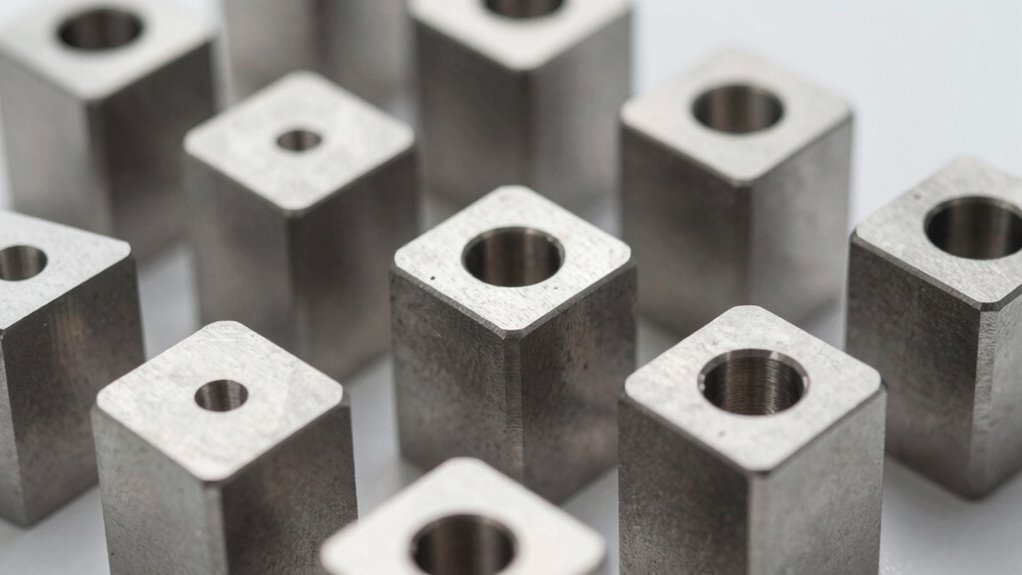
Have you ever wondered how the precise shapes and dimensions of manufactured parts are controlled? It’s a complex process that hinges on understanding the relationship between geometry, material properties, and tooling accuracy. When you’re producing parts that need to fit perfectly, finish smoothly, and be consistently repeatable, these factors become the backbone of quality control. Material properties, such as hardness, ductility, and thermal expansion, influence how a material responds during manufacturing. For example, a metal with high ductility might deform more easily, affecting the final shape, while a brittle material could crack if not handled carefully. Recognizing these properties helps you select the right material and adjust your processes accordingly, guaranteeing the geometric features hold true through production.
Tooling accuracy is equally vital. Your tools—whether they’re molds, dies, or cutting implements—must be manufactured with high precision. Even the slightest deviation can result in parts that don’t meet specifications. When you set up your tooling, you rely on the accuracy of your equipment and the precision of your measurements. Fine-tuning these tools ensures that the geometry of each part remains consistent from one batch to another. This consistency is essential for parts that need to fit together seamlessly or function reliably in assemblies. If tooling errors creep in, they can cause dimensional inaccuracies, surface finish issues, and ultimately reduce the overall quality of your product. Additionally, understanding the relationship between geometry and material properties is crucial for predicting how parts will behave during manufacturing. A thorough understanding of tooling accuracy can help mitigate many common manufacturing errors. Moreover, the importance of process parameter management cannot be overstated, as it directly influences the fidelity of the final geometry.
The shape and dimensions of a part are also governed by how well the manufacturing process respects the initial geometry. This means that not only must your tools be precise, but your process parameters—such as feed rates, speeds, and temperature controls—must be carefully managed to prevent distortion or warping. When these factors are aligned correctly, you achieve a high level of repeatability. You can produce identical parts time after time, which is imperative for mass production and quality assurance. Moreover, implementing advanced measurement techniques can further enhance your control over geometric accuracy and consistency.
In essence, achieving the perfect fit and finish hinges on your understanding of how geometry interacts with material properties and tooling accuracy. By controlling these elements, you guarantee that every part meets exact specifications, maintains quality, and performs reliably in its intended application. Your attention to detail in managing these factors transforms raw materials into precise, functional components that uphold the standards of modern manufacturing.
As an affiliate, we earn on qualifying purchases.
Frequently Asked Questions
How Does Geometry Influence Material Selection in Manufacturing?
You understand that geometry influences material selection because it directly affects material properties needed for strength, flexibility, or durability. Your design constraints, such as shape complexity and tolerances, determine whether you choose metals, plastics, or composites. By considering geometry, you guarantee the chosen material meets performance requirements while fitting within manufacturing processes, optimizing product quality, and reducing costs. This way, geometry guides you in selecting materials that best suit your specific application.
What Tools Are Used to Measure Complex Geometries Accurately?
Think of complex geometries as intricate puzzles where precision is your guiding star. You use coordinate measurement machines (CMMs) to navigate this maze, capturing detailed data points with high accuracy. These tools enable geometric validation, ensuring parts meet exact specifications. With CMMs, you can measure complex shapes reliably, confirming fit and finish while maintaining repeatability, so each piece aligns perfectly like a well-orchestrated symphony.
How Does Geometry Affect Manufacturing Cycle Times?
Geometry directly impacts manufacturing cycle times because precise geometric control guarantees parts fit correctly and need fewer adjustments. When you maintain high manufacturing precision and focus on geometric consistency, you reduce rework and inspection steps, speeding up production. Accurate geometry streamlines the process, minimizes errors, and leads to faster cycle times, ultimately improving efficiency and ensuring consistent quality throughout your manufacturing operations.
Can Geometry Control Be Automated in Production Lines?
Yes, geometry control can be automated in production lines. You can achieve this with automated inspection systems that utilize advanced geometric algorithms to measure and verify parts in real-time. These systems quickly identify deviations from specified dimensions, ensuring consistent quality. By integrating automated inspection with geometric algorithms, you streamline quality control, reduce manual errors, and speed up production, making the entire process more efficient and reliable.
What Are Common Challenges in Maintaining Geometric Tolerances?
You face challenges in maintaining geometric tolerances due to factors like tolerance stacking and equipment drift. Precision calibration helps you keep measurements accurate, but small deviations can accumulate over multiple parts, affecting overall quality. Temperature changes, tool wear, and misalignment also complicate things. Regular checks and adjustments are essential to prevent tolerance stacking from impacting fit and finish, ensuring consistent repeatability in your manufacturing process.
As an affiliate, we earn on qualifying purchases.
Conclusion
Remember, in manufacturing, your geometry is the foundation that shapes fit, finish, and repeatability. When you control it precisely, you guarantee consistent quality and efficiency. Don’t underestimate the power of accurate measurements—small details make a big difference. As the saying goes, “A chain is only as strong as its weakest link,” so focus on perfecting each geometric aspect. Master this, and you’ll build products that stand the test of time.
manufacturing measurement instruments
As an affiliate, we earn on qualifying purchases.
As an affiliate, we earn on qualifying purchases.
As an affiliate, we earn on qualifying purchases.
Fall yard work Picks
leaf blowers
As an affiliate, we earn on qualifying purchases.