
Thales’ Theorem makes it easier for you to recognize right angles in circle problems by showing that any inscribed triangle with a diameter as one side is a right triangle. This quick link helps you identify key angles without complex calculations. It also clarifies relationships between chords, arcs, and angles, making geometry more intuitive. By understanding these connections, you’ll solve problems faster and see circle properties more clearly—keep exploring to discover even more insights.
Key Takeaways
- Thales’ Theorem directly links diameters to right angles, simplifying the identification of right triangles inscribed in a circle.
- It allows quick recognition of inscribed angles without complex calculations, streamlining problem-solving.
- The theorem visually connects arc measures to inscribed angles, making arc and angle relationships easier to understand.
- It aids in identifying chord properties and relationships based on their position relative to the diameter.
- Overall, Thales’ Theorem enhances intuitive geometric reasoning and reduces reliance on memorized formulas.
Have you ever struggled with understanding the complex relationships within circles? If so, you’re not alone. Many students find it challenging to grasp how different parts of a circle relate to each other, especially when it comes to chord properties and arc measurements. That’s where Thales’ Theorem comes in—it offers a simple, elegant way to decode these relationships and make circle reasoning much clearer.
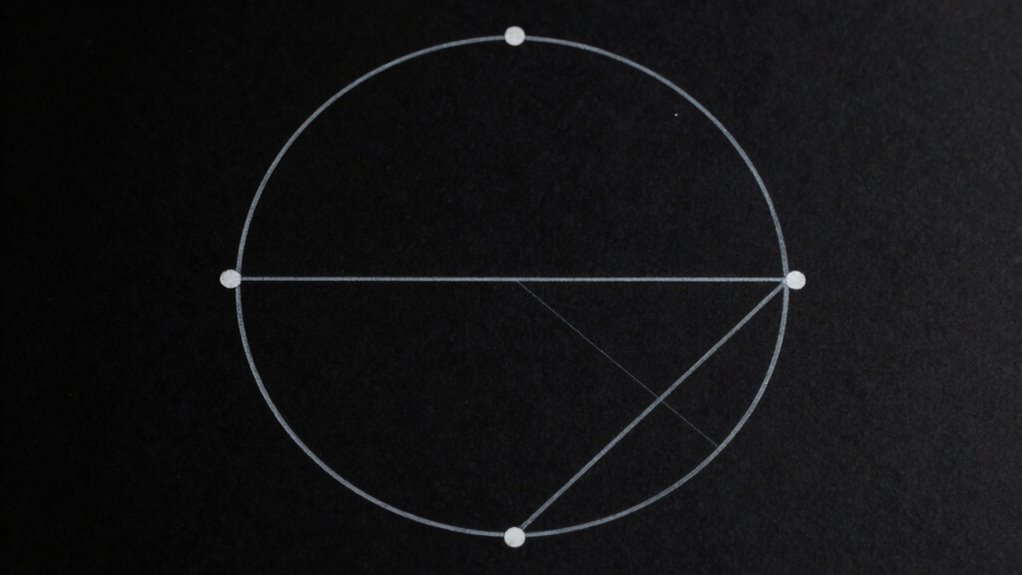
Thales’ Theorem states that if you have a triangle inscribed in a circle and one side of that triangle is a diameter, then the triangle is a right triangle. This might sound straightforward, but its implications are powerful. It means that whenever you identify a diameter in the circle, you automatically know that the angles subtended by that diameter are right angles. This simplifies many problems involving inscribed angles and helps you quickly determine unknown angles without complex calculations.
Identifying a diameter reveals right angles, simplifying inscribed angle problems and enabling quick, intuitive geometric reasoning.
Understanding how Chord properties fit into this is essential. When you consider chords in a circle, Thales’ Theorem helps you see that any point on the circle forming a triangle with the endpoints of a diameter creates a right angle. This insight allows you to determine which chords are perpendicular or bisect each other, based on their position relative to the diameter. You no longer have to rely solely on memorizing formulas; instead, you can use the theorem to visualize relationships and predict properties intuitively. Recognizing these circle properties can also help you identify special points and segments, such as midpoints and perpendicular bisectors, making geometric constructions more intuitive.
Arc measurements are also simplified through Thales’ Theorem. Since angles inscribed in a circle are directly related to the arcs they intercept, recognizing that a triangle with a diameter as one side contains a right angle helps you connect the measure of the arc to the inscribed angle. For example, if you know the measure of an arc, you can instantly find the measure of the inscribed angles, and vice versa. This reduces the need for complicated calculations and makes reasoning about arcs much more straightforward. Additionally, understanding circle properties can deepen your overall grasp of geometric relationships, and recognizing how diameters influence angles can lead to more intuitive problem-solving.

Mr. Pen- Geometry Set, 15 Piece Set with 6 Inch Swing Arm Protractor
Geometry Set For All Levels Designed in USA
As an affiliate, we earn on qualifying purchases.
As an affiliate, we earn on qualifying purchases.
Frequently Asked Questions
How Does Thales’ Theorem Relate to Other Circle Theorems?
Thales’ theorem relates closely to other circle theorems by highlighting key circle properties, such as the inscribed angle subtending a diameter. You can use it in geometric proofs to establish right angles and prove properties of cyclic quadrilaterals. Its simplicity helps you understand complex circle relationships, making it a foundational tool for reasoning about angles and arcs in circle theorems, streamlining your geometric reasoning.
Can Thales’ Theorem Be Applied in Non-Euclidean Geometries?
You’d think Thales’ Theorem, rooted in Euclidean geometry, would be useless in Non-Euclidean worlds. Surprisingly, it doesn’t quite translate, because Non-Euclidean geometries introduce curved spaces that defy our flat-plane intuitions. The geometric challenges here are immense, making Thales’ elegant, circle-based insights nearly irrelevant. So, while charming in Euclidean settings, Thales’ theorem struggles to find footing in the warped, curved realities of Non-Euclidean geometries.
What Are Common Real-World Applications of Thales’ Theorem?
You use Thales’ Theorem in real-world applications like circle construction and geometric proofs. For example, architects rely on it to verify right angles when designing circular structures or arches, ensuring stability and accuracy. Engineers also apply it in calibrating instruments or in satellite dish alignment. Its straightforward principle helps verify angles and construct circles precisely, making it invaluable in fields where accurate geometric reasoning is essential.
How Can Thales’ Theorem Be Demonstrated Visually?
You can demonstrate Thales’ theorem visually through a dynamic demonstration by drawing a circle with a diameter and a triangle inscribed so that one side is the diameter. As you move the third point along the circle, you’ll see the angle opposite the diameter remains a right angle. This visual proof clearly shows how the theorem works, making it easier to understand and remember.
Are There Exceptions or Special Cases in Thales’ Theorem?
Imagine a perfect circle like a tranquil pond, with a triangle inscribed, but watch out for special cases where Thales’ theorem doesn’t apply. If the points aren’t on the diameter or the triangle isn’t right-angled, the theorem’s exceptions come into play. These special cases highlight that Thales’ theorem has limitations, especially when the circle’s points aren’t positioned as required. Always check conditions carefully to avoid mistaken assumptions.

Nicpro 22 PCS Compass Geometry Tools with Case, Drafting Tools Geometry Set with Swing Arm Protractor, Rulers, Metal Compass, Square Set, Mechanical Pencil, Back to School Supplies for Students
Complete Compass Geometry Set – This all-in-one compass geometry set includes 3 types of compasses (study, graphic, bow),…
As an affiliate, we earn on qualifying purchases.
As an affiliate, we earn on qualifying purchases.
Conclusion
You see, Thales’ theorem truly transforms your approach to circle challenges. It simplifies seemingly complex scenarios, making your reasoning more reliable and remarkably straightforward. By understanding this theorem, you master the magic of meaningful, minimal moves, turning tricky tangents into transparent truths. With clarity and confidence, you conquer circles with cleverness and ease. So, embrace Thales’ theorem’s teaching, and let your geometric genius grow, guiding you gracefully through every circle conundrum you encounter.

Helix Angle and Circle Maker with Integrated Circle Templates, 360 Degree, 6 Inch / 15cm, Assorted Colors (36002)
2 in1 ANGLE AND CIRCLE MAKER – can be used as both a protractor and compass; ideal for…
As an affiliate, we earn on qualifying purchases.
As an affiliate, we earn on qualifying purchases.
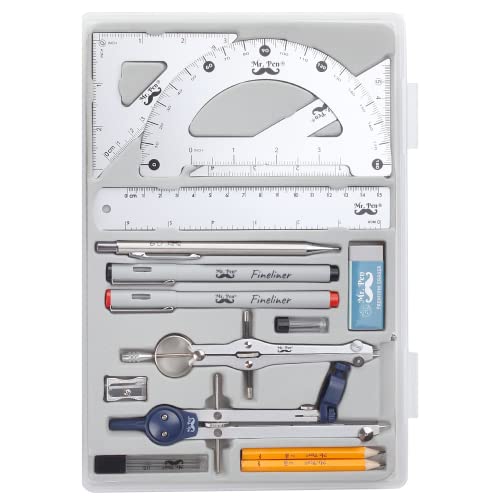
Mr. Pen- Professional Geometry Set, 15 pcs, Drafting Tools with Protractor
Package includes 2 Compasses, 2 triangles, 1 6-inch ruler, 1 protractor, 2 pencils for compass, 2 fineliners, 1…
As an affiliate, we earn on qualifying purchases.
As an affiliate, we earn on qualifying purchases.