Understanding angle vocabulary greatly affects how you perceive the world around you. Words like “acute,” “obtuse,” and “right” help you visualize and interpret shapes, spaces, and structures more accurately. They boost your spatial reasoning, making you better at judging distances, angles, and proportions in everyday life. Developing this language sharpens your perception of architecture, landscapes, and even natural formations. Keep exploring, and you’ll discover how powerful precise angle terms can be in understanding your environment better.

Prime made for students and young adults
- Fast, free delivery for dorm and study essentials
- Prime Video and Amazon Music included
- Member-only deals
Key Takeaways
- Precise angle vocabulary shapes our perception and interpretation of spatial relationships in both natural and built environments.
- Understanding terms like “acute” and “obtuse” enhances mental visualization of geometric and architectural structures.
- Angle language improves spatial reasoning, aiding in accurate measurement, problem-solving, and design tasks.
- Descriptive angle words influence how we perceive and appreciate spaces, from streets to artistic compositions.
- Developing a strong angle vocabulary fosters overall spatial awareness and confidence in everyday navigation and analysis.

Have you ever stopped to reflect on how the words we use to describe angles shape our understanding of geometry and everyday spaces? The language surrounding angles isn’t just technical jargon—it influences how you perceive and interpret the world around you. When you talk about angles as “acute,” “obtuse,” or “right,” you’re not merely describing measurements; you’re engaging in a perspective shift that affects your visual interpretation of space. This vocabulary acts as a lens through which you see and understand the shapes and structures you encounter daily, from the pitch of a roof to the bend of a street corner.
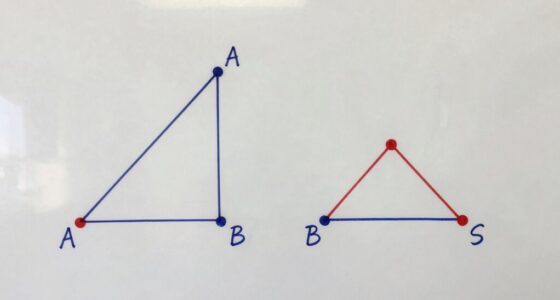
Using precise terminology helps you develop a clearer mental image of geometric relationships. For instance, recognizing that an “obtuse angle” is greater than 90 degrees immediately alters your perception of an object’s shape or position. It’s easy to think of angles as just numbers, but the words give you a richer, more nuanced understanding. When you grasp these terms, you gain the ability to interpret visual cues more accurately, making it easier to decipher architectural designs, artworks, or even natural formations. Your visual interpretation becomes sharper because you’re not just guessing about angles—you’re using a language that fine-tunes your perspective.
This expanded vocabulary also enhances your spatial reasoning. When you understand what makes an angle “acute” versus “obtuse,” you’re better equipped to judge distances and proportions. It’s not just about recognizing angles; it’s about seeing them as part of a bigger picture. This perspective shift allows you to better grasp how different parts of a space relate to each other, whether you’re steering through a room or analyzing a landscape. Recognizing the importance of angle vocabulary helps you develop a more precise and confident perception of the spaces you inhabit. Additionally, understanding geometric relationships can improve your ability to solve practical problems involving measurements and design. Recognizing the measurement units used in describing angles further sharpens your comprehension of their sizes and applications. Developing a solid understanding of spatial awareness can also foster greater appreciation for the natural and built environments around you.
As an affiliate, we earn on qualifying purchases.
Frequently Asked Questions
How Does Angle Vocabulary Influence Overall Geometric Understanding?
Your angle vocabulary greatly influences your overall geometric understanding by improving angle comprehension and enabling you to describe and analyze shapes accurately. When you develop your vocabulary, you can recognize various angles, such as acute, obtuse, or right, more easily. This foundation helps you solve problems faster, communicate ideas clearly, and deepen your grasp of complex concepts. Strong vocabulary development ultimately makes geometry more intuitive and accessible for you.
Can Improving Angle Vocabulary Aid in Real-World Problem Solving?
Yes, improving your angle language and vocabulary precision can greatly aid in real-world problem solving. When you clearly understand and accurately describe angles, you can better analyze situations, communicate solutions effectively, and avoid misunderstandings. Whether you’re reading blueprints, finding your way on maps, or troubleshooting mechanical parts, strong angle vocabulary helps you interpret and manipulate the geometric aspects of problems with confidence and precision, leading to more effective solutions.
What Are Common Mistakes Students Make With Angle Terminology?
You often make angle misconceptions when you confuse terms like complementary, supplementary, or adjacent angles, leading to errors in problem-solving. Terminology confusion arises when you don’t clearly distinguish between angles’ types or their relationships, such as interior versus exterior angles. These mistakes happen because you overlook precise definitions, so improving your understanding of angle vocabulary helps you avoid misconceptions and solve problems more accurately and confidently.
How Early Should Students Start Learning Advanced Angle Vocabulary?
You should start learning advanced angle vocabulary as early as possible, ideally in the middle school years. This helps you develop strong angle terminology skills and builds a solid foundation for more complex geometry concepts. Incorporating vocabulary development into your regular study routine guarantees you understand and use precise language, which improves problem-solving and communication. Early exposure makes mastering advanced angle terminology more intuitive, setting you up for success in higher-level math.
Are There Effective Strategies to Enhance Angle Vocabulary Retention?
Did you know students who use memorization techniques combined with contextual learning improve their retention by 50%? To boost angle vocabulary, you should actively engage with terms through visual aids, real-world examples, and practice. Repetition alone isn’t enough; integrating new words into meaningful contexts helps them stick. Consistent review, discussing angles in different scenarios, and connecting concepts make your understanding deeper and longer-lasting.
As an affiliate, we earn on qualifying purchases.
Conclusion
Understanding angle vocabulary isn’t just about passing tests; it shapes how you see and interpret the world around you. Did you know that studies show students with a strong grasp of geometric terms tend to excel in problem-solving across disciplines? By mastering these words, you boost your critical thinking and communication skills. So, next time you encounter an angle, remember—it’s more than just a number; it’s a key to understanding the bigger picture.
As an affiliate, we earn on qualifying purchases.
As an affiliate, we earn on qualifying purchases.
Fall Picks
fall essentials
As an affiliate, we earn on qualifying purchases.