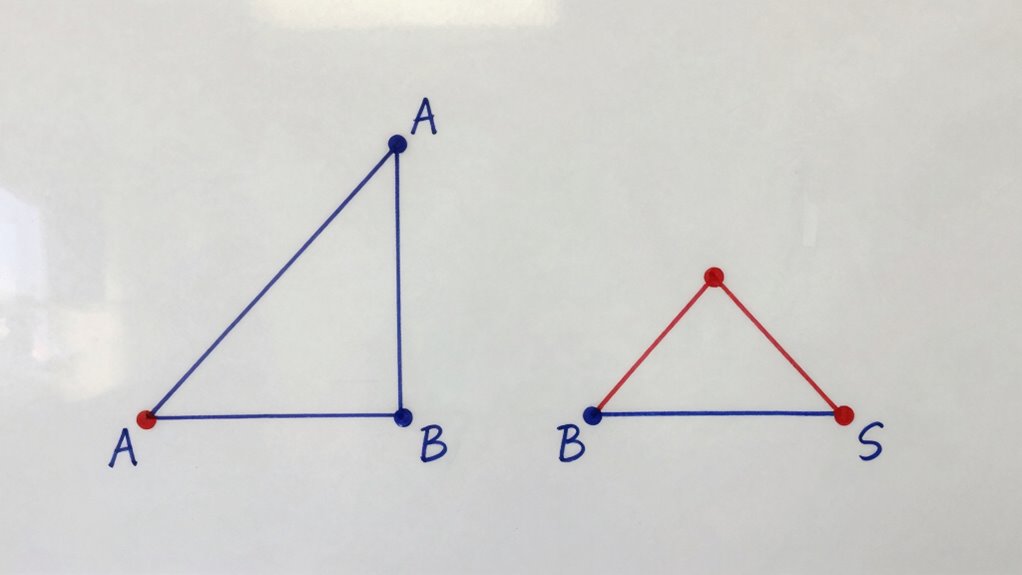
To avoid missing key clues, start by identifying all fundamental parts like points, lines, and angles. Watch for markings such as arcs, tick marks, or dotted lines indicating equal segments or angles, and note any auxiliary lines added for clarification. Look carefully at relationships like parallelism, perpendicularity, and congruence. Recognize special configurations and understand the symbols used. If you keep exploring, you’ll uncover even more tips to interpret diagrams accurately.

Prime made for students and young adults
- Fast, free delivery for dorm and study essentials
- Prime Video and Amazon Music included
- Member-only deals
Key Takeaways
- Identify all points, lines, angles, and segments, noting markings indicating equality or special relationships.
- Look for auxiliary lines, dashed or dotted, that reveal hidden or additional geometric relationships.
- Recognize markings like arcs, tick marks, and labels that indicate equal segments or angles.
- Observe angle relationships such as complementary, supplementary, or vertical angles to find key clues.
- Check for parallel, perpendicular lines, and congruencies to understand the diagram’s structure and properties.

When you look at a geometry diagram, understanding its components is essential for solving problems accurately. Recognizing the various parts of the diagram—points, lines, angles, and segments—allows you to see how each piece relates to the others. One of the most important aspects to focus on is the relationships between angles, known as angle relationships. These include complementary, supplementary, vertical, and adjacent angles. By identifying these, you can determine unknown angles quickly. For example, if you see two angles that are vertical, you know they are equal, which helps you establish the values of other angles in the diagram. Similarly, recognizing when angles are supplementary or complementary can guide you toward the correct calculations or logical deductions. Paying attention to angle relationships can also help you identify patterns and make connections more easily across different diagrams. Segment properties are just as vital. When you observe segments, pay attention to their lengths, intersections, and how they connect different points. Segments can be equal, bisected, or part of larger shapes like triangles or polygons. Noticing these properties gives you clues about the relationships within the diagram. For instance, if a segment is marked as a bisector, it divides a larger segment into two equal parts, revealing symmetry and helping you set up equations or prove certain facts. Segments also help identify congruent parts, which is essential when using properties like side-side-side (SSS) or side-angle-side (SAS) congruence in triangles. Another key to reading a diagram effectively is to look for special configurations or markings that indicate particular properties. For example, arcs and tick marks often show equal angles or segments, while dotted or dashed lines might indicate hidden or auxiliary segments added for clarity. These clues can be instrumental in understanding the setup and the constraints of the problem. Always check if the diagram hints at parallel lines, perpendicular segments, or congruent angles, as these features often lead to important theorems and relationships. Recognizing geometric symbols and their meanings can also aid in interpreting the diagram more quickly. In essence, reading a geometry diagram without missing key clues involves a careful, systematic approach. Focus on angle relationships to understand how angles interact, and analyze segment properties to see how lengths and divisions shape the figure. Combining these observations allows you to piece together the full picture efficiently and solve geometry problems with confidence.
As an affiliate, we earn on qualifying purchases.
Frequently Asked Questions
How Can I Identify Hidden Angles in a Diagram?
To identify hidden angles in a diagram, look for subtle hints like angle markings, arcs, or numbers near the vertices. These markings often indicate the measure of angles, including hidden ones. Check for intersecting lines, parallel lines, or diagonals, as they can reveal hidden clues about angles. Carefully examine all labels and symbols; they often provide essential information that helps uncover angles that aren’t immediately obvious.
What Symbols Indicate Congruence or Similarity?
Think of symbols on a diagram like secret codes. When you see small, curved angle markings, they indicate congruent angles—meaning they are equal. Similarity is shown with tilde (~) symbols, like a squiggly line, signifying figures have the same shape but not necessarily the same size. These symbol meanings help you quickly identify relationships between angles and shapes, making it easier to analyze the diagram accurately.
How Do I Interpret Multiple Diagrams in One Problem?
When interpreting multiple diagrams in one problem, focus on the angle relationships and how they connect across diagrams. Carefully examine diagram labeling to identify corresponding angles, side lengths, or congruent segments. Look for shared points or lines that link the diagrams, and note any given measurements. By observing how the diagrams relate through angle relationships and consistent labeling, you can understand the overall problem and find the necessary solutions efficiently.
What Are Common Mistakes When Reading Diagrams?
A common mistake is ignoring labeling conventions, which can lead to misidentifying angles, side lengths, or points. You might also misinterpret the scale, causing inaccuracies in measurements or proportions. Always double-check labels and symbols, and compare the scale with known references. Carefully analyzing these details guarantees you understand the diagram correctly, preventing errors that could affect your problem-solving accuracy.
How Can I Verify if My Understanding Matches the Diagram?
You can verify your understanding by cross-checking the diagram against the coordinate systems and labeling conventions used. Make certain your interpretation of shapes, angles, and distances aligns with the labels and axes. Revisit key points, like midpoints or intersections, and confirm they match your mental image. If discrepancies arise, re-examine the diagram, paying close attention to how the coordinate system guides your spatial understanding.
As an affiliate, we earn on qualifying purchases.
Conclusion
Now that you know how to interpret a geometry diagram, you’re equipped to uncover hidden clues and solve problems with confidence. Just like a map guides a traveler through unfamiliar terrain, your understanding guides you through complex figures. Don’t overlook small details—they’re often the key to big solutions. With sharp eyes and keen observation, you’ll navigate any diagram effortlessly, turning what once seemed confusing into a clear, insightful picture—an essential skill in every geometry adventure.
As an affiliate, we earn on qualifying purchases.
As an affiliate, we earn on qualifying purchases.
Halloween Picks
halloween
As an affiliate, we earn on qualifying purchases.