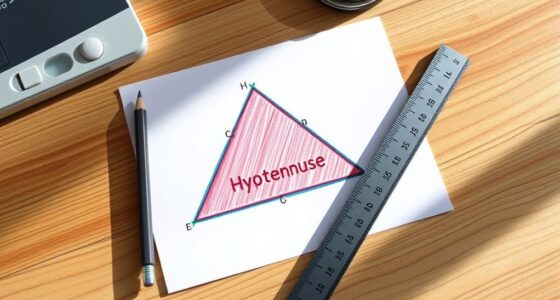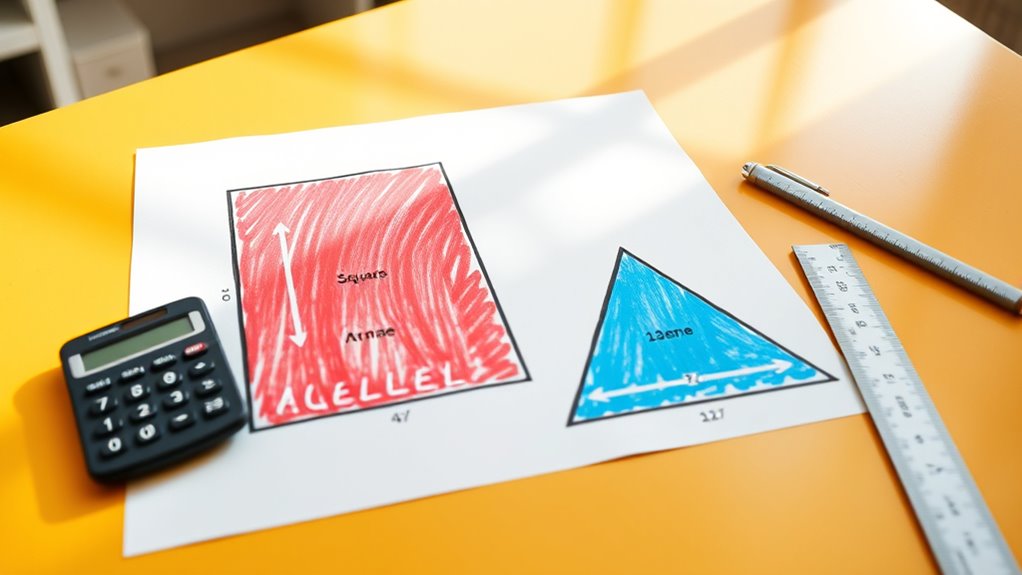

To understand basic geometry, you need to learn how to find the perimeter and area of simple shapes like circles and triangles. Perimeter is the distance around a shape, while area is the space inside it. For circles, multiply the radius or diameter by pi to get the circumference and use base times height divided by two for triangle areas. Keep exploring these concepts to build your skills further and see how they apply in real life.

Prime made for students and young adults
- Fast, free delivery for dorm and study essentials
- Prime Video and Amazon Music included
- Member-only deals
Key Takeaways
- Perimeter is the total length around a shape, calculated by adding all side lengths.
- Area measures the space inside a shape, often calculated using specific formulas for each shape.
- For rectangles and squares, multiply length by width; for triangles, use half the base times height.
- Circles’ perimeter (circumference) is 2 times pi times radius; area is pi times radius squared.
- Understanding perimeter and area helps in design, construction, and real-world measurement tasks.
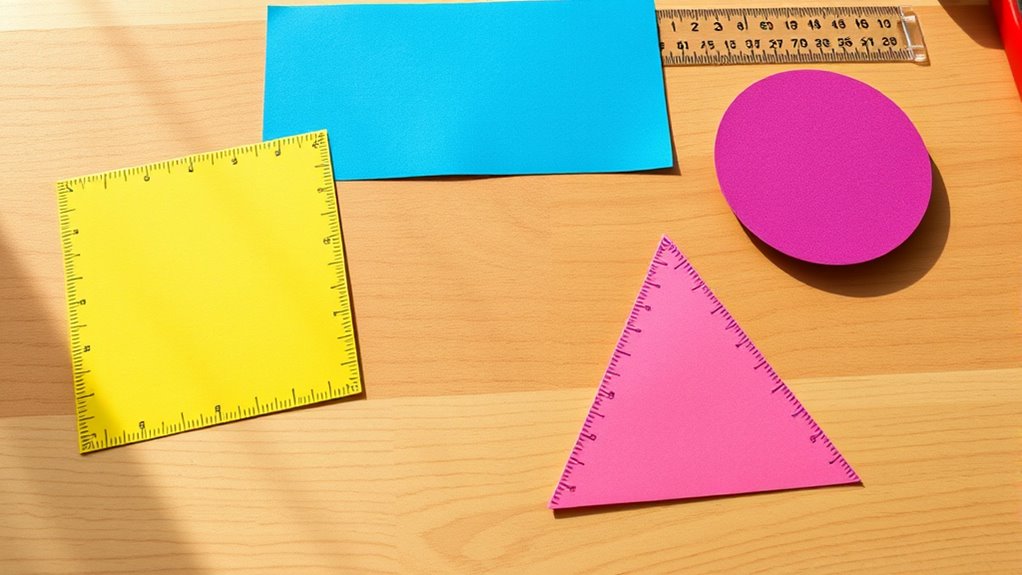
Have you ever wondered what shapes and lines make up the world around you? From the round edges of a coin to the sharp points of a roof, understanding basic geometry helps you see how everything fits together. One of the foundational concepts is learning about different shapes, such as circles and triangles, and how to measure their size using perimeter and area. When you explore circle measurements, you’re dealing with the distance around the circle, called the circumference, and the space inside it, known as the area. To find the circumference, you multiply the diameter or radius by pi (approximately 3.14). For example, if a circle has a radius of 5 units, its circumference would be 2 x 3.14 x 5, which equals about 31.4 units. Measuring these aspects helps you understand how much space a circle covers or how far it extends around. Recognizing how the contrast ratio affects image quality can improve your understanding of visual clarity. Triangles, on the other hand, are three-sided shapes with specific properties that can help you find their perimeter and area. The perimeter of a triangle is simply the sum of its three side lengths. If you know the lengths of each side, adding them gives you the total distance around the shape. But calculating the area of a triangle can be trickier, especially if you don’t have a right triangle. Triangle properties, such as the base and height, are essential because you can use them to find the area with the formula: half the base times the height. This means if you have a triangle with a base of 10 units and a height of 6 units, the area would be 0.5 x 10 x 6, giving you 30 square units. Knowing these properties allows you to measure and compare shapes accurately, whether you’re designing a garden, building a piece of furniture, or simply trying to understand how shapes fit together in your daily life. Understanding circle measurements and triangle properties gives you a solid foundation for grasping more complex geometry topics later on. These measurements help you see how shapes relate to each other and to real-world objects. For instance, knowing how to calculate the area of a triangle can help in construction projects, while understanding the circumference of a circle might be useful for measuring round objects or designing circular patterns. As you practice, you’ll become more confident in your ability to analyze shapes, measure their dimensions, and apply this knowledge to practical situations. Geometry isn’t just about formulas; it’s about understanding the world around you and being able to quantify and work with the shapes that make up your environment. By mastering these basic measurements, you’re taking the first step toward a deeper understanding of the spatial relationships that define your everyday life.
geometry calculator for perimeter and area
As an affiliate, we earn on qualifying purchases.
As an affiliate, we earn on qualifying purchases.
Frequently Asked Questions
How Do I Find the Perimeter of Irregular Shapes?
To find the perimeter of irregular shapes, you need to measure each side carefully and add all these lengths together. Use irregular shape measurement techniques like a ruler or flexible measuring tape for accuracy. Perimeter calculation methods involve breaking the shape into smaller, manageable segments if needed. Once you measure every side, simply sum them up to get the total perimeter. This approach guarantees precise irregular shape measurement.
Can Area Be Negative or Zero?
Area can’t be negative; it’s always positive or zero. If you have a shape with no size, like a line or a point, it has zero area. For example, a flat, thin shape like a paper sheet has a positive area, while a line or a dot has zero area. So, you’ll never find negative area, just positive or zero, depending on the shape’s size.
How Do I Convert Units for Perimeter and Area?
Ever wondered how to convert units for perimeter and area? You simply change the measurement units using unit conversion. For perimeter, multiply or divide by the same factor to switch between units like inches to centimeters. For area, remember to square the conversion factor because area units are squared. Double-check your calculations to guarantee your measurements stay accurate. This way, you can confidently switch between different measurement systems.
What Is the Difference Between Perimeter and Circumference?
The difference between perimeter and circumference is that circumference specifically refers to the circle measurement around its shape boundary, while perimeter applies to any polygon or shape. You measure the circumference by using the formula 2πr or πd for circles, whereas perimeter involves summing the lengths of all sides in any shape. Understanding this distinction helps you accurately calculate the boundary length for different shapes.
Are There Formulas for Three-Dimensional Shapes’ Surface Area?
Yes, there are formulas for three-dimensional shapes’ surface area. You can calculate the surface area by adding up the areas of all faces or surfaces, like on a cube or sphere. For example, a sphere’s surface area uses 4πr², and a cube’s is 6s². Remember, surface area helps you understand the total exterior, while volume tells you how much space is inside.
math measurement tools for students
As an affiliate, we earn on qualifying purchases.
As an affiliate, we earn on qualifying purchases.
Conclusion
Now that you’ve explored the fundamentals of perimeter and area, think of shapes as the building blocks of a world you can shape and measure. Just like a sculptor molds clay, you have the power to craft and understand these simple forms. Remember, mastering these basics opens doors to bigger, more complex designs. With each shape you conquer, you’re laying a solid foundation—like planting seeds for a future full of creative possibilities, waiting to bloom.
As an affiliate, we earn on qualifying purchases.
circle and triangle measurement kit
As an affiliate, we earn on qualifying purchases.
As an affiliate, we earn on qualifying purchases.
Columbus Day / Indigenous Peoples' Day Picks
long weekend sales
As an affiliate, we earn on qualifying purchases.