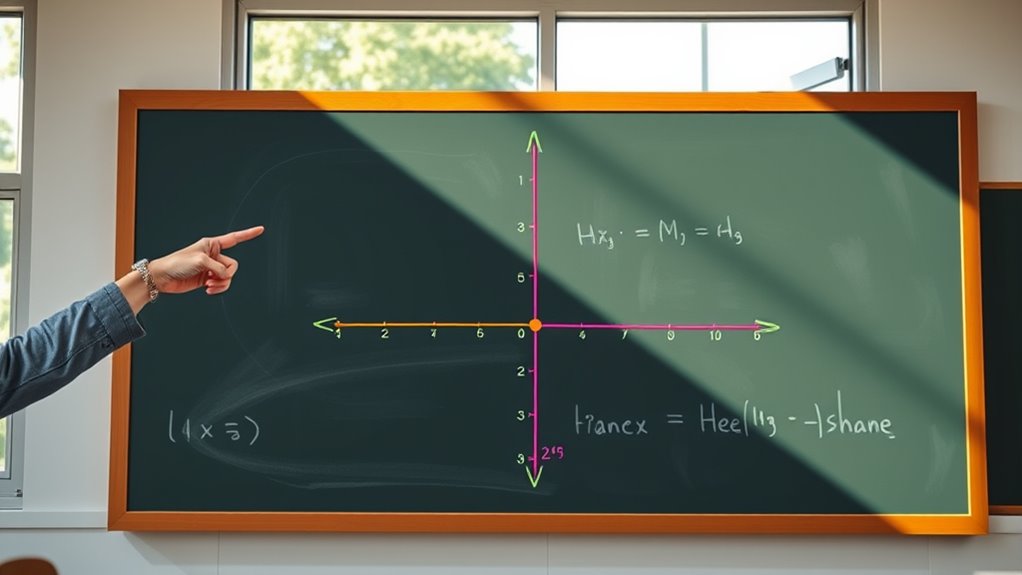

The coordinate plane helps you locate and analyze points, shapes, and distances in two-dimensional space. It uses two perpendicular lines called axes: the x-axis (horizontal) and y-axis (vertical). You mark points with ordered pairs (x, y), which tell you how far along and up they are. Knowing how to plot points and find distances between them is essential for understanding geometry. Keep exploring, and you’ll discover how these skills apply to more complex shapes and problems.

Prime made for students and young adults
- Fast, free delivery for dorm and study essentials
- Prime Video and Amazon Music included
- Member-only deals
Key Takeaways
- The coordinate plane uses x and y axes to locate points in two-dimensional space.
- Points are represented as ordered pairs (x, y) and plotted accordingly.
- The distance between two points is calculated using the distance formula: √[(x₂ – x₁)² + (y₂ – y₁)²].
- Plotting points and calculating distances help analyze geometric shapes and spatial relationships.
- Mastering these basics enhances understanding of geometry, graphing, and spatial problem-solving skills.
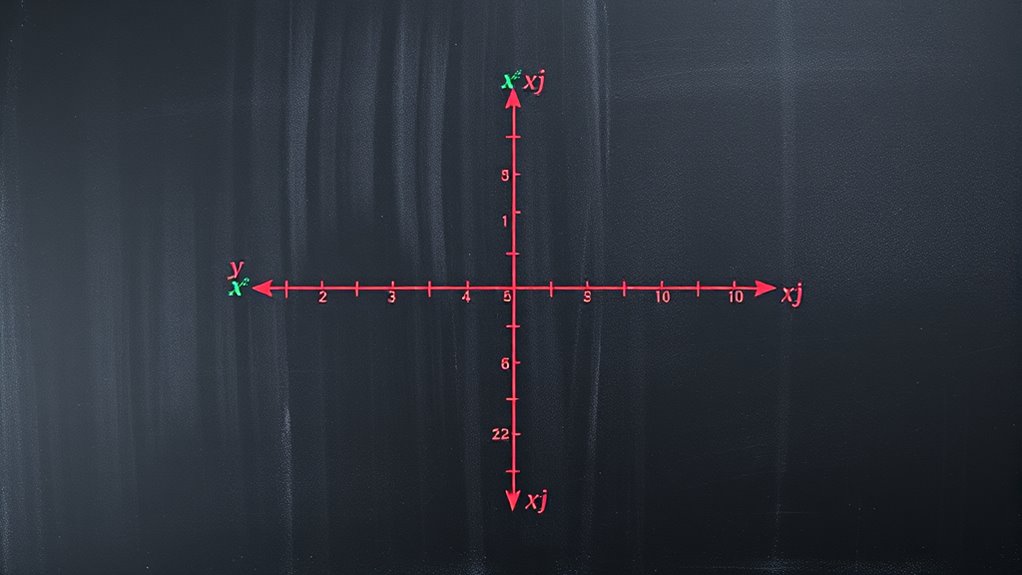
Have you ever wondered how shapes and spaces fit together in the world around you? It’s fascinating to think about how everything from city maps to game boards relies on coordinates and positions. When you start exploring the coordinate plane, you’re stepping into a system that helps you locate and understand points in space precisely. At the core of this system is the idea of plotting points, which means placing a dot at a specific location defined by an ordered pair, like (x, y). This process makes it easier to analyze shapes, distances, and relationships between different points in a two-dimensional space.
Plotting points on the coordinate plane is straightforward once you understand the axes. The horizontal line is called the x-axis, and the vertical line is the y-axis. Each point you plot is identified by its coordinates, which tell you exactly where to place it. For example, the point (3, 4) means you move three units along the x-axis and four units up along the y-axis. This simple idea forms the foundation for much of geometry, especially when you want to find the distance between two points. That’s where the distance formula comes into play. The distance formula is derived from the Pythagorean theorem and helps you calculate the straight-line distance between any two points on the plane. If you have two points, (x₁, y₁) and (x₂, y₂), you can find the distance between them by plugging their coordinates into the formula: √[(x₂ – x₁)² + (y₂ – y₁)²]. This formula is powerful because it gives you an exact measurement of how far apart two points are, whether you’re working on a math problem or mapping out a route.
Using the distance formula makes plotting points and understanding their relationships much easier. Instead of guessing or estimating distances, you can calculate them accurately. For example, if you’re trying to determine how far apart two landmarks are on a map, you can assign coordinates to each location, then apply the formula to find the exact distance. This method helps with navigation, design, and even analyzing shapes like triangles and rectangles on the plane. By mastering plotting points and the distance formula, you gain the tools to interpret the world in a precise way, turning abstract coordinates into meaningful information. Whether you’re graphing a line, solving a geometry problem, or designing a layout, understanding how to move between points and measure distances is essential. It’s a fundamental skill that opens up a whole new way of thinking about space and relationships in the world around you. Additionally, knowing how to calculate distances using the formula can improve your problem-solving skills and boost confidence in handling spatial tasks.
As an affiliate, we earn on qualifying purchases.
Frequently Asked Questions
How Do I Plot Points Accurately on the Coordinate Plane?
To plot points accurately on the coordinate plane, start by identifying the x-coordinate and y-coordinate. Use plotting techniques like marking the x-value on the horizontal axis first, then move vertically to the y-value. Carefully draw your point at the intersection of these coordinates. Double-check your work by ensuring the point lines up correctly on both axes. With practice, you’ll become confident in plotting coordinates precisely every time.
What Are the Common Mistakes Beginners Make in Graphing?
Like a medieval knight wielding a quill, you might misstep by not labeling axes clearly or plotting mislabeled points, causing confusion. Common mistakes include skipping axis labels, misreading the coordinates, or forgetting to double-check points before plotting. These errors can lead to incorrect graphs. Always double-check your labels and coordinates, and verify each point matches its proper location to avoid mistakes and create accurate, reliable graphs.
How Can I Find the Distance Between Two Points Quickly?
To find the distance between two points quickly, use the distance formula: √[(x₂ – x₁)² + (y₂ – y₁)²]. Start by subtracting the x-coordinates and y-coordinates, then square both differences. Add those squares together, and take the square root of the sum. Practice these steps to make quick calculations, so you can find distances efficiently on the coordinate plane without wasting time on complex calculations.
What Is the Significance of the Origin in Graphing?
The origin is the key reference point in the coordinate system, where the x-axis and y-axis intersect at (0,0). It helps you locate points accurately by serving as the starting point for measuring distances along the axes. When graphing, you rely on axes labels to identify coordinates relative to the origin, making it easier to understand positions and relationships between points on the plane.
How Do I Determine the Quadrant of a Point?
Ever wonder how to quickly identify a point’s quadrant? You just need to look at its coordinate signs. If both x and y are positive, it’s in quadrant I. If x is negative and y is positive, it’s in quadrant II. For negative x and y, it’s quadrant III. And if x is positive with a negative y, it’s quadrant IV. Recognizing these signs makes quadrant identification straightforward!
geometry plotting and distance tools
As an affiliate, we earn on qualifying purchases.
As an affiliate, we earn on qualifying purchases.
Conclusion
Remember, understanding the coordinate plane is fundamental to mastering geometry. As the saying goes, “A journey of a thousand miles begins with a single step.” By grasping these basics now, you’ll build a strong foundation for more complex concepts later. Keep practicing, stay curious, and don’t be afraid to explore. The more you learn, the easier it becomes to see the world through a geometric lens. Keep moving forward—you’re on the right path!
As an affiliate, we earn on qualifying purchases.
As an affiliate, we earn on qualifying purchases.
Fall Picks
fall essentials
As an affiliate, we earn on qualifying purchases.