To understand the basics of volume and surface area of solids, you need to learn how to calculate these for common shapes like cylinders and cones. For cylinders, use the formula V=πr²h for volume and 2πrh + 2πr² for surface area. Cones have a volume of (1/3)πr²h and surface area calculations involve the slant height. Mastering these formulas helps you measure and design objects accurately—keep exploring to discover more details.
Key Takeaways
- Volume of cylinders: V = πr²h; multiply base area by height for the total volume.
- Surface area of cylinders: total = 2πr² + 2πrh, including top, bottom, and lateral surfaces.
- Volume of cones: V = (1/3)πr²h; accounts for smaller volume compared to cylinders.
- Cone surface area: total = πr² + πr * l, with l as the slant height.
- Calculating both volume and surface area helps in designing, packaging, and material estimation.
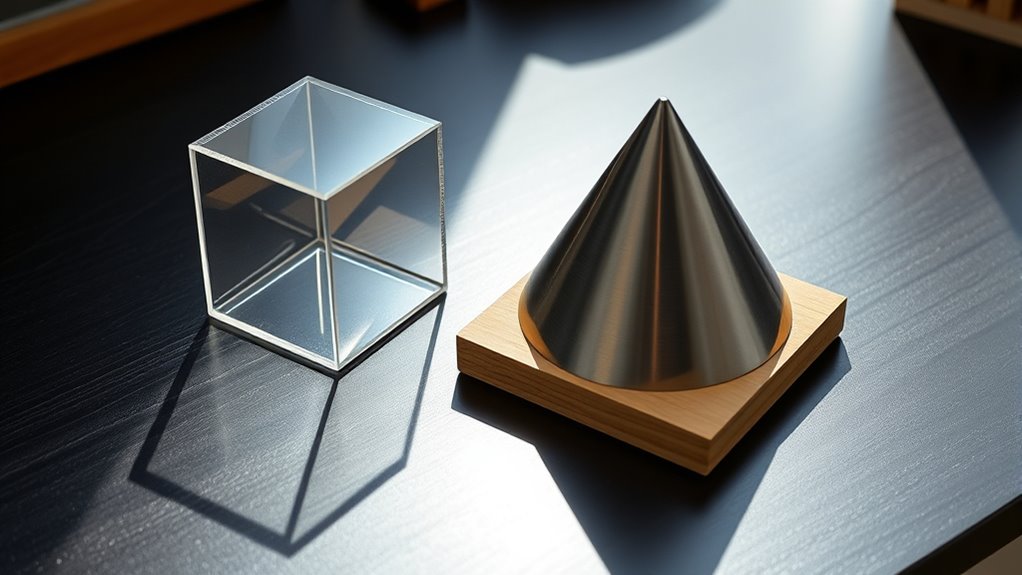
Have you ever wondered what shapes and sizes make up the world around you? Understanding basic geometry helps you grasp how objects are measured and constructed. When exploring the volume and surface area of solids, it’s vital to know how to perform cylinder calculations and apply cone formulas. These calculations are fundamental for various practical applications, from packaging to engineering. Additionally, understanding how to calculate high-quality images ensures your visuals are sharp and vibrant. Let’s start with cylinders. Imagine a can of soup or a pipe—these are perfect examples of cylinders. To find their volume, you need to know the radius of the circular base and the height of the cylinder. The formula for the volume of a cylinder is straightforward: multiply the area of the base by the height. Since the base is a circle, its area is π times the radius squared (πr²). So, the cylinder volume formula becomes V = πr²h. When performing cylinder calculations, always remember to keep your units consistent to get an accurate result. For surface area, you need to calculate both the side and the top and bottom circles. The lateral surface area is found by multiplying the circumference of the base (2πr) by the height, giving you 2πrh. To get the total surface area, add the areas of the two circular bases: 2πr², to the lateral area. This way, you understand how much material you’d need to cover the entire cylinder.
Moving on to cones, these shapes are common in everyday objects like ice cream cones or traffic cones. To find a cone’s volume, you need its radius and height. The cone formula for volume is similar to that of a cylinder but includes a division by 3: V = (1/3)πr²h. This accounts for the fact that cones have less volume than cylinders with the same base and height. Calculating the surface area of a cone involves knowing its slant height, which is the length of the inclined side. The lateral surface area formula for a cone is πr * l, where l is the slant height. To find the total surface area, add the base area (πr²) to the lateral surface area. These formulas, especially cone formulas, are vital when designing objects or understanding how materials cover different shapes.
Frequently Asked Questions
How Do I Calculate the Volume of Irregular Solids?
To calculate the volume of irregular solids, you can use volume estimation methods like water displacement. Fill a graduated container with water, note the initial level, then submerge the solid carefully. The change in water level equals the solid’s volume. This method works well for irregular shapes, giving you an accurate estimate of their volume. Just guarantee the object is fully submerged without trapping air bubbles for best results.
What Formulas Are Used for Composite Solid Shapes?
Think of composite shapes as a puzzle, where each piece is a solid. To find the volume, you add the volumes of each combined solid, using formulas like V=Bh for cylinders or V= (4/3)πr³ for spheres. For surface area, calculate each shape’s area separately and sum them up, adjusting for overlapping parts. These formulas help you solve complex, combined solids step by step.
How Does Surface Area Relate to Material Cost?
You realize that the surface area of a solid directly impacts material cost because larger surface areas require more material to cover or construct. When the surface area increases, you’ll spend more on materials like paint, metal, or wood. By calculating surface area accurately, you can better estimate expenses and avoid waste, ensuring your project stays within budget while efficiently covering the entire solid shape.
Can Volume and Surface Area Be Minimized Simultaneously?
You can’t usually minimize both volume and surface area at the same time because of optimization challenges. When designing, you’ll find that reducing surface area to cut material costs often decreases volume, which might not meet your needs. Conversely, maximizing volume can increase surface area. So, you need to balance these design considerations, prioritizing what’s most important for your specific application to find the best compromise.
What Are Common Mistakes in Calculating Surface Area?
Did you know that about 30% of students struggle with surface area misconceptions? When calculating surface area, common mistakes include forgetting to include all faces, mixing units, or misapplying formulas. These calculation errors often lead to inaccurate results. To avoid this, double-check your measurements, carefully identify each face, and make certain you’re using the correct formula for the shape. Attention to detail helps prevent these frequent errors.
Conclusion
Now that you’ve grasped the fundamentals of volume and surface area, you’ll see how these concepts bring shapes to life. Remember, understanding solids isn’t just about memorizing formulas—it’s about seeing the bigger picture. With practice, you’ll be able to tackle real-world problems with confidence. Keep your eye on the ball, and you’ll find that mastering geometry is within your reach. Don’t let this knowledge slip through your fingers; use it to build a solid foundation.