
Angles come in different types based on their measurements: acute (less than 90°), right (exactly 90°), obtuse (more than 90° but less than 180°), straight (exactly 180°), and reflex (more than 180°). To measure them accurately, you can use tools like a protractor or a compass, following proper alignment techniques. If you keep exploring, you’ll discover simple methods to identify and measure each type with ease.
Key Takeaways
- Recognize angles as acute (<90°), right (=90°), obtuse (>90° and <180°), straight (=180°), or reflex (>180°).
- Use a protractor to measure angles accurately by aligning the baseline and reading at the vertex.
- Identify right angles by checking for a perfect 90° corner or using a protractor for confirmation.
- Measure obtuse and acute angles with a protractor, noting the degree value between the sides.
- For complex angles, tools like digital angle meters or smartphone apps can provide precise measurements.
Understanding the Basic Types of Angles
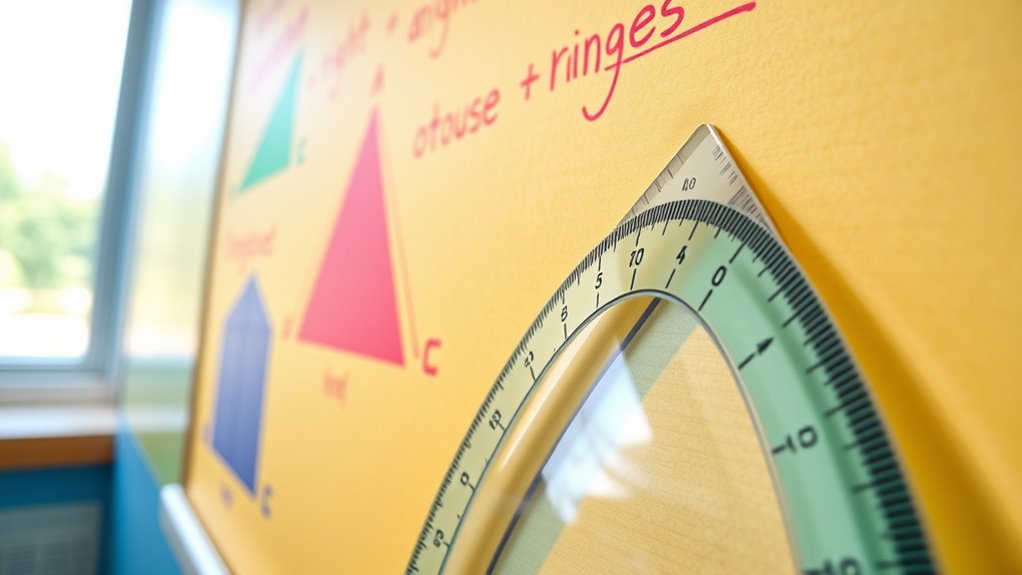
Understanding the basic types of angles is essential for grasping how angles are classified and measured. Using proper angle terminology helps you accurately describe and identify angles. You’ll learn that angles are classified by their measure, based on specific angle properties. For example, an acute angle measures less than 90 degrees, while a right angle measures exactly 90 degrees, and an obtuse angle is greater than 90 but less than 180 degrees. Recognizing these types relies on understanding the key angle properties and how they relate to their measures. Additionally, understanding the classification of angles is fundamental for analyzing geometric figures and understanding the relationships between different angles. By mastering the basic angle types, you’ll be better equipped to analyze geometric figures and understand the relationships between different angles. This foundation makes it easier to learn more advanced concepts later on.
Identifying Acute Angles

Have you ever looked at an angle and wondered whether it’s less than a right angle? If so, you’re exploring angle classification. An acute angle measures less than 90°, making it smaller than a right angle. To identify an acute angle, look for angles that are sharp and narrow. You can also use angle calculation tools like a protractor for precise measurement. Here’s a helpful table:
| Angle Type | Range of Measurement | Example Description |
|---|---|---|
| Acute | Less than 90° | Sharp, narrow angles |
| Right | Exactly 90° | Perpendicular lines |
| Obtuse | Greater than 90° | Wide, blunt angles |
| Straight | Exactly 180° | Flat, straight line |
| Reflex | More than 180° | Curved, extended angles |
Recognizing Right Angles
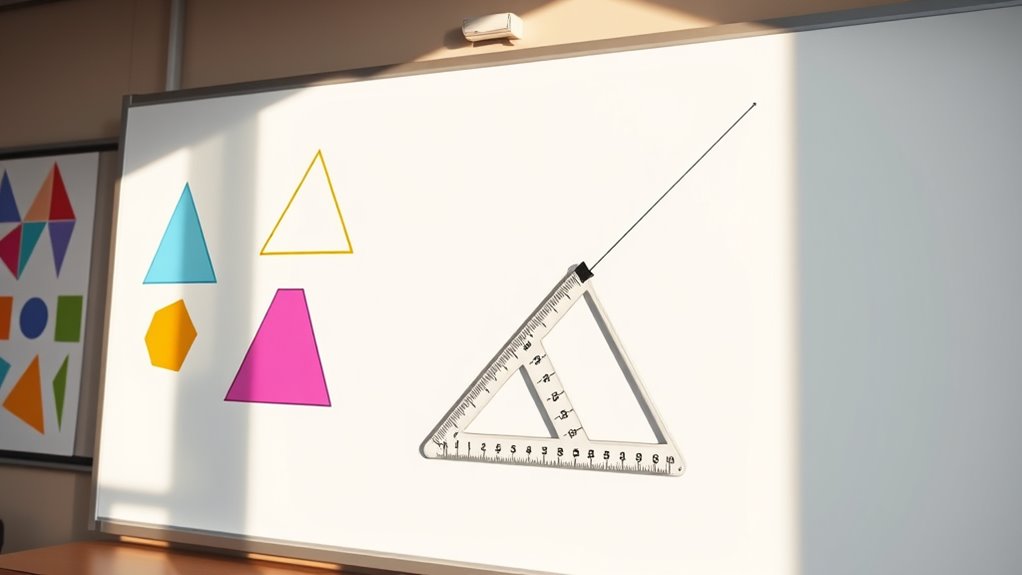
Ever wonder how to quickly spot a right angle? You can recognize one by its perfect L-shape, measuring exactly 90 degrees. To check, use a protractor or perform an angle construction with a compass and straightedge. When constructing a right angle, you can use angle bisectors to divide it into smaller, equal parts, confirming its accuracy. If the angle bisector hits the vertex and splits the angle into two equal parts, it’s a strong sign you’re dealing with a right angle. Remember, right angles are common in many structures and shapes, so practicing their recognition helps you become more confident in geometry. With these methods, distinguishing right angles becomes quick and straightforward. Additionally, understanding the properties of different angle types enhances your overall geometry skills.
Exploring Obtuse Angles
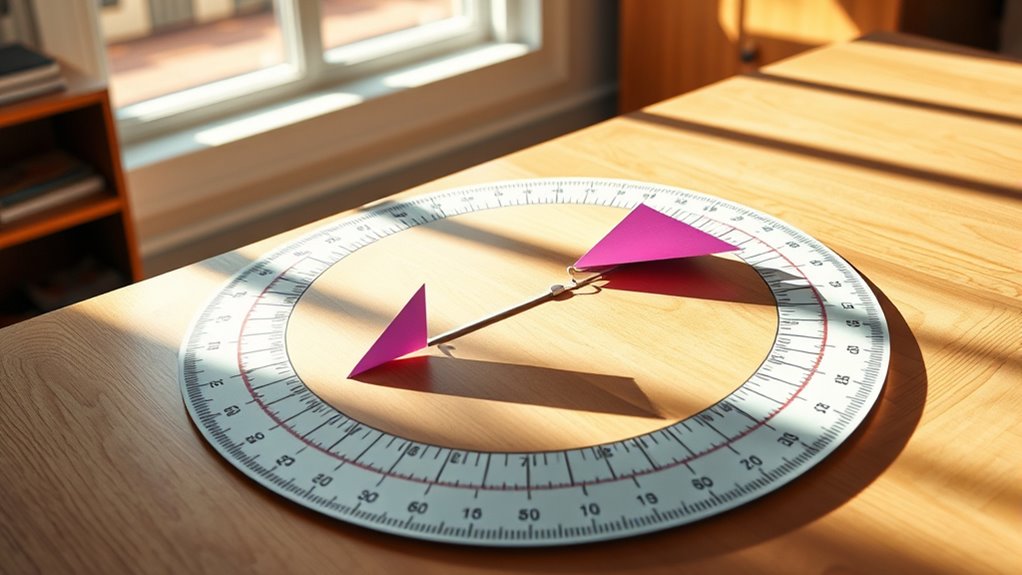
Are you curious about angles that are larger than right angles but less than a straight line? These are called obtuse angles, which measure between 90° and 180°. When exploring obtuse angles, consider how angle bisectors divide them into smaller parts, sometimes creating angles that are still obtuse or even acute. Understanding angle supplements is also helpful—two angles that add up to 180°. For example, if one angle is obtuse, its supplement will be an acute angle. Recognizing how these relationships work helps you grasp the nature of obtuse angles and see their connection to other angles. By practicing with different angles and their bisectors, you’ll develop a clearer picture of how obtuse angles behave within geometric figures. Additionally, using measuring tools can help you accurately determine the size of these angles.
Knowing Straight and Reflex Angles

Do you know what distinguishes straight angles and reflex angles from other types? In angle classification, straight angles measure exactly 180 degrees, forming a straight line, while reflex angles are greater than 180 degrees but less than 360 degrees. These angles are unique in angle terminology because they mark specific points in a full circle. Straight angles are often considered a special case of an angle, representing a straight line, whereas reflex angles describe a wide opening beyond a straight line. Recognizing these angles helps you understand the broader spectrum of angle types. Knowing how to identify straight and reflex angles also aids in solving geometric problems, especially when analyzing shapes and their internal and external angles. Additionally, understanding the concept of angle measurement can help you accurately determine the size of various angles in different scenarios.
Tools Used to Measure Angles

To accurately measure angles, you need the right tools, which vary depending on the type and size of the angle. Digital angle meters offer precise readings, perfect for larger or more complex angles. Smartphone apps are convenient, allowing you to measure angles quickly using your device’s sensors. These tools make measuring angles accessible and easy, whether you’re working on a DIY project or professional task. Additionally, understanding Bitcoin IRA concepts can help in financial planning and diversification strategies. Using these tools, you can confidently measure angles, ensuring your work is precise and reliable. Embrace modern technology to make your angle measurements effortless and accurate.
How to Measure Angles With a Protractor

Measuring angles with a protractor is a straightforward process that requires careful alignment and reading. First, place the protractor’s baseline along the straight side of the angle, ensuring the center point lines up with the vertex. Make sure the protractor is properly calibrated; if not, you may need to adjust or verify its accuracy before measuring. When reading the angle, identify whether it’s an acute, right, or obtuse angle to determine which scale (inner or outer) to use. If you need to perform angle conversion, such as from degrees to radians, do so after recording the measurement. Keep your eye level with the protractor for precise reading, and double-check your alignment for accurate results. Properly aligning the protractor is essential for reliable measurements, especially in environments where environmental factors might influence your reading.
Using a Compass to Find Angles
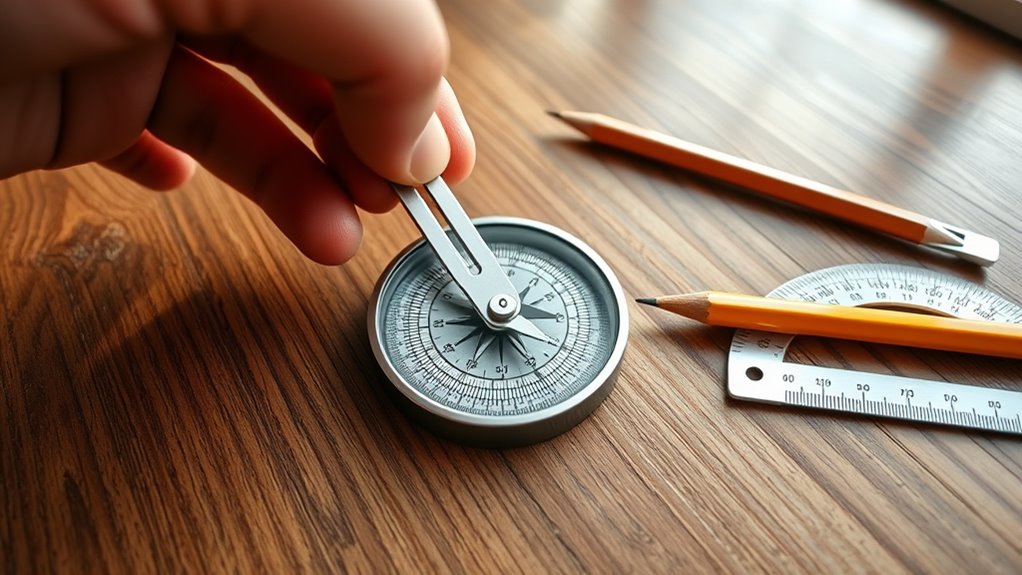
When using a compass to find angles, start by aligning the compass’s edge with the two points you’re measuring between. Make sure the needle stays steady and points to the magnetic north, so your readings are accurate. Then, read the degree mark where the compass’s base crosses the angle’s vertex to determine the measurement. Additionally, understanding holistic approaches to health and wellness can help you interpret your measurements within a broader context of personal well-being.
Aligning the Compass
Ever wondered how to accurately find an angle using a compass? Aligning your compass correctly is essential for precise magnetic orientation and determining nautical bearings. First, hold the compass flat in your hand, keeping it steady. Rotate the housing until the magnetic needle aligns with the north mark, ensuring the compass is level. Then, turn your body or the compass itself so that the desired landmark or direction lines up with the compass’s direction of travel arrow. This way, you can read the angle directly from the degree markings. Proper alignment helps you measure angles accurately, whether you’re navigating in the wilderness or at sea. Remember, consistent and careful alignment ensures your compass gives you reliable readings for all your navigation needs. Additionally, understanding regional legal resources can help if you encounter legal issues during your journey.
Reading the Degree Mark
Have you ever wondered how to precisely read the angle on your compass? Understanding how to interpret the degree mark is essential for accurate navigation. First, look at the compass needle and find where it points; this indicates your current heading. Pay attention to the angle notation, which shows degrees from 0° to 360°. To convert angles into different units, like radians, perform degree conversion as needed. Here are key points to keep in mind:
- Read the degree mark carefully to determine your exact angle.
- Understand the angle notation used on your compass.
- Use degree conversion if you need angles in radians or other units.
- Recognizing the importance of accurate navigation can enhance your confidence when exploring unfamiliar areas.
Mastering how to read the degree mark helps you navigate confidently and understand angles precisely.
Practical Examples of Angle Measurement
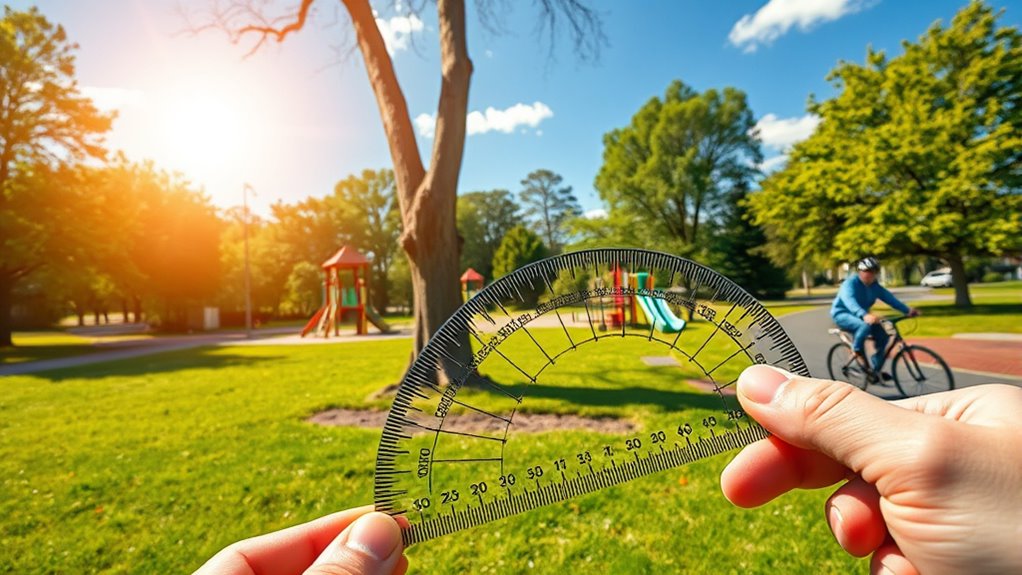
How do you apply angle measurement in everyday situations? You often rely on angle estimation, even without realizing it. For example, when you adjust a picture frame, you estimate the angle to ensure it’s straight. In real world applications, measuring angles is essential for tasks like cutting wood at specific angles or setting up furniture. You can use a protractor or even smartphone apps to measure angles accurately. These practical examples help you understand the importance of precise angle measurement in daily life. Whether you’re fixing a shelf, designing a garden, or hanging artwork, knowing how to measure and estimate angles makes your tasks easier and more accurate. Understanding these real-world applications improves your skills and confidence in practical situations. Additionally, being aware of geometric principles can enhance your ability to perform these tasks more efficiently and with greater precision.
Frequently Asked Questions
How Do Angles Relate to Geometric Shapes and Their Properties?
Angles are fundamental in understanding geometric shapes and their properties. They help you determine the angle sum, which is essential for shape classification, like triangles or quadrilaterals. When angles add up to specific totals, you can identify the shape. Recognizing these relationships allows you to analyze shapes more effectively, understanding their structure and properties. This connection between angles and shapes makes geometry easier to learn and apply confidently.
Can Angles Be Negative or Greater Than 360 Degrees?
When thinking about angle rotation, you might wonder if angles can be negative or surpass 360 degrees. Yes, angles can be negative, reflecting rotation in the opposite direction, and they can also be greater than 360 degrees, showing multiple rotations around a point. This angle negativity and rotation repetition help you understand how angles work beyond simple measurements, making your geometric grasp greater and more grand.
What Are the Real-World Applications of Measuring Angles?
You use measuring angles in real-world situations like architectural design, ensuring structures are accurate and safe. Navigation techniques also depend on angle measurements to determine directions and distances. By understanding angles, you can create precise blueprints, plan routes, and even analyze the terrain. These applications help you build better buildings, navigate efficiently, and solve practical problems where accurate angle measurement is essential.
How Do Digital Tools Assist in Angle Measurement Today?
Digital tools like digital compasses and angle sensors make measuring angles quick and accurate. You simply point the device at the objects or directions you’re interested in, and it provides precise readings instantly. These tools are handy for navigation, construction, and engineering tasks. You benefit from their ease of use, reducing errors and saving time. Whether you’re outdoors or in a workshop, digital compasses and angle sensors help you measure angles efficiently.
Are There Any Special Angles With Unique Properties or Names?
Imagine you’re designing a bridge and need precise angles. Special angles like right angles, with their unique property of forming perfect perpendicular intersections, are vital. These angles have unique properties that make construction easier and more accurate. Other examples include straight angles, which measure 180°, and reflex angles over 180°. Recognizing these special angles helps you understand their significance in geometry and real-world applications.
Conclusion
Now that you know how to identify and measure angles, imagine yourself as an artist shaping a perfect masterpiece. With each angle you measure, you add depth and dimension, like a painter blending colors. Whether you’re using a protractor or a compass, you’re shaping the world around you with precision. So, grab your tools and see angles come alive in your daily life—every turn, bend, and line waiting for your touch.