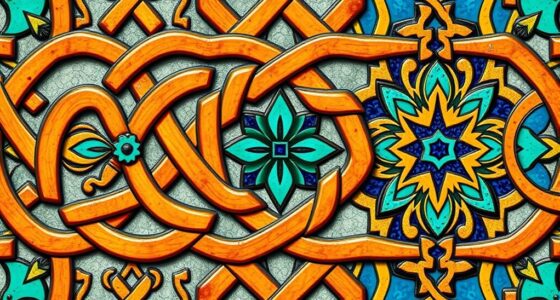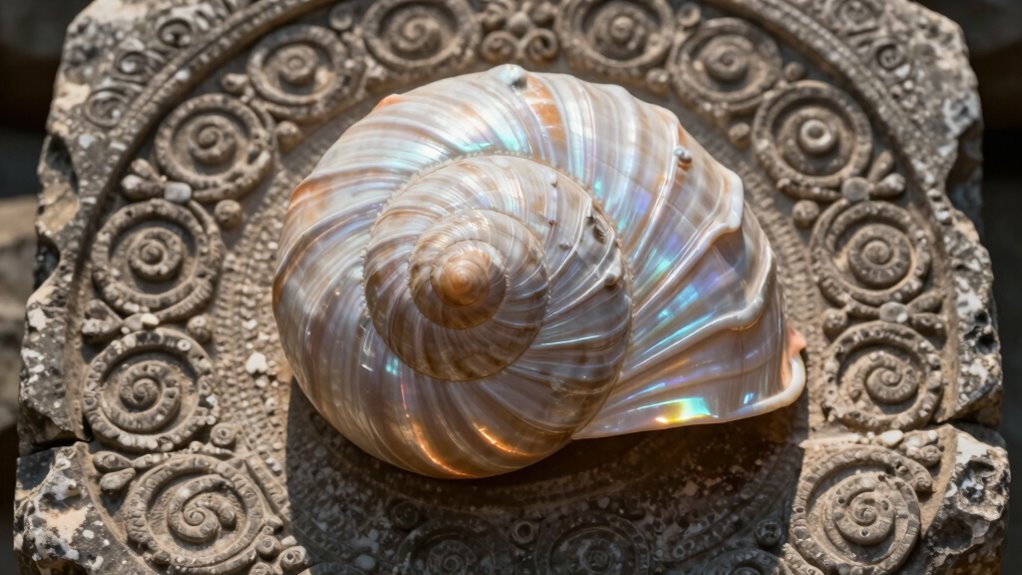

You’ll notice spirals appear in sacred, ancient, and modern visual culture because they symbolize growth, cycles, and spiritual transformation that everyone can connect with. These shapes embody universal ideas of renewal, eternity, and life’s continuous flow. From prehistoric art to contemporary design, their enduring presence shows their deep significance across different times and cultures. To understand how these shapes continue to influence us and their lasting meaning, keep exploring their fascinating history and symbolism.
Key Takeaways
- Spirals symbolize universal concepts of growth, cycles, and eternity, connecting natural phenomena with spiritual and cultural meanings.
- Their presence in ancient art reflects spiritual journeys, rebirth, and cosmic understanding across civilizations.
- Spirals serve as portals to the divine, guiding inward toward enlightenment or outward toward higher realms.
- Natural spiral patterns, like galaxies and seashells, reinforce their universal and aesthetic significance in human culture.
- The enduring symbolism of spirals adapts across cultures and eras, uniting spiritual, scientific, and artistic expressions.
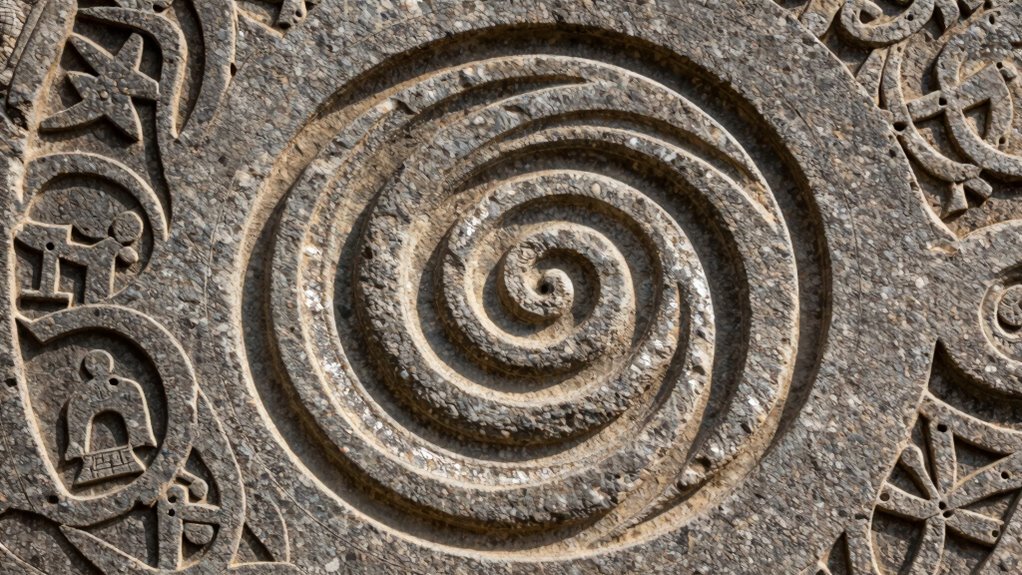
Have you ever noticed how spirals appear everywhere in visual culture, from ancient art to modern design? These graceful curves seem to resonate deeply across different eras and societies, embodying a universal language that connects the spiritual, the natural, and the artistic. The symbolism of spirals is rich and varied, often representing concepts like growth, cycles, and eternity. When you see a spiral, you might sense its connection to life’s continuous flow—an ongoing process of evolution and renewal. This symbolism isn’t just modern; it stretches back thousands of years, with ancient cultures using spirals to express their understanding of the universe and human existence.
The evolution of spiral art reflects humanity’s ongoing fascination with this shape. In prehistoric times, spiral motifs appeared in cave paintings and carvings, serving as symbols of spiritual journeys or natural forces like water and wind. As civilizations advanced, the spiral became more sophisticated, incorporating geometric precision and complex patterns. Ancient cultures such as the Celts, Greeks, and Egyptians integrated spirals into their architecture, jewelry, and sacred symbols, emphasizing their importance in spiritual and cultural contexts. These designs often represented concepts like life cycles, rebirth, or the cosmos, illustrating how deeply intertwined the spiral is with humanity’s understanding of the world. Additionally, the study of geometric patterns reveals how these designs evolved to reflect both aesthetic and symbolic purposes across different cultures. Moreover, the mathematical properties of spirals, such as the Fibonacci sequence, demonstrate how naturally pleasing and meaningful these shapes are.
In sacred art, spirals often serve as portals to the divine or as symbols of spiritual awakening. You might find spirals in sacred sites, such as megalithic monuments or religious manuscripts, where they act as visual cues guiding you inward toward enlightenment or outward toward the divine sphere. The spiral’s continuous, unbroken line mirrors the journey of the soul or the cycle of life and death, reminding you that growth often involves returning to the same point with new insight. Throughout history, the spiral has maintained its significance, adapting to different religious and philosophical ideas while retaining its core symbolism. Additionally, the spiral’s presence in natural formations like galaxies and seashells highlights its fundamental connection to the natural world and universal patterns. This enduring presence across disciplines underscores its significance as a universal symbol that bridges human understanding with the cosmos.

LZAOA Fibonacci Spiral Metal Wall Art, Math Art Fibonacci Spiral Gold Wall Decor, Metal Wall Decor for Living Room, Office, Outdoor, Indoor (12 * 12 In)
- Material: High-quality iron with double-sided finish
- Size: 12 x 12 inches
- Durability: Resistant to fading, wear, bending, and deformation
As an affiliate, we earn on qualifying purchases.
As an affiliate, we earn on qualifying purchases.
Frequently Asked Questions
How Do Spirals Influence Modern Digital Art?
Spirals influence modern digital art by harnessing fractal complexity, creating intricate, mesmerizing patterns that captivate viewers. You notice how these shapes enhance visual perception, drawing your eye deeper into the artwork. Digital artists use spirals to evoke a sense of movement and harmony, making compositions more dynamic. By incorporating fractal-inspired spirals, they tap into universal patterns that resonate on a subconscious level, enriching the overall aesthetic experience.
Are Spirals Used in Contemporary Architecture?
Yes, spirals are used in contemporary architecture. You’ll notice their influence in design elements that evoke ancient symbolism and spiritual symbolism, creating a sense of continuity and connection to history. Architects incorporate spirals to symbolize growth, cycles, and harmony, blending tradition with modern aesthetics. These shapes add visual interest and depth, making spaces feel more dynamic and meaningful, resonating with both historical significance and current design trends.
What Is the Psychological Impact of Spiral Patterns?
You might find that spiral patterns promote mindfulness meditation by drawing your focus inward, calming your cognitive perception. Some theories suggest spirals activate the brain’s reward system, encouraging relaxation and mental clarity. When you observe or engage with spirals, they can induce a hypnotic state, reducing stress and enhancing concentration. This psychological impact makes spirals powerful tools for fostering mindfulness and deepening your awareness of the present moment.
Do Spirals Have Specific Meanings in Different Cultures?
You’ll find that spirals hold specific meanings in different cultures, often symbolizing growth, transformation, or eternity. In some cultures, like Celtic traditions, they represent spiritual significance and connection to the divine. In others, such as ancient Greek or Indigenous cultures, spirals embody cycles of life and nature. These patterns serve as powerful tools of cultural symbolism, conveying deep spiritual messages that resonate across time and societies.
How Are Spirals Created in Natural Phenomena?
Imagine watching a hurricane swirl or a snail coil—these natural phenomena create spirals through fractal complexity and energy flow. As energy moves, it forms patterns that repeat at different scales, producing the elegant curves we see in nature. You can observe this in galaxies, weather systems, and seashells, where the spiral’s formation results from dynamic forces balancing growth and motion, revealing nature’s innate preference for this mesmerizing shape.

Fashtour Copper Orgone Energy Pendant – Handmade Sacred Geometry Spiral Tensor Ring Necklace for Balance & Mindfulness (Triple Infinity Tensor Necklace) (Copper005)
- Sacred Spiral Design: Handwoven copper with sacred geometry
- Orgone Energy Pendant: Channels positive energy and mindfulness
- Made from Pure Copper: High-quality, durable, lightweight copper
As an affiliate, we earn on qualifying purchases.
As an affiliate, we earn on qualifying purchases.
Conclusion
So, as you see, spirals symbolize spirituality, science, and stories across centuries and civilizations. Their mesmerizing motion mirrors life’s mysteries, making them mighty markers of meaning. By recognizing their recurring rhythms, you deepen your discovery of cultural connections and cosmic cycles. Spirals, simple yet stunning, serve as symbols that subtly stretch through time, tying together tradition with today. Embrace these enduring designs and let their endless energy inspire your own exploration of the extraordinary.

HERZWILD 180g Sea Shells Mixed Ocean Beach Seashells Tiny Natural Spiral Seashells for Home Wedding Decorations Fishtank Vase Fillers Candle Making DIY Jewelry Making
- Package Content: 180g of tiny shell beads
- Shell Size: 12-25 mm long
- Natural & Colorful: Handpicked, cleaned, vibrant shells
As an affiliate, we earn on qualifying purchases.
As an affiliate, we earn on qualifying purchases.

The Art & Science of Geometric Origami: Create Spectacular Paper Polyhedra, Waves, Spirals, Fractals and More! (More than 60 Models!)
As an affiliate, we earn on qualifying purchases.
As an affiliate, we earn on qualifying purchases.