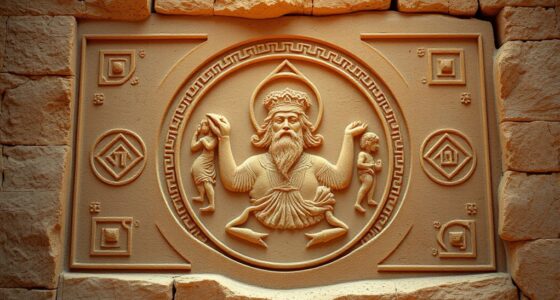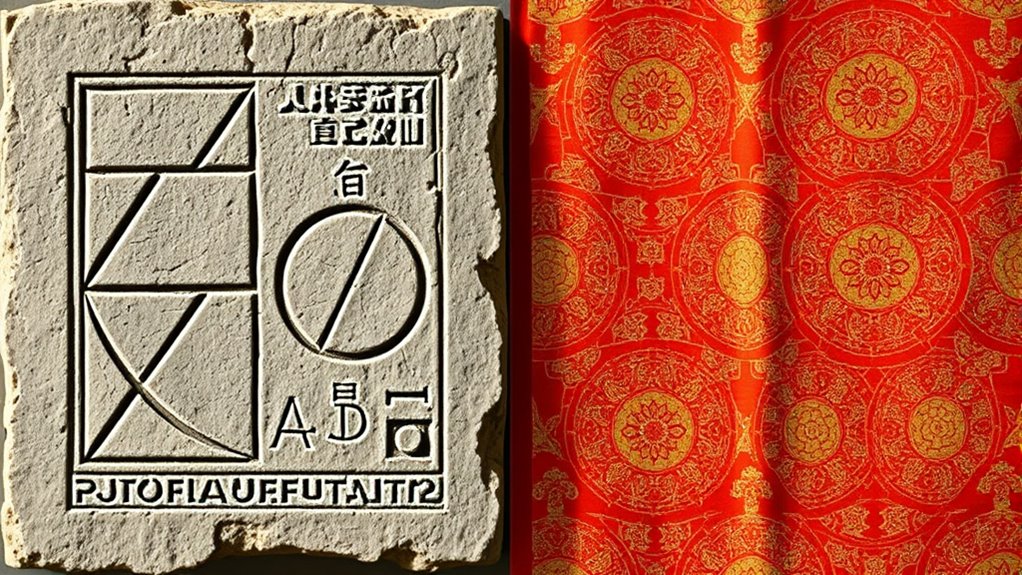

Ancient Greek and Chinese geometries reflect different cultural values through their methods and priorities. Greeks focus on formal proofs, axioms, and logical reasoning, emphasizing theory and critical thinking. Chinese geometry centers on practical applications and visual, hands-on techniques that solve real-world problems like land measurement and architecture. These approaches reveal how each culture viewed mathematics—either as an abstract discipline or a useful tool. Exploring these differences can deepen your understanding of their unique contributions.
Play games included with Prime
Start a Prime free trial and play with Amazon Luna on your devices.
As an affiliate, we earn on qualifying purchases.
Key Takeaways
- Greeks emphasized axiomatic, proof-based geometry focused on theoretical understanding, while Chinese prioritized practical, intuitive methods for everyday applications.
- Greek education centered on formal logic and deductive reasoning; Chinese methods relied on problem-solving and illustrative examples.
- Greek culture valued critical thinking and abstract reasoning; Chinese culture emphasized utility and experiential learning in geometry.
- Greeks laid the foundation for modern formal mathematics through axioms and proofs; Chinese contributed techniques for land measurement and architecture.
- Both cultures balanced theory and practice, but Greeks prioritized formal structure, whereas Chinese emphasized immediate applicability and hands-on techniques.
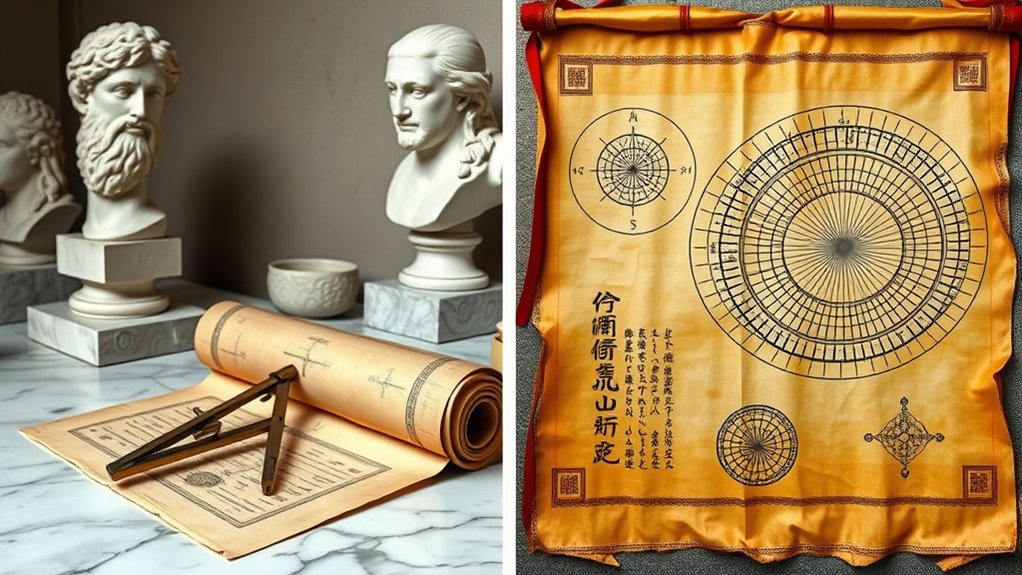
Geometry has played a crucial role in shaping ancient civilizations, and two of the most influential cultures—Greeks and Chinese—developed their own unique approaches. As you explore their methods, you’ll notice how their mathematical foundations and pedagogical approaches reflect their broader cultural values. The Greeks emphasized logical reasoning and proof-based understanding, establishing a rigorous framework that forms the core of Western mathematical tradition. Their mathematical foundations were built on axioms and deductive logic, which they used to explore properties of shapes, angles, and ratios. You might find it fascinating how figures like Euclid systematically organized geometric knowledge into extensive treatises, making complex concepts accessible through clear proofs. This emphasis on formal proof and logical structure not only advanced mathematics but also shaped educational methods, encouraging students to develop critical thinking and rigorous argumentation.
In contrast, Chinese geometry evolved with a different pedagogical approach, rooted more in practical applications and intuitive understanding. Their mathematical foundations were deeply intertwined with daily life, focusing on solving real-world problems such as land measurement, architecture, and astronomy. Instead of relying heavily on formal proofs, Chinese mathematicians used problem-solving strategies and algorithms passed down through generations. Their texts, like the “Nine Chapters on the Mathematical Art,” feature worked examples and practical exercises, aiming to develop skills that could be directly applied. This pragmatic approach influenced how geometry was taught, favoring demonstration through examples over abstract reasoning. As you study Chinese methods, you’ll notice how their focus on utility and experience encourages learners to grasp concepts through visual and hands-on techniques, fostering a different kind of mathematical intuition.
Both cultures, however, contributed substantially to the evolution of geometry by balancing theory and practice. The Greeks pushed the boundaries of abstract reasoning, creating a foundation that would influence mathematics for centuries. Meanwhile, the Chinese prioritized applicability and accessible problem-solving methods, ensuring that geometry remained an essential tool for everyday life. If you compare their pedagogical approaches, you’ll see how each culture’s values shaped their teaching and learning processes—either through the formal, proof-driven methods of the Greeks or the practical, example-based techniques of the Chinese. Additionally, the Greeks’ development of axioms and deductive logic laid the groundwork for modern formal mathematics, influencing subsequent scientific and educational advancements. Understanding these differences helps you appreciate the diverse ways humans have approached the same fundamental subject, highlighting how cultural priorities influence educational practices and mathematical understanding across civilizations.
As an affiliate, we earn on qualifying purchases.
Frequently Asked Questions
How Did Geographic Location Influence Greek and Chinese Geometric Development?
Your geographic location played a big role in shaping Greek and Chinese geometric development. Greece’s geographic isolation meant they relied on internal cultural exchange and philosophical inquiry, fostering unique mathematical ideas. In contrast, China’s central position encouraged extensive cultural exchange along trade routes like the Silk Road, which influenced their geometric advancements. This geographic influence helped each culture develop distinct mathematical approaches, reflecting their environments and connections.
Were There Any Notable Greek or Chinese Mathematicians Who Integrated Cultural Beliefs?
You’ll find that both Greek and Chinese mathematicians often integrated cultural symbolism into their work. For example, Pythagoras believed in the mystical significance of numbers, blending mathematical symbolism with spiritual beliefs. Similarly, Chinese scholars like Liu Hui used geometric principles to reflect philosophical ideas, merging cultural beliefs with mathematical concepts. These integrations show how their cultural values deeply influenced their approach to and understanding of geometry.
How Did Religious Practices Impact the Emphasis on Geometry in Both Cultures?
Religious practices deeply influenced the emphasis on geometry in both cultures. You’ll notice that religious symbolism and ritual practices often dictated how geometry was used—like in Greek temples or Chinese ancestral altars. These structures incorporated precise geometric principles to honor deities, reflect cosmic order, or facilitate spiritual rituals. Consequently, spirituality and religious symbolism played a significant role in shaping the focus and development of geometric concepts in both societies.
What Role Did Mathematics Play in Ancient Greek and Chinese Architecture?
Mathematics played a vital role in ancient Greek and Chinese architecture by guiding structural engineering and incorporating mathematical symbolism. You can see this in Greek temples, where precise ratios and proportions ensured stability and aesthetic harmony. Similarly, Chinese architecture used mathematical principles for intricate designs and durable structures, often embedding symbolic meanings. These cultures relied on mathematical understanding to create lasting, beautifully proportioned buildings that reflect their cultural values.
Did Trade Routes Influence the Exchange of Geometric Knowledge Between Greece and China?
Trade influence and cultural exchange definitely played a role in sharing geometric knowledge between Greece and China. As you follow trade routes like the Silk Road, you can see how ideas and techniques spread across regions. This exchange allowed both cultures to learn from each other’s advances, enriching their understanding of geometry and architecture. So, trade routes facilitated a significant cross-cultural transfer of mathematical concepts, shaping their development over time.
land measurement tools for architecture
As an affiliate, we earn on qualifying purchases.
As an affiliate, we earn on qualifying purchases.
Conclusion
As you reflect on the similarities and differences between Greek and Chinese geometry, it’s fascinating how history seems to weave their paths together. Coincidentally, both cultures valued harmony and order, yet approached geometry through different lenses—one through rigorous proof, the other through practical application. You realize that, despite their separate journeys, their shared curiosity about shapes and space reveals a universal human desire to understand the world. It’s as if geometry itself connects us across time and culture.
Chinese math problem-solving books
As an affiliate, we earn on qualifying purchases.
As an affiliate, we earn on qualifying purchases.
Euclidean geometry educational kit
As an affiliate, we earn on qualifying purchases.
As an affiliate, we earn on qualifying purchases.
Fall yard work Picks
leaf blowers
As an affiliate, we earn on qualifying purchases.