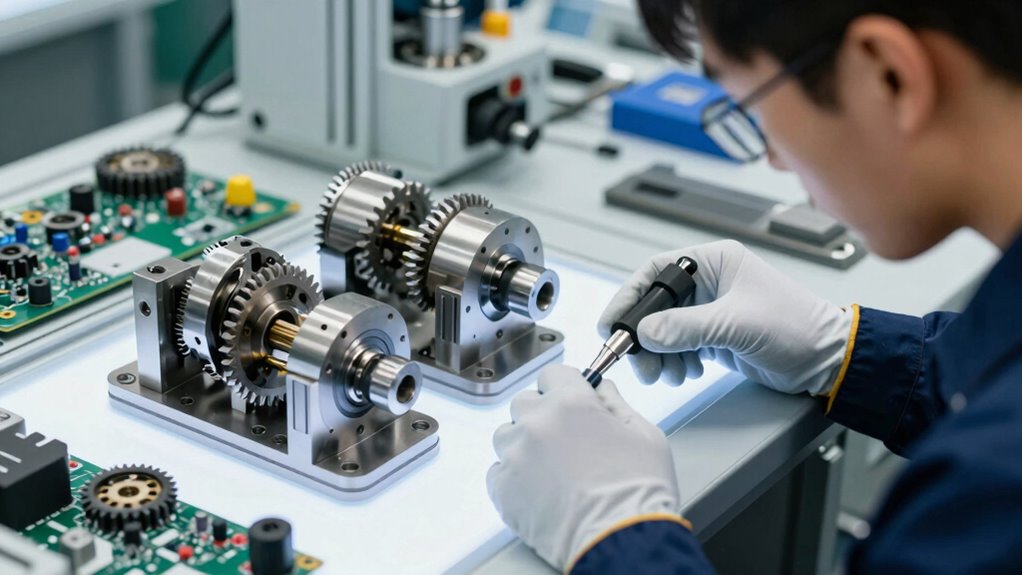

As a manufacturing technician, your role now demands sharper spatial reasoning skills than ever before. You must visualize complex assemblies, navigate intricate machinery, and adapt quickly to ergonomic layouts. Digital tools like augmented reality overlay precise schematics, requiring you to interpret digital and physical environments seamlessly. Developing these skills helps you work accurately, stay safe, and improve efficiency amid evolving technology. Keep exploring further to discover how mastering spatial reasoning can boost your capabilities even more.
Key Takeaways
- Complex machinery integration demands precise mental visualization of part placement and movement.
- AR technology overlays digital schematics, requiring accurate spatial mapping for effective use.
- Ergonomic workspace designs necessitate quick judgment of distances and spatial relationships for safety.
- Advanced tools and digital systems require refined mental models for efficient operation and troubleshooting.
- Continuous technological evolution demands ongoing spatial skills to adapt and optimize manufacturing workflows.
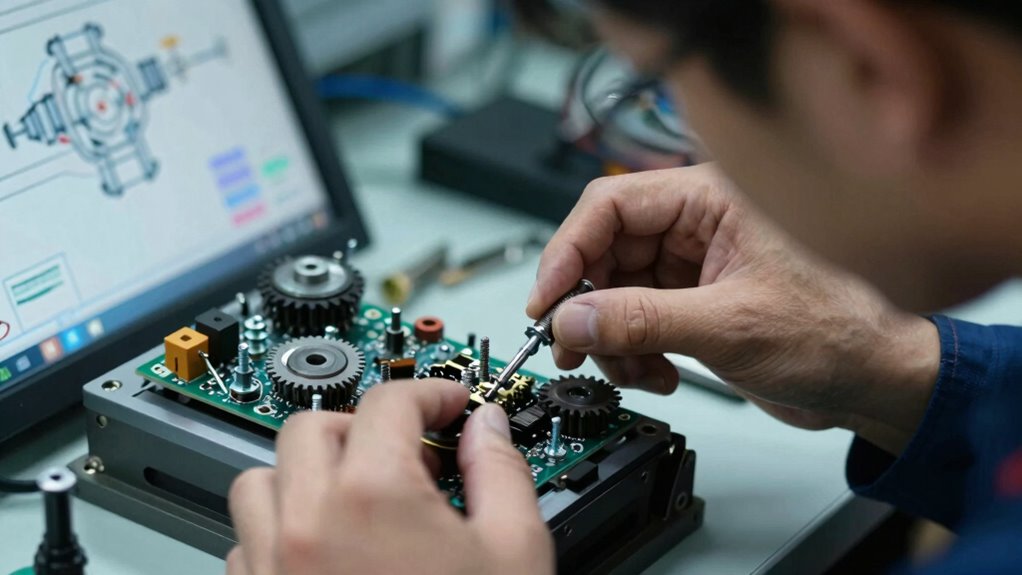
Manufacturing technicians rely heavily on spatial reasoning skills to perform their tasks efficiently. As technology advances, your ability to visualize how parts fit together, navigate complex machinery, and troubleshoot issues becomes more essential. Today, tools like augmented reality are transforming how you interpret and interact with your workspace. With AR glasses or headsets, you can see digital overlays of schematics directly on physical components, making it easier to identify correct placement or detect errors in real time. This immersive technology reduces the need to constantly switch between manuals and physical parts, streamlining your workflow. As a result, your spatial reasoning isn’t just about mental visualization anymore; it’s about interacting with a blended digital-physical environment that demands quick, accurate mental mapping.
AR technology enhances spatial reasoning by overlaying digital schematics directly onto physical parts, streamlining workflows and improving accuracy.
Furthermore, ergonomic design is shaping how you approach your daily tasks. Modern manufacturing setups prioritize your comfort and efficiency, but they also require you to adapt your spatial understanding of the workspace. When workstations are designed with ergonomics in mind, you may need to reach, bend, or maneuver in ways that challenge your spatial awareness. You have to quickly judge distances, angles, and spatial relationships to perform tasks safely and effectively. These ergonomic considerations force you to refine your mental models of your environment, especially as equipment and tools become more sophisticated. Incorporating spatial awareness training can further enhance your ability to navigate complex environments safely and efficiently. Staying updated on emerging manufacturing technologies can help you adapt your skills to evolving systems and tools. Additionally, understanding digital tools used in modern manufacturing can improve your overall spatial competence and operational efficiency.
augmented reality glasses for manufacturing
As an affiliate, we earn on qualifying purchases.
As an affiliate, we earn on qualifying purchases.
Frequently Asked Questions
How Can Technicians Improve Their Spatial Reasoning Skills Quickly?
To improve your spatial reasoning skills quickly, try practicing visualization techniques regularly. Picture objects in your mind and manipulate them mentally, focusing on mental rotation exercises. These activities help your brain understand how objects change in space. You can also use 3D models or virtual simulations to enhance your skills. Consistent practice with these techniques boosts your ability to interpret spatial information efficiently, making you a more effective manufacturing technician.
What Tools Assist in Enhancing Spatial Understanding in Manufacturing?
You can enhance your spatial understanding in manufacturing with tools like augmented reality and 3D modeling. Augmented reality overlays digital information onto real-world views, helping you visualize complex parts and assemblies in real time. 3D modeling allows you to manipulate and explore virtual prototypes, improving your grasp of spatial relationships. These tools make it easier to understand designs, troubleshoot issues, and improve precision, ultimately boosting your efficiency on the shop floor.
Are There Specific Training Programs for Developing Spatial Skills?
Think of your mind as a sculptor shaping a masterpiece—specific training programs sharpen your spatial visualization and mental mapping skills. These programs often include virtual reality exercises, simulation-based workshops, and hands-on projects that challenge you to see structures in three dimensions. By engaging in these targeted activities, you strengthen your ability to mentally navigate complex machinery and layouts, making you more precise and confident on the manufacturing floor.
How Does Spatial Reasoning Impact Safety in Manufacturing Environments?
Your spatial reasoning skills directly impact safety by enhancing hazard detection and adherence to safety protocols. When you can visualize machinery, pathways, and potential obstacles accurately, you’re less likely to make mistakes that lead to accidents. Improved spatial awareness helps you anticipate risks, navigate complex environments confidently, and respond quickly to hazards, ultimately creating a safer workplace for everyone. Better spatial reasoning is essential for maintaining safety standards in manufacturing.
Can Virtual Reality Be Used for Spatial Skill Development?
Virtual immersion can be a powerful tool for developing your spatial skills through skill simulation. It allows you to practice complex tasks in a safe, controlled environment, sharpening your understanding of spatial relationships. With immersive experiences, you can visualize and manipulate objects in three dimensions, enhancing your ability to navigate real-world manufacturing challenges. This innovative approach helps you build confidence and precision, making you more effective and safer on the job.
digital schematics overlay headset
As an affiliate, we earn on qualifying purchases.
As an affiliate, we earn on qualifying purchases.
Conclusion
As a manufacturing technician, your spatial reasoning is the compass guiding you through complex tasks, turning chaos into order. Think of it as a lighthouse illuminating the path amid foggy uncertainties, helping you navigate intricate machinery and precision demands. Strengthening this skill isn’t just about efficiency; it’s about safeguarding your craft and future. Embrace this mental lighthouse—your beacon of clarity—so you can confidently steer through any challenge that comes your way.
3D visualization tools for technicians
As an affiliate, we earn on qualifying purchases.
As an affiliate, we earn on qualifying purchases.
spatial reasoning training software
As an affiliate, we earn on qualifying purchases.
As an affiliate, we earn on qualifying purchases.