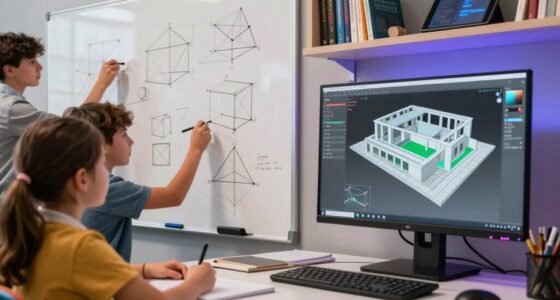
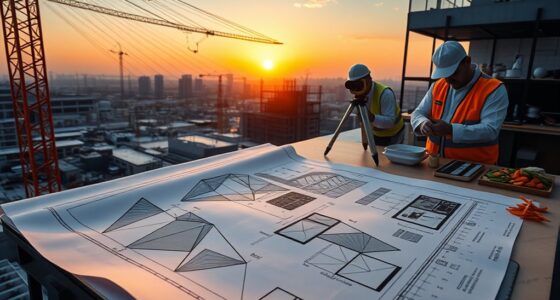
In your architecture career, mastering spatial reasoning, symmetry, and proportion is vital for designing functional and visually appealing buildings. Precise measurement skills guarantee your plans are accurate, while strong spatial visualization helps you communicate complex ideas effectively. These geometric skills enable you to create innovative structures that are safe and aesthetically balanced. Developing these abilities will open many design possibilities and support your success—continue exploring, and you’ll discover how to elevate your skills even further.

Prime made for students and young adults
- Fast, free delivery for dorm and study essentials
- Prime Video and Amazon Music included
- Member-only deals
Key Takeaways
- Spatial reasoning to visualize and manipulate three-dimensional structures effectively.
- Proficiency in symmetry and proportion to create balanced and harmonious designs.
- Accurate measurement skills for precise construction and detailed plans.
- Ability to analyze and apply geometric patterns inspired by historical and cultural influences.
- Competence in using CAD and other software for complex geometric modeling and innovation.
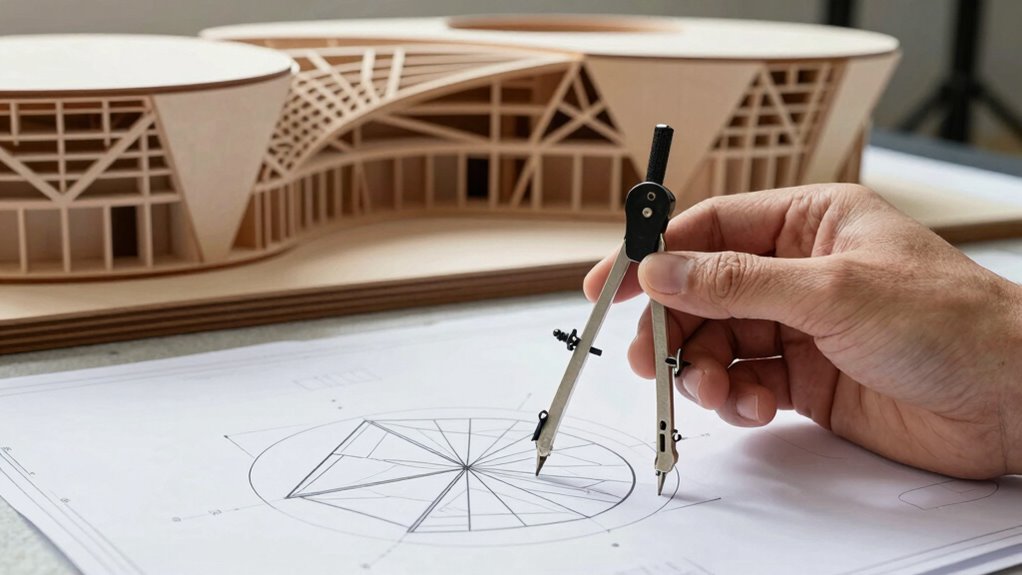
Have you ever wondered how architects create buildings that are both functional and visually stunning? A lot of it comes down to your understanding of geometry skills. Geometry isn’t just about shapes and angles; it’s the foundation that allows you to design structures that are safe, efficient, and mesmerizing. When you develop strong geometric skills, you can translate complex ideas into workable plans, ensuring your designs are both innovative and practical. These skills become even more essential when you consider the historical influences that have shaped architecture over centuries. From the precise proportions of ancient Greek temples to the intricate geometric patterns in Islamic architecture, historical influences teach you how geometry has been used to evoke harmony, balance, and spiritual symbolism. By studying these patterns, you gain insight into how geometric principles can imbue your designs with cultural significance and aesthetic appeal. This historical perspective enriches your understanding and helps you incorporate timeless elements into modern applications. Today’s architects leverage these classical concepts in contemporary contexts, blending tradition with innovation. Modern applications of geometry in architecture include complex curves, parametric designs, and innovative structural systems that push the boundaries of what’s possible. You might find yourself working with computer-aided design (CAD) software that allows for precise manipulation of geometric forms, enabling the creation of organic shapes or highly efficient spatial layouts. Mastering skills like spatial reasoning, symmetry, and proportion will help you craft buildings that not only stand out visually but also function seamlessly for their intended purpose. Whether designing a sleek skyscraper or an environmentally friendly public space, your ability to apply geometric principles ensures structural integrity and aesthetic coherence. More importantly, these skills help you communicate your ideas clearly to clients, engineers, and construction teams, making sure everyone’s on the same page. As you progress in your architecture career, you’ll see how foundational geometric skills serve as a bridge between the artistic and engineering aspects of your work. From understanding the historical influences that inform design traditions to utilizing modern applications that solve complex structural challenges, geometry remains at the core of great architecture. So, honing your skills in areas like measurement, symmetry, and spatial visualization isn’t just about passing exams — it’s about building a versatile toolkit that supports innovative, functional, and visually compelling structures throughout your career.
CAD software for architectural design
As an affiliate, we earn on qualifying purchases.
As an affiliate, we earn on qualifying purchases.
Frequently Asked Questions
How Do Geometry Skills Influence Architectural Creativity?
Your geometry skills directly influence your architectural creativity by enabling you to explore design innovation and achieve aesthetic harmony. When you understand geometric principles, you can experiment with complex shapes and structures, pushing boundaries beyond conventional forms. This mastery allows you to craft visually striking, functional spaces that resonate with harmony and balance, fostering creative expression. Strong geometry skills empower you to transform bold ideas into impressive, innovative architectural masterpieces.
What Advanced Geometry Concepts Are Essential for Modern Architecture?
You’ll find that understanding Euclidean principles and symmetry analysis are essential for modern architecture. These advanced geometry concepts help you create balanced, innovative designs with precise structural harmony. Euclidean geometry guides your measurements and spatial reasoning, while symmetry analysis allows you to craft visually appealing, functional spaces. Mastering these skills enables you to push design boundaries while maintaining stability and elegance, making your architectural visions both groundbreaking and practical.
Can Geometry Skills Improve Collaboration With Engineers and Designers?
Yes, geometry skills can considerably improve your collaboration with engineers and designers. By understanding concepts like structural integrity and material efficiency, you can communicate more effectively, ensuring designs are both safe and optimized. Precise geometric calculations help identify potential issues early, making teamwork smoother. Your ability to analyze and share geometric insights fosters better coordination, leading to innovative, durable structures that meet project goals efficiently.
How Do Geometry Skills Impact Architectural Project Cost Estimation?
Your geometry skills directly influence architectural project cost estimation by enhancing structural analysis and material optimization. With strong geometry, you accurately assess load-bearing capacities, which helps avoid over- or under-designing structures. This precision minimizes material waste and reduces costs. By understanding complex shapes and spatial relationships, you streamline construction processes, ensuring efficient use of resources. Ultimately, solid geometry skills help you deliver cost-effective projects without compromising structural integrity or aesthetic quality.
Are Geometry Skills More Important Than Other Technical Skills in Architecture?
Is geometry more important than other technical skills? Think of it as the backbone of architectural history—fundamental yet interconnected. Your understanding of geometry shapes your ability to design structurally sound, aesthetically pleasing buildings. While other skills like engineering or material science are vital, without a solid grasp of geometry, your designs risk losing clarity and coherence. Ultimately, all technical skills work together, but geometry provides the essential foundation.
As an affiliate, we earn on qualifying purchases.
Conclusion
Think of geometry skills as the compass guiding your architectural journey. Just like a sailor relies on a compass to navigate uncharted waters, your understanding of shapes, angles, and spatial relationships steers you through complex designs and innovative structures. Mastering these skills keeps you on course, turning abstract ideas into tangible masterpieces. Embrace geometry as your trusted navigator, and watch your architectural dreams unfold with confidence and precision.
geometric pattern stencils for architects
As an affiliate, we earn on qualifying purchases.
As an affiliate, we earn on qualifying purchases.
As an affiliate, we earn on qualifying purchases.
Fall Picks
fall essentials
As an affiliate, we earn on qualifying purchases.