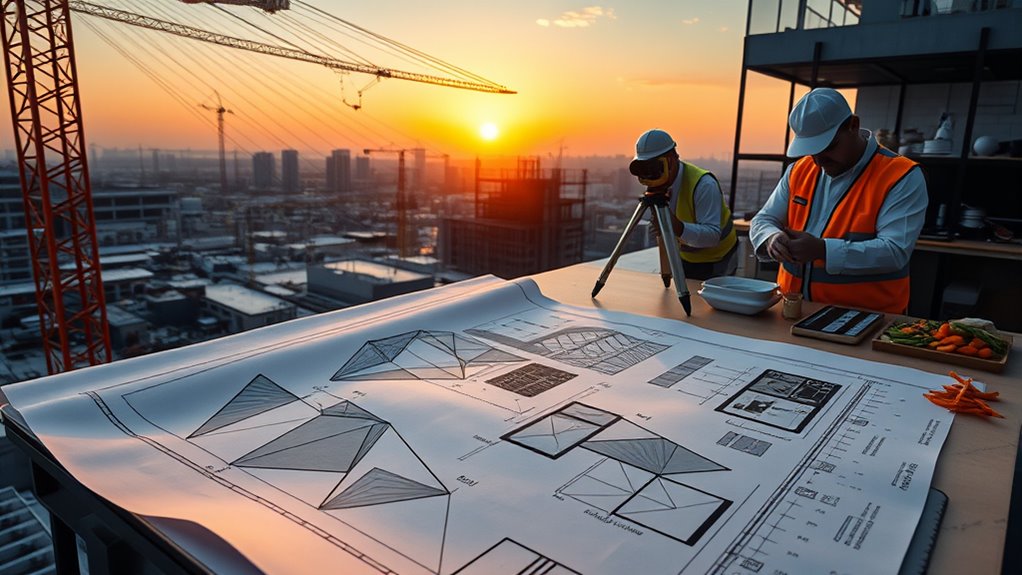

If you pursue careers like architecture, engineering, graphic design, interior design, or virtual environment development, you’ll rely daily on geometry. You’ll use it to create accurate blueprints, ensure structural integrity, design balanced visuals, optimize space, and program immersive virtual worlds. Mastering geometric concepts helps you solve real-world problems and craft aesthetically pleasing, functional environments. Keep exploring to discover more about how these professions depend on geometry in everyday work.
Key Takeaways
- Architects rely on geometry for precise blueprints, structural calculations, and visualizing 3D spaces in 2D drawings.
- Engineers use geometric principles to design supports, components, and optimize spatial relationships for safety and efficiency.
- Graphic designers apply geometry to create balanced compositions, symmetry, and perspective in visual artwork and branding.
- Interior designers utilize geometric measurements and spatial reasoning to maximize space and ensure harmonious layouts.
- Virtual environment developers leverage geometry for 3D modeling, realistic interactions, and immersive digital experiences.

Geometry is a foundational skill that plays a crucial role in many careers you might not expect. Whether you’re designing buildings, creating visual art, or solving complex problems, understanding geometric principles helps you turn ideas into tangible results. One of the most prominent fields where geometry is essential is architectural design. When you work in architecture, you use geometry daily to develop accurate blueprints, calculate structural integrity, and ensure that buildings are both functional and aesthetically pleasing. You sketch out plans that require precise measurements, angles, and spatial reasoning. Without a solid grasp of geometric concepts, creating balanced and safe structures becomes a challenge. Your ability to visualize three-dimensional spaces and translate them into two-dimensional drawings is fundamental, making geometry the backbone of your creative and technical process in architecture.
Similarly, if you’re involved in graphic illustration, geometry becomes a powerful tool to shape your art. You use geometric principles to construct balanced compositions, create symmetry, and develop perspective. When designing logos, icons, or digital artwork, understanding shapes, proportions, and spatial relationships allows you to craft visuals that are harmonious and eye-catching. You manipulate lines, angles, and curves to produce clean, precise images that communicate your message effectively. Geometry helps you understand how different elements relate to each other within a design, enabling you to create compelling visuals with accuracy and clarity. Whether you’re scaling images or aligning components, your grasp of geometric concepts ensures your work is both visually appealing and structurally sound. Mastery of foundational geometric concepts is crucial for advancing in these fields.
In addition to architecture and graphic illustration, geometry is vital in fields like engineering, interior design, and even game development. You might be calculating the angles needed for structural supports, designing interior layouts that maximize space, or programming virtual environments that require spatial awareness. Every day, you leverage geometric reasoning to make informed decisions, optimize designs, and bring ideas to life. The skills you develop in understanding shapes, measurements, and spatial relationships not only enhance your technical proficiency but also improve your problem-solving abilities. As you gain experience, you’ll recognize how integral geometry is to transforming abstract concepts into real-world applications, making it an indispensable part of many innovative careers.
Frequently Asked Questions
How Can I Improve My Geometry Skills for These Careers?
To improve your geometry skills for these careers, focus on solving geometry puzzles regularly to sharpen your problem-solving abilities. Practice spatial visualization by imagining and manipulating shapes mentally, which helps in understanding complex concepts. Use online resources, apps, or textbooks to challenge yourself with real-world problems. Consistent practice keeps your skills sharp, boosts confidence, and prepares you to apply geometry effectively in your chosen field.
Are There Online Courses Specific to Geometry Applications in These Fields?
Did you know that over 60% of professionals in engineering and architecture use geometry daily? You can find online resources and certification programs tailored to these fields. Many platforms offer specialized courses that focus on applying geometry in real-world scenarios. These online courses help sharpen your skills and boost your confidence, making you more competitive in your career. Enrolling in these programs is a practical step toward mastering geometry for your chosen field.
Do These Careers Require Advanced Degrees or Certifications?
Many careers that use geometry require advanced qualifications or certification requirements. You might need a bachelor’s degree or even a master’s for specialized roles, especially in engineering or architecture. Certifications can also boost your credentials and job prospects, like becoming a licensed engineer or certified surveyor. You should check specific industry standards, but generally, pursuing advanced qualifications helps you excel and stay competitive in these fields.
What Are the Typical Daily Tasks Involving Geometry in These Jobs?
In these jobs, you’ll use geometry daily for practical design and spatial reasoning. You measure angles, calculate dimensions, and create precise plans or models. Whether you’re designing structures, analyzing blueprints, or optimizing layouts, geometry helps you visualize and solve real-world problems. Your ability to understand spatial relationships guarantees accuracy and efficiency, making geometry an essential skill for smooth, effective work in these careers.
How Does Geometry Influence Decision-Making in These Professions?
You’re really on the ball when it comes to decision-making because geometry sharpens your spatial reasoning and problem-solving skills. These tools help you visualize options, weigh pros and cons, and foresee potential issues. With geometry, you can think outside the box and make informed choices quickly. It’s like having a secret weapon that guides you through complex situations, ensuring you choose the best path forward.
Conclusion
Now that you know how essential geometry is, consider this: over 70% of architects and engineers use geometry daily to design structures and solve complex problems. Whether you’re planning a building or creating a video game, understanding geometry can open doors to exciting careers. So, if you love math and creativity, exploring these careers might just be your perfect fit. Embrace geometry—it’s the foundation of many amazing professions!