

Geometry in robotics helps you navigate and map the world by analyzing shapes, distances, and trajectories in real-time. It interprets sensor data from lasers, cameras, and ultrasonic devices to create geometric maps of surroundings. Using these calculations, you can identify obstacles, plan smooth routes, and adapt to new terrain. This mathematical foundation makes autonomous exploration safer and more efficient, and in the following, you’ll discover how these geometric principles work together to enhance robotic navigation.
Key Takeaways
- Geometry enables robots to interpret sensor data for obstacle detection and environment mapping.
- It facilitates path planning by calculating distances, angles, and trajectories for safe navigation.
- Geometric algorithms help update internal maps dynamically, adapting to new obstacles and terrain changes.
- Spatial analysis of obstacle shapes and positions allows for collision-free movement and environment understanding.
- Geometry provides a structured language for robots to communicate environmental information and make autonomous decisions.
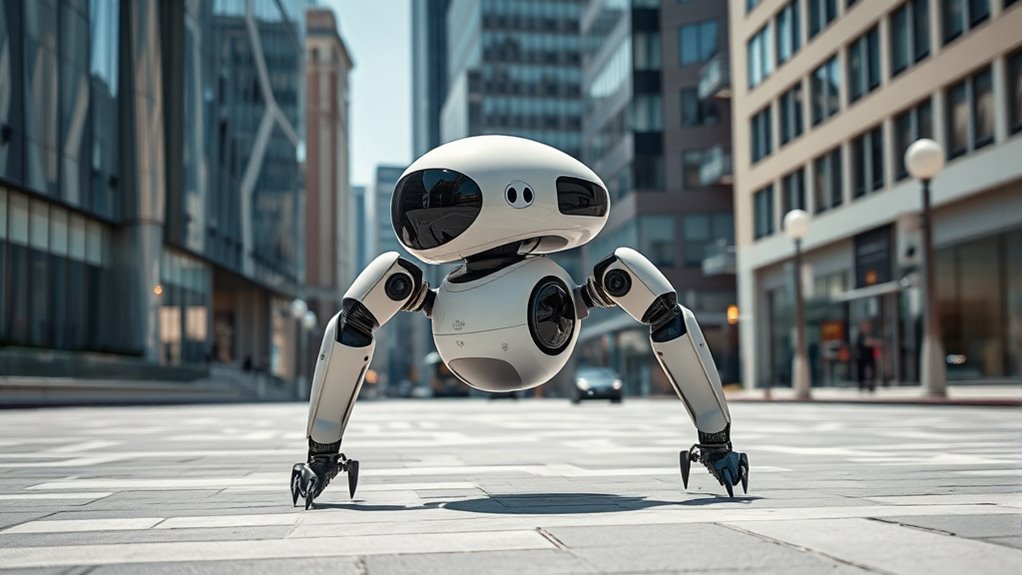
Have you ever wondered how robots move so precisely and effectively? The answer lies in the fascinating world of geometry, which provides the foundation for navigation and mapping in robotics. At the core of this is path planning—an essential process that helps robots determine the best route from one point to another. Using geometric algorithms, robots analyze their environment to plot smooth, efficient paths, avoiding unnecessary detours or hazards. Path planning involves calculating distances, angles, and trajectories, often in real-time, to adapt to changing conditions. It guarantees that robots can reach their destinations quickly and safely, whether they’re navigating a warehouse or exploring unfamiliar terrain. Storage in a cool, dark place can prolong shelf life and help maintain the integrity of the stored items.
Path planning uses geometric algorithms to help robots find safe, efficient routes in dynamic environments.
But before a robot can confidently follow a planned route, it needs to detect obstacles in its environment. Obstacle detection relies heavily on geometric principles to interpret data gathered from sensors like lasers, cameras, or ultrasonic devices. These sensors create a geometric map of the surroundings, identifying objects, walls, or other barriers that could impede movement. By analyzing the shapes, sizes, and positions of these obstacles, the robot can determine safe pathways to traverse. Geometric algorithms help the robot understand the spatial relationships between objects, allowing it to avoid collisions and adjust its trajectory dynamically.
Together, path planning and obstacle detection form a seamless loop that keeps robots moving efficiently and safely. As the robot gathers data from its sensors, geometric calculations help it update its internal map, refining its understanding of the environment. This continuous process enables robots to adapt to new obstacles or changes in terrain, making their navigation more resilient. The geometric approach also assists in mapping unfamiliar areas, allowing robots to build detailed representations of their surroundings, which can be used for future navigation or analysis. Recognizing the importance of accurate measurements, many robotic systems incorporate calibration techniques to improve sensor accuracy and reliability.
In essence, geometry acts as the language that robots speak to interpret and steer the world. It transforms raw sensor data into meaningful spatial information, empowering robots to make precise decisions. Whether it’s plotting a collision-free path or recognizing obstacles, geometric principles provide clarity and structure. By harnessing these concepts, robots become more autonomous, capable of exploring complex environments with minimal human intervention. So next time you see a robot move smoothly through a cluttered space, remember the powerful role that geometry plays behind the scenes, guiding its every move with mathematical precision.
Frequently Asked Questions
How Does Geometry Improve Robot Obstacle Avoidance?
Geometry improves your robot’s obstacle avoidance by providing precise spatial understanding. Using sensor fusion, it combines data from multiple sensors to create accurate maps of the environment. This enables effective path planning, allowing your robot to navigate around obstacles smoothly. By understanding shapes, distances, and angles, geometry helps your robot predict and react to obstacles quickly, ensuring safer and more efficient movement in complex environments.
What Are the Latest Geometric Algorithms Used in Robotics?
You’ll find that the latest geometric algorithms in robotics rely heavily on sensor fusion and advanced motion planning. Techniques like probabilistic roadmaps (PRMs) and rapidly-exploring random trees (RRTs) help your robot navigate complex environments efficiently. By combining sensor data with geometric computations, these algorithms enable precise, real-time mapping and obstacle avoidance, making your robot smarter and more adaptable in dynamic, unpredictable settings.
How Do Robots Interpret 3D Spatial Data?
Imagine you’re exploring a dark room with a flashlight; you interpret spatial data by combining signals from various sensors through sensor fusion. Robots do the same, using laser scanners and cameras to create a detailed point cloud. They then process this data with algorithms that interpret the 3D structure, helping them understand their environment. This active interpretation enables robots to navigate safely and make informed decisions.
Can Geometry Help Robots Navigate Dynamic Environments?
Yes, geometry can definitely help you navigate dynamic environments. By using coordinate systems, you can precisely locate objects and obstacles in real-time. Geometric modeling allows you to create accurate maps of your surroundings, even as they change. This helps you adapt your path quickly, avoid collisions, and reach your destination efficiently, making your navigation smarter and more reliable in constantly evolving situations.
What Role Does Topology Play in Robotic Mapping?
You might be surprised to learn that over 60% of robotic mapping systems rely heavily on topology. Topology plays a vital role in maintaining topological consistency and understanding spatial connectivity within a robot’s environment. It helps robots create simplified, yet accurate, representations of complex spaces, enabling efficient navigation. By focusing on how spaces connect rather than exact measurements, topology makes robotic mapping more adaptable and robust in dynamic, unpredictable environments.
Conclusion
So, next time you think about robots maneuvering complex environments, remember how vital geometry is. It helps them understand the world, avoid obstacles, and create accurate maps. Without geometry, their movements would be random and inefficient. Isn’t it fascinating how mathematical principles shape the way robots see and move through our world? By mastering geometry, you’re opening the potential for smarter, more capable robots that can seamlessly integrate into everyday life.