
To master high school geometry, you need to understand key concepts like angle relationships, triangle properties, and the characteristics of polygons and circles. Knowing how complementary, supplementary, and vertical angles work helps solve many problems, while recognizing triangle types and their angle sums is essential. Grasping polygon angles and circle theorems builds a strong foundation. Keep exploring these ideas, and you’ll gain the skills to handle even the most challenging geometry questions with confidence.
Key Takeaways
- Understand and apply fundamental angle relationships, such as complementary, supplementary, vertical, and corresponding angles.
- Master geometric proofs by logically connecting properties like angle relationships and parallel line theorems.
- Learn triangle properties, including angle sums and classifications, to solve for unknown angles.
- Familiarize yourself with polygon and circle concepts, focusing on angle sums and exterior angle rules.
- Develop geometric reasoning skills by analyzing shapes and applying angle relationships across various figures.
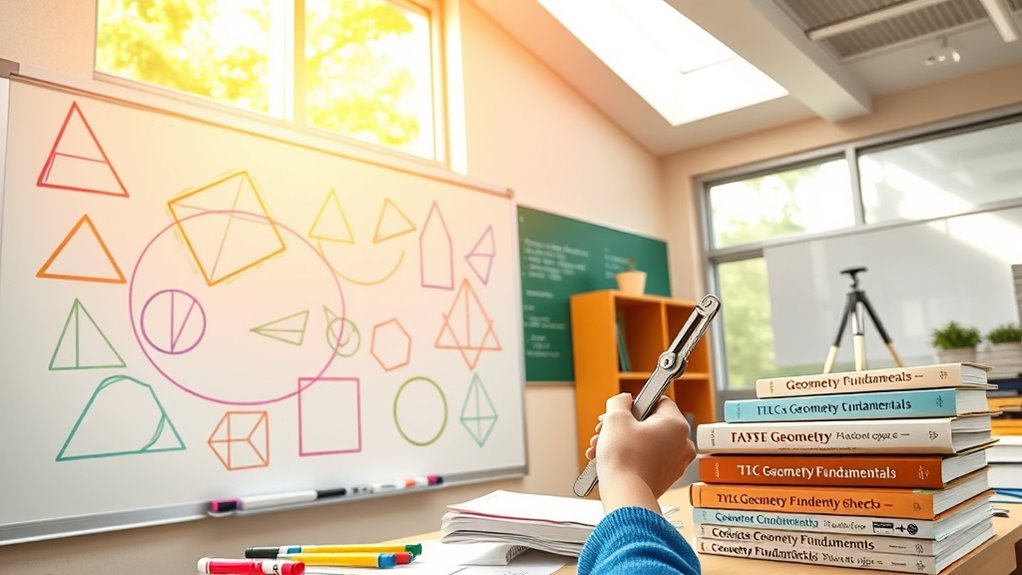
Have you ever wondered how to reveal the secrets of shapes, angles, and spaces in high school geometry? It all starts with understanding the fundamental concepts behind angles relationships and geometric proofs. When you grasp how angles relate to each other within various figures, you unlock a powerful way to analyze and solve complex problems. For example, knowing how to identify complementary and supplementary angles helps you quickly determine the measures of unknown angles. These relationships are the building blocks for more advanced topics like congruence and similarity, which are essential in understanding geometric patterns and proofs.
Geometric proofs might seem intimidating at first, but they’re really just a logical way to demonstrate why certain properties or theorems hold true. When you approach proofs systematically, you’re essentially telling a story with facts, steps, and logical connections that lead to a conclusion. These proofs rely heavily on the relationships between angles, such as vertical angles, corresponding angles, and alternate interior angles, especially when dealing with parallel lines cut by a transversal. Recognizing these relationships allows you to set up your proof correctly, making it easier to justify each step with a reason rooted in geometric principles. Over time, you’ll see how these proofs reinforce your understanding of the subject and develop your problem-solving skills.
To master these concepts, you need to practice identifying different types of angles and understanding how they interact in various shapes—triangles, quadrilaterals, circles, and more. For instance, in triangles, internal angles always add up to 180 degrees, which is a critical relationship for solving many problems. Moreover, understanding the properties of special triangles, like equilateral, isosceles, and right triangles, further enhances your grasp of angles relationships. This knowledge also extends to polygons, where the sum of interior angles depends on the number of sides, and exterior angles follow specific rules. Recognizing these patterns helps you quickly identify the missing measures and verify the accuracy of your solutions. Additionally, understanding how to identify and work with various types of angles is essential for mastering angle relationships, which are foundational in geometric reasoning.

Everything You Need to Ace Geometry in One Big Fat Notebook
As an affiliate, we earn on qualifying purchases.
As an affiliate, we earn on qualifying purchases.
Frequently Asked Questions
How Do I Improve My Problem-Solving Speed in Geometry?
To improve your problem-solving speed in geometry, focus on effective time management by setting strict time limits for each problem. Use mental strategies like visualizing diagrams quickly and recognizing patterns early. Practice regularly to build familiarity with common problem types, which boosts your confidence and efficiency. Stay calm and avoid overthinking—trust your instincts, and you’ll solve problems faster while maintaining accuracy.
What Are Common Mistakes Students Make in Geometry Proofs?
Did you know that over 60% of students struggle with geometry proofs? Common misconceptions include assuming the converse or inverse are true without proof, and using weak proof strategies like neglecting to justify every step. To avoid these, focus on clear logic, carefully analyze given information, and always support your statements with appropriate reasons. These habits will strengthen your proofs and boost your confidence in tackling complex problems.
How Can I Relate Geometry Concepts to Real-Life Applications?
You can relate geometry concepts to real-life applications by recognizing practical uses and everyday examples. When you see a bridge, think about angles and structural stability. Use your understanding of shapes when arranging furniture or designing a garden. Recognizing how geometric principles apply to navigation, architecture, or art helps you see their relevance. Connecting these concepts to daily life makes learning more meaningful and boosts your ability to solve real-world problems.
What Resources Are Best for Extra Practice Outside Class?
To get the most out of extra practice, you should explore interactive worksheets and online tutorials. These resources make learning geometry more engaging and convenient, helping you grasp concepts at your own pace. Interactive worksheets offer hands-on experience, while online tutorials provide clear explanations and visual aids. Using both will boost your confidence and understanding, making studying enjoyable and effective outside of class.
How Do I Prepare Effectively for High School Geometry Exams?
To prepare effectively for your high school geometry exams, you should organize focused study sessions and practice problems regularly. Use note-taking techniques like highlighting key formulas, drawing diagrams, and summarizing concepts to reinforce your understanding. During study sessions, actively quiz yourself and review mistakes. This approach helps you retain information, identify weak spots, and build confidence, ensuring you’re well-prepared when exam day arrives.

STAEDTLER 10-Piece Math Set with Metal Compass, 6" Ruler & Triangle Squares, 45° & 30/60° Set Squares, Alphabet Stencil – Measuring Tools
COMPLETE DRAWING SET – This geometry set includes a metal compass, ruler, alphabet stencil, and two set squares…
As an affiliate, we earn on qualifying purchases.
As an affiliate, we earn on qualifying purchases.
Conclusion
Now that you’ve explored the key concepts of high school geometry, you’re equipped to navigate shapes and angles like a skilled navigator charting new waters. Remember, geometry is the blueprint of the world around you—each theorem and proof is a building block in your understanding. Keep practicing, stay curious, and let these ideas be the compass guiding you through the exciting landscape of mathematics. With each step, you’ll build a solid foundation that supports your success.
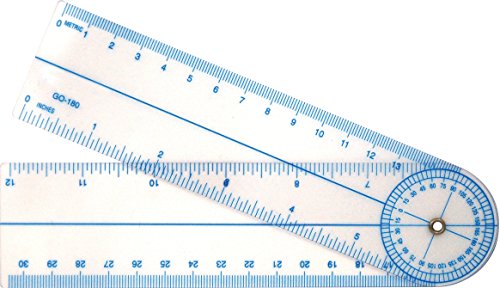
Westcott 7-Inch Goniometer Quick Angle Protractor Measuring Tool (GO-180)
CLEAR PROTRACTOR RULER: 7 Inch goniometer quick angle protractor includ inch and metric scal; Making it ideal for…
As an affiliate, we earn on qualifying purchases.
As an affiliate, we earn on qualifying purchases.

Jianwen Magnetic 3D Shapes & Nets Flash Cards 3"x3", Geometry Math Manipulatives, Educational Aids for Classroom and Home Use
Including: a set of magnetic cards, featuring 3D shapes and nets, great for understand the connection between solid…
As an affiliate, we earn on qualifying purchases.
As an affiliate, we earn on qualifying purchases.