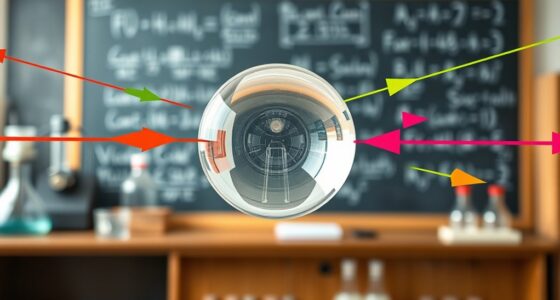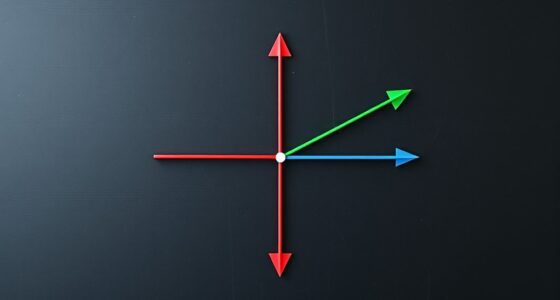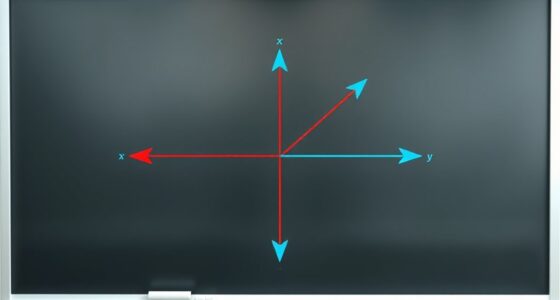
You use dot products every day without realizing it. They help you find out if two directions are aligned or perpendicular, like when you check if roads intersect at right angles. They also let you project one vector onto another, helping with tasks like aiming, force analysis, or shadows. These calculations make complex spatial relationships simple and quick. If you keep exploring, you’ll discover even more ways dot products quietly support your understanding of everyday geometry.

Prime made for students and young adults
- Fast, free delivery for dorm and study essentials
- Prime Video and Amazon Music included
- Member-only deals
Key Takeaways
- Dot products determine if vectors are perpendicular, aiding in simple checks for right angles in daily spatial tasks.
- They help project one vector onto another, clarifying directional components in real-world measurements.
- Calculating the cosine of angles using dot products simplifies understanding of spatial relationships without complex tools.
- Dot products are essential for analyzing forces and shadows, impacting fields like engineering and physics.
- They enable quick assessments of vector alignment, supporting navigation, design, and structural analysis in everyday activities.
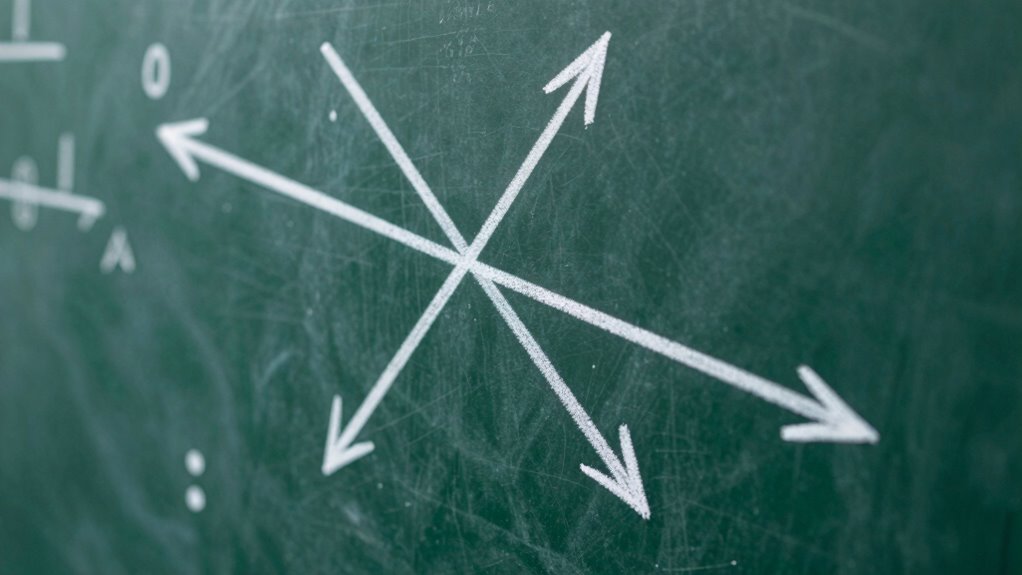
Have you ever wondered how to determine the angle between two vectors or whether they are perpendicular? The answer lies in a concept often overlooked in everyday geometry: the dot product. While it might seem abstract at first, the dot product becomes a powerful tool for understanding relationships between vectors through simple calculations. When you perform a dot product, you’re essentially measuring how much two vectors point in the same direction. This is particularly useful when you want to find the angle between them, as it directly relates to the cosine of that angle.
Performing angle calculations with vectors is straightforward once you grasp the role of the dot product. If you have vectors A and B, their dot product is calculated by multiplying their corresponding components and summing the results. The magic happens when you divide this dot product by the product of their magnitudes. This division yields the cosine of the angle between the vectors. If the result is zero, it tells you the vectors are perpendicular—at a 90-degree angle—making the dot product a quick way to check for orthogonality. Conversely, a positive or negative value indicates the vectors are pointing more in the same or opposite directions, respectively.
Dividing the dot product by the product of magnitudes reveals the cosine of the angle between vectors, indicating their directional relationship.
You’ll find that the concept of vector projections ties into the dot product as well. When you project one vector onto another, you’re essentially finding the component of one vector that lies along the direction of the other. This is incredibly useful in many real-world scenarios, such as determining how much of a force acts in a specific direction or understanding the shadow of a vector when light hits it at an angle. The projection length can be calculated by multiplying the magnitude of your first vector by the cosine of the angle between them—something you can determine using the dot product. This makes the dot product a key step in computing vector projections, helping you analyze complex spatial relationships with ease.
Additionally, understanding the geometric interpretation of the dot product can deepen your grasp of how vectors relate spatially. Recognizing how the dot product connects to vector magnitudes and the angles between vectors can enhance your intuitive understanding of spatial relationships, whether you’re working in two or three dimensions. Exploring the orthogonality of vectors and how it impacts their behavior in different contexts can be very enlightening. Moreover, the dot product also plays a crucial role in understanding vector spaces, which are fundamental in many areas of mathematics and physics. Exploring these concepts reveals the fundamental principles that underpin spatial reasoning and helps you develop a more visual understanding of vectors in your mind.
In everyday life, whether you’re steering a map, designing a structure, or analyzing physical forces, the dot product quietly powers your understanding of geometry. It helps you make sense of angles, perpendicularity, and directional components without requiring complex geometry tools. Instead, you rely on simple calculations that reveal deep insights into how vectors relate to each other. So, next time you’re faced with a problem involving directions or forces, remember that the dot product is your silent ally—making angle calculations and vector projections quick, precise, and intuitive.
As an affiliate, we earn on qualifying purchases.
Frequently Asked Questions
How Do Dot Products Relate to Vector Projections?
You can find the relation between dot products and vector projections by recognizing that the projection of one vector onto another involves scalar multiplication. The dot product helps you calculate the component of one vector along the direction of the other, using the vector’s magnitude and the cosine of the angle between them. Fundamentally, you’re scaling one vector’s magnitude by the cosine of that angle, giving you the projected vector.
Can Dot Products Determine if Two Vectors Are Perpendicular?
Yes, you can use the dot product to determine if two vectors are perpendicular. When the vectors are perpendicular, their dot product equals zero because the cosine of the angle between them is zero. To check, you multiply their corresponding components—this scalar multiplication gives the dot product—and compare it to zero. If it’s zero, the vectors are perpendicular; if not, they’re inclined at some other angle.
How Are Dot Products Used in Computer Graphics?
Imagine a painter’s brush guiding your view—dot products are essential in computer graphics. You use them for vector shading, determining how surfaces reflect light, giving realism to images. They also power lighting calculations, helping simulate shadows and highlights by measuring angles between light sources and surfaces. Without dot products, your virtual worlds would lack depth, making scenes appear flat and lifeless. They quietly shape the vibrant visuals you enjoy every day.
What Is the Geometric Interpretation of a Dot Product?
The geometric interpretation of a dot product is that it measures how much one vector extends in the direction of another, based on their vector magnitudes and the angle between them. You can think of it as scalar multiplication that projects one vector onto another, giving a single value. This value indicates the strength of the relationship, helping you understand angles, projections, and how vectors relate in space.
How Do Dot Products Help in Calculating Angles Between Vectors?
Imagine you’re measuring the space between two arrows pointing in different directions. The dot product helps you find that angle by combining their vector magnitudes and the cosine of the angle between them. You divide the dot product by the product of the vectors’ magnitudes, then use an inverse cosine function. This calculation reveals the precise angle, making it easier to understand how vectors relate in space.
geometry protractor and ruler set
As an affiliate, we earn on qualifying purchases.
As an affiliate, we earn on qualifying purchases.
Conclusion
As you reflect on how dot products silently shape your world, it’s almost like they’re guiding your steps without you realizing. Just as everyday moments connect in subtle ways, the math behind the scenes quietly influences your perceptions and choices. Sometimes, it’s the unseen forces that hold everything together, reminding you that even the simplest tools can carry profound meaning. In this quiet power, you find a deeper connection to the geometry woven into your life.
physics force and vector experiment kit
As an affiliate, we earn on qualifying purchases.
As an affiliate, we earn on qualifying purchases.
angle measurement tool for students
As an affiliate, we earn on qualifying purchases.
As an affiliate, we earn on qualifying purchases.
Fall Picks
fall essentials
As an affiliate, we earn on qualifying purchases.