
Digital geometry tools revolutionize how you learn shapes by offering immediate, interactive feedback that helps you understand concepts more clearly. You can experiment freely, adjusting parameters to see how shapes change in real-time, which deepens your insight and corrects misconceptions quickly. These tools make complex ideas like tessellations and fractals accessible and engaging. If you keep exploring, you’ll discover even more ways these tools can enhance your understanding of geometric structures.
Key Takeaways
- Enable real-time manipulation for immediate visual feedback, deepening understanding of geometric properties.
- Facilitate active exploration and hypothesis testing beyond physical or textbook limitations.
- Enhance visualization of complex concepts like tessellations and fractals for clearer comprehension.
- Democratize access to advanced geometric ideas, making learning inclusive and engaging for diverse learners.
- Promote active engagement by showing instant consequences of shape adjustments, boosting retention.
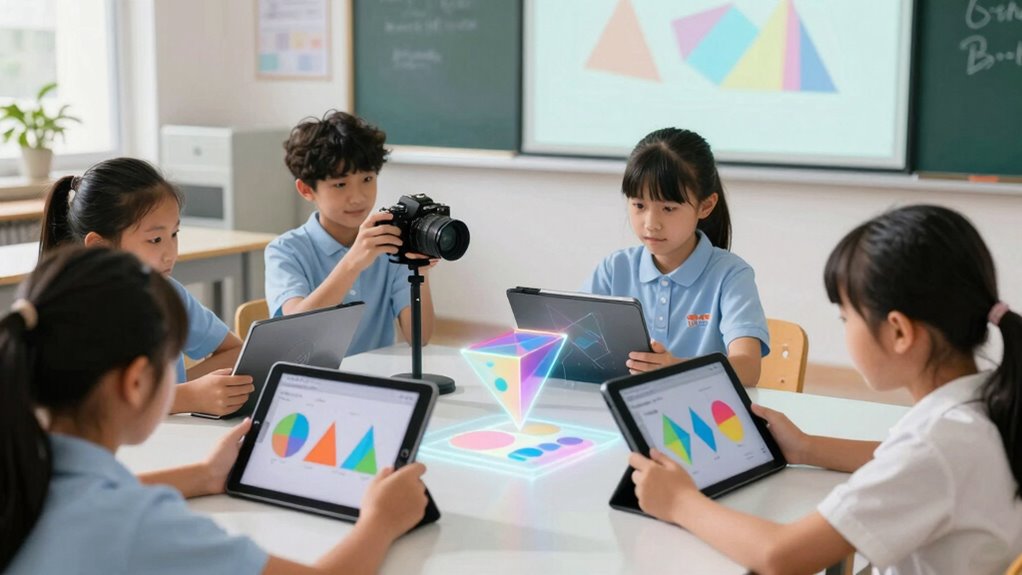
With real-time manipulation, you’re no longer limited to imagining how a shape changes or relying solely on static images. You can adjust parameters instantly and observe immediate results, which deepens your understanding. For example, in learning about polygons, you can manipulate vertices in real time, seeing how the shape’s angles and sides respond. This instant feedback makes abstract ideas concrete, helping you identify patterns and relationships that might be missed in traditional lessons. The ability to tweak dimensions and watch the effects unfold fosters a deeper, more intuitive grasp of geometric properties.
Real-time shape manipulation deepens understanding and reveals geometric patterns through instant feedback.
Furthermore, digital geometry tools facilitate exploration at your own pace. You can experiment freely, testing hypotheses and uncovering insights without the constraints of physical models or textbooks. This freedom to manipulate shapes interactively encourages curiosity and active learning. You might rotate a 3D object to view it from different angles or stretch and compress it to understand deformation. All these actions occur seamlessly, providing a fluid learning experience that adapts to your needs and interests. Additionally, these tools promote interactive learning, which enhances retention and engagement. The immediate visual feedback also helps in reinforcing geometric concepts through experimentation.
In addition, digital tools can include features such as dynamic visualization** that further aid comprehension by illustrating complex ideas more clearly. The instant feedback loop created by real-time manipulation helps you identify errors, correct misconceptions, and refine your understanding efficiently. You’re not waiting for explanations or static images; you’re actively involved in shaping the learning process. This immediacy fosters conceptual clarity** by allowing you to see how theoretical principles operate in practice.
These tools also democratize advanced geometric concepts, making them accessible to learners at various levels. Whether you’re a beginner or more advanced, digital visualization allows you to visualize complex structures, such as tessellations or fractals, with clarity. The instant feedback loop created by real-time manipulation helps you identify errors, correct misconceptions, and refine your understanding efficiently. You’re not waiting for explanations or static images; you’re actively involved in shaping the learning process.
In addition, digital tools enable students to see the immediate consequences of their adjustments, fostering a stronger connection between actions and outcomes. In essence, digital geometry tools revolutionize how you learn shapes by making the process interactive and immediate. Instead of studying shapes passively, you become a participant, exploring, adjusting, and observing in real time. This active engagement accelerates comprehension, nurtures curiosity, and transforms geometric learning into a dynamic, immersive experience. As a result, the concepts become clearer, more memorable, and more applicable to real-world situations, fundamentally changing your approach to understanding geometry.

Big Fat High School Geometry Workbook: 400+ Geometry Practice Exercises (Big Fat Notebook)
As an affiliate, we earn on qualifying purchases.
As an affiliate, we earn on qualifying purchases.
Frequently Asked Questions
How Do Digital Tools Improve Understanding of Three-Dimensional Shapes?
Digital tools improve your understanding of three-dimensional shapes through interactive visualization and real-time manipulation. You can rotate, zoom, and explore shapes from every angle, making complex concepts easier to grasp. These features allow you to see relationships and properties clearly, enhancing spatial reasoning. By actively engaging with the models, you develop a deeper, more intuitive understanding of 3D structures, which is hard to achieve with static images or traditional methods.
Are Digital Geometry Tools Accessible for Students With Disabilities?
Yes, digital geometry tools are accessible for students with disabilities. They incorporate accessible design features, making learning inclusive and engaging. Assistive technology enhances these tools by providing features like screen readers, magnification, and voice commands. This guarantees students with diverse needs can explore shapes effectively, participate actively, and develop a deeper understanding. By prioritizing accessibility, digital tools create equitable learning opportunities for all students, regardless of their abilities.
What Are the Best Digital Tools for Teaching Geometric Transformations?
You should explore interactive simulations and virtual manipulatives to effectively teach geometric transformations. These digital tools allow you to visualize and manipulate shapes easily, making concepts like rotations, reflections, and translations clearer. By engaging with these resources, you can provide hands-on experiences that deepen understanding. They’re flexible, accessible, and encourage active learning, helping students grasp complex transformations more intuitively and confidently.
How Do Digital Tools Support Collaborative Learning in Geometry?
You’ll find digital tools boost collaborative learning by enabling virtual collaboration and peer feedback. Research shows students engaging in online geometry activities are 30% more likely to actively participate. These tools let you work with classmates in real-time, share ideas instantly, and receive immediate feedback, fostering a deeper understanding of shapes. This interactive environment encourages teamwork, enhances communication skills, and makes learning geometry more engaging and effective.
Can Digital Geometry Tools Be Integrated Into Standardized Curricula?
Yes, digital geometry tools can be integrated into standardized curricula through thoughtful instructional design. You can incorporate these tools by aligning activities with learning objectives and standards, ensuring they complement traditional teaching methods. Effective curriculum integration involves designing lessons that leverage digital features for interactive exploration, making geometry more engaging and accessible. This approach helps students develop deeper understanding while meeting curriculum requirements seamlessly.

Pull String 3D Geometry Learning Book, 3D Geometry Learning Book with Braided Rope Design, Interactive Math Teaching Tool for Geometric Beginners, Teach Volume & Surface Area Formulas (15 Models)
- Enhances Geometry Understanding: Master points, lines, planes, volume, surface area
- Instant 3D Models: Pull to transform 2D shapes into 3D models
- Rich Content: Includes 15 geometric models and 16 hidden animals
As an affiliate, we earn on qualifying purchases.
As an affiliate, we earn on qualifying purchases.
Conclusion
Just as Da Vinci revolutionized art with new tools, digital geometry transforms how you learn shapes—making complex concepts clearer and more engaging. These tools act as your modern palette, inviting exploration and creativity. Embrace this technological renaissance, and you’ll discover that understanding shapes becomes as intuitive as a master’s brushstroke—bridging the past’s ingenuity with today’s innovation, shaping a smarter, more inspired way to learn.

3D Printing and Maker Lab for Kids: Create Amazing Projects with CAD Design and STEAM Ideas (Volume 22)
As an affiliate, we earn on qualifying purchases.
As an affiliate, we earn on qualifying purchases.

Sacred Geometry Patterns Sleeping Sounds for Fire TV
- Continuous Sound Playback: Sounds remain constant throughout the experience
- High-Quality Audio: Crisp and clear sounds with minimal hiss
As an affiliate, we earn on qualifying purchases.
As an affiliate, we earn on qualifying purchases.