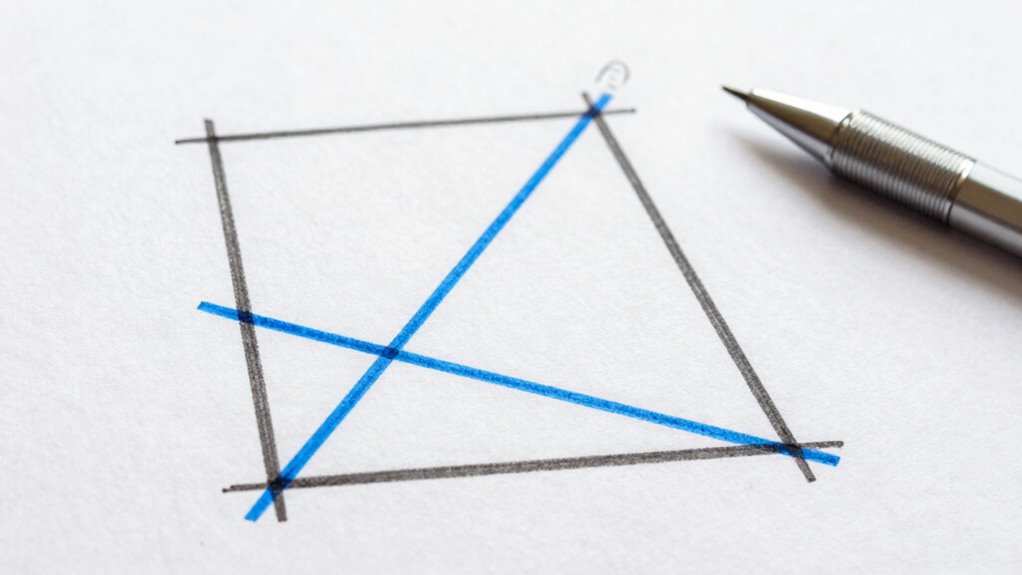

To spot the right auxiliary line in a tough geometry problem, look for clues like angles, key points, or symmetries that aren’t immediately clear. Focus on parts of the figure that seem complicated and consider lines that can split angles into manageable sections or create recognizable shapes like cyclic quadrilaterals. Drawing lines through strategic points can reveal hidden properties and simplify relationships. Keep exploring these ideas—there’s more to uncover if you stay curious.
Key Takeaways
- Identify complex or confusing regions where auxiliary lines can simplify relationships.
- Look for angles or segments that, if connected, create known shapes or cyclic quadrilaterals.
- Detect symmetry or congruence hints that auxiliary lines can reveal or establish.
- Consider bisecting angles or connecting key points to uncover hidden properties.
- Use circle theorems to guide the placement of auxiliary lines that reveal equal angles or segments.

Have you ever wondered how to identify the right auxiliary line in a drawing or diagram? When tackling tough geometry problems, adding auxiliary lines can clarify relationships and lead you to the solution. The key is recognizing which lines will reveal hidden properties or simplify complex figures. For example, understanding how to spot angle bisectors can be essential. These lines divide angles into equal parts, often helping you establish congruent triangles or find key points of intersection. If you notice an angle that seems pivotal, drawing its bisector might uncover symmetries or equal segments that weren’t obvious before. Recognizing cyclic quadrilaterals is also crucial, as they open up circle theorems and properties that can simplify your reasoning. Cyclic quadrilaterals are another critical concept. These are four-sided figures inscribed in a circle, meaning all vertices lie on the circle’s circumference. Recognizing a cyclic quadrilateral can be a game-changer because it introduces circle theorems and properties you can exploit. For instance, angles subtended by the same arc are equal, and the sum of opposite angles in a cyclic quadrilateral is 180 degrees. When you suspect a quadrilateral is cyclic, drawing the diagonals or connecting certain vertices with auxiliary lines can help show this. These lines often reveal pairs of equal angles or lengths, making it easier to prove congruencies or similarity. To identify the right auxiliary line, look at what part of the problem seems complicated or confusing. If you’re working with angles, consider whether an angle bisector could split the problem into manageable parts. If you’re dealing with a quadrilateral, check whether connecting specific points or drawing a diagonal might expose a cyclic nature. Sometimes, drawing a line to create a triangle inside a quadrilateral helps prove it’s cyclic or sets up similar triangles, leading to more straightforward calculations. Visualize how the line interacts with existing elements—does it pass through a key point, bisect an angle, or connect vertices to create known geometric shapes? Additionally, understanding the properties of circle theorems can guide you in choosing the most effective auxiliary line. When you identify these properties, you’ll see which auxiliary lines can unlock the problem.

Nicpro 22 PCS Compass Geometry Tools with Case, Drafting Tools Geometry Set with Swing Arm Protractor, Rulers, Metal Compass, Square Set, Mechanical Pencil, Back to School Supplies for Students
Complete Compass Geometry Set – This all-in-one compass geometry set includes 3 types of compasses (study, graphic, bow),…
As an affiliate, we earn on qualifying purchases.
As an affiliate, we earn on qualifying purchases.
Frequently Asked Questions
How Do I Determine Which Auxiliary Line Simplifies the Problem Most Effectively?
To determine which auxiliary line simplifies the most complex figure, focus on auxiliary line strategies that reveal hidden relationships or symmetry. You should look for lines that create congruent triangles, bisect angles, or help prove equal segments. Test potential auxiliary lines by visualizing how they break down the problem; the one that clarifies multiple relationships or reduces the figure’s complexity most effectively is your best choice.
Are There Common Mistakes to Avoid When Choosing Auxiliary Lines?
Yes, avoid common mistakes like choosing auxiliary lines that clutter your diagram or don’t align with key angles and segments. Use visualization techniques to see how different auxiliary line types interact with the problem’s elements. Don’t select lines solely based on intuition; instead, verify if they simplify relationships or create useful congruences. Remember, the right auxiliary line clarifies the problem, not complicates it, so choose wisely.
Can Auxiliary Lines Be Used in All Types of Geometry Problems?
Auxiliary lines can be useful in many geometry problems, but they’re not always necessary. You should consider alternative problem-solving strategies, like coordinate geometry or symmetry, before adding lines. Understanding the historical development of geometric methods can also guide your choices. Use auxiliary lines selectively, mainly when they simplify complex configurations or lead to clear proofs, rather than relying on them in every problem.
How Do Auxiliary Lines Help in Proving Geometric Properties?
Auxiliary lines amplify your understanding by aiding visualization techniques, revealing hidden relationships, and simplifying complex configurations. They help you identify additional angles, congruencies, or similarities, making proofs more manageable. For example, drawing an altitude or median can clarify properties like congruent triangles or parallel lines. These auxiliary line examples serve as strategic stepping stones, transforming tricky problems into approachable puzzles, and ultimately proving geometric properties with precision and confidence.
When Should I Reconsider My Choice of Auxiliary Lines During Solving?
You should reconsider your auxiliary lines if your visual intuition suggests they aren’t simplifying the problem as expected or if your current approach stalls. Sometimes, exploring alternative approaches helps uncover more straightforward auxiliary lines that better reveal the properties you’re trying to prove. Trust your instincts—if the current lines don’t seem to enhance clarity or progress, testing different options can lead to a breakthrough in understanding and solution.
Nicpro 22 PCS Compass Geometry Tools with Case, Drafting Tools Geometry Set with Swing Arm Protractor, Rulers, Metal Compass, Square Set, Mechanical Pencil, Back to School Supplies for Students
Complete Compass Geometry Set – This all-in-one compass geometry set includes 3 types of compasses (study, graphic, bow),…
As an affiliate, we earn on qualifying purchases.
As an affiliate, we earn on qualifying purchases.
Conclusion
Think of solving a tough geometry problem like steering through a dense forest. The auxiliary line is your compass, guiding you through the trees of complexity. When you spot the right one, it’s like finding a clear path to the clearing. Trust your intuition, observe carefully, and select the line that reveals the hidden symmetry or pattern. With patience and sharp eyes, you’ll chart a course to the solution, turning confusion into clarity.

4 Pack Multifunctional Geometric Ruler, Mathematics Measuring Tool Draft Rulers Set, Rotatable Circular Drawing Template Ruler for Student Studying Designing Office Supplies (4 Styles)
【Clever Design】 With a rotatable inner ring, can easily slide to draw various shapes, effectively developing your child's…
As an affiliate, we earn on qualifying purchases.
As an affiliate, we earn on qualifying purchases.
Nicpro 22 PCS Compass Geometry Tools with Case, Drafting Tools Geometry Set with Swing Arm Protractor, Rulers, Metal Compass, Square Set, Mechanical Pencil, Back to School Supplies for Students
Complete Compass Geometry Set – This all-in-one compass geometry set includes 3 types of compasses (study, graphic, bow),…
As an affiliate, we earn on qualifying purchases.
As an affiliate, we earn on qualifying purchases.