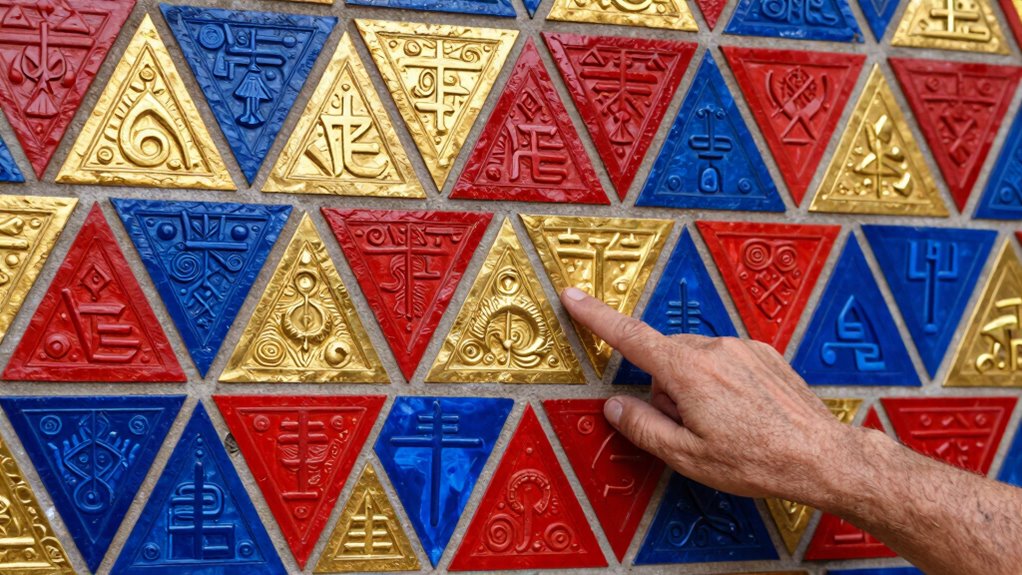

Across cultures, you’ll find the triangle symbolizing strength, spiritual connection, and harmony. Ancient Egyptians used it to represent the soul’s journey and divine stability in pyramids. Western traditions link it to the Holy Trinity and divine unity in art and architecture. In Eastern philosophies, triangles embody balance and opposing forces, like yin and yang. Indigenous cultures see it as a sacred link between heaven and earth. If you explore further, you’ll uncover even deeper meanings behind this powerful shape.
Key Takeaways
- In ancient Egypt, triangles symbolized the sun’s rays and the soul’s journey to the afterlife.
- Western Christianity uses triangles to represent the Holy Trinity and divine unity.
- In Eastern traditions, triangles embody balance and harmony, as seen in yin-yang symbolism and Feng Shui.
- Indigenous cultures associate triangles with sacred sites, nature, and spiritual connections between heaven and earth.
- Globally, triangles serve as symbols of stability, strength, harmony, and complex spiritual or philosophical ideas.
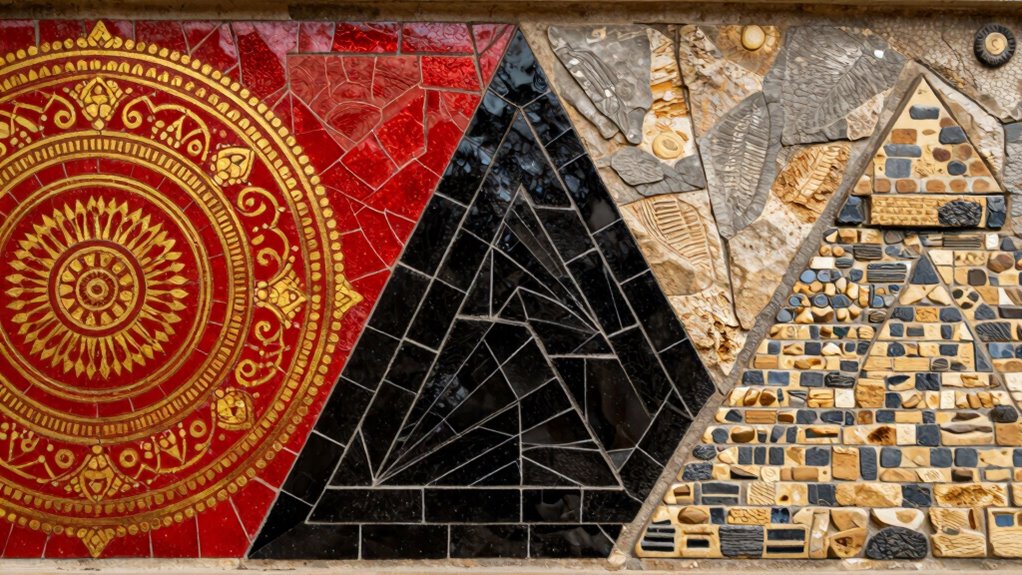
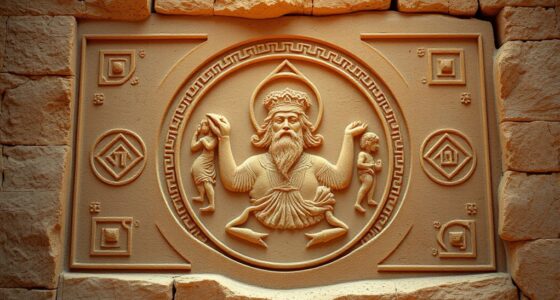
Throughout history, cultures worldwide have assigned diverse symbolic meanings to the triangle, reflecting their unique beliefs, values, and worldviews. You might notice that this simple geometric shape carries profound significance, often seen in religious symbols, art, and architecture. Its symbolic significance varies from culture to culture, but its prominence in architectural representations highlights its importance. In many ancient civilizations, the triangle was used to symbolize stability and strength, especially in structures like pyramids and temples. These architectural representations were not just practical but carried deeper meanings—conveying spiritual ideals or societal values. For example, the Egyptian pyramids, with their triangular faces, symbolized the rays of the sun and the journey of the soul to the afterlife, blending function with spiritual symbolism.
The triangle symbolizes stability, strength, and spiritual ascent across cultures and architectural marvels.
In Western traditions, the triangle often represents the Holy Trinity—Father, Son, and Holy Spirit—highlighting its religious and spiritual symbolic significance. Its pointed shape directs attention upward, symbolizing a connection to the divine or higher consciousness. Similarly, in Christian art and architecture, triangles are used to create visual harmony and spiritual focus, reinforcing the idea of divine unity. You can see this in the way churches incorporate triangular motifs into stained glass windows and spires, emphasizing spiritual ascent and divine truth.
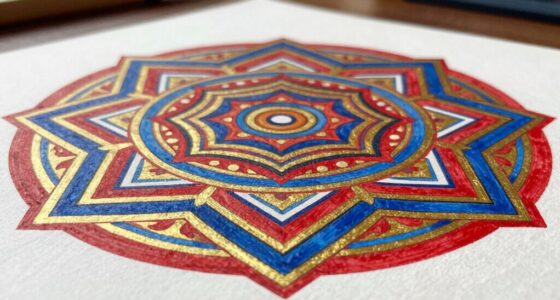
In Eastern cultures, especially in Chinese philosophy, the triangle takes on a different symbolic significance. It often appears in the form of yin-yang symbolism, representing balance and harmony. The geometric shape embodies the dynamic interplay of opposing forces—light and dark, male and female—highlighting a worldview centered on harmony and interconnectedness. Architecturally, these ideas translate into structures that emphasize balance and flow, with triangular elements often incorporated into Feng Shui principles to foster positive energy and stability. Additionally, the triangle’s association with cosmology underscores its importance in understanding the universe’s structure. Moreover, the triangle frequently appears in mandalas and spiritual diagrams, illustrating its role in sacred geometry. The enduring presence of triangles in various spiritual symbols across cultures underscores its universal significance.
In indigenous cultures, the triangle frequently appears in sacred symbols and motifs, representing concepts like water, mountains, or the sacred axis connecting heaven and earth. These symbols are embedded in architectural representations of sacred sites, where the shape underscores spiritual relationships and cosmology. For instance, Native American petroglyphs and totem poles often feature triangular patterns that encode spiritual stories or natural elements, emphasizing the shape’s role in conveying cultural identity and spiritual beliefs. Such symbols often serve as a bridge between the material and spiritual worlds, highlighting the triangle’s role in cultural symbolism.
Across the globe, the triangle’s versatility in symbolism and architectural representations underscores its universal power to communicate complex ideas. Whether as a spiritual emblem, a sign of stability, or a symbol of harmony, this shape remains a potent visual language that transcends cultures and centuries.

Qallicon 5.31" Sacred Geometry Wall Art 4 PCS Set, (Metatron Cube, 64 Tetrahedron, Torus, Merkaba) Crystal Grid Meditation Chakra Wooden Wall Art Yoga Decor Spiritual Gifts
POSITIVE ENERGY & VIBRATION – This fine artwork set of 4 sacred geometry wall decor will turn your…
As an affiliate, we earn on qualifying purchases.
As an affiliate, we earn on qualifying purchases.
Frequently Asked Questions
How Did Ancient Civilizations Initially Discover the Significance of Triangles?
You discover that ancient civilizations initially uncovered the significance of triangles through practical applications of geometric principles in everyday life. They observed how triangles provided stability and strength, especially in architectural structures like bridges and temples. By experimenting with different shapes, they realized the architectural significance of triangles, as their inherent stability made them ideal for supporting loads and creating durable constructions. This hands-on approach helped them understand the fundamental role triangles played in their engineering feats.
Are There Any Modern Cultural Groups That Still Emphasize Triangle Symbolism?
You’ll find that some modern art and architectural symbolism still emphasize triangles. For example, in contemporary architecture, triangles symbolize stability and strength, evident in structures like the Louvre Pyramid. Artists also use triangles to evoke spirituality and harmony. These modern groups and creators continue to interpret triangles as powerful symbols, blending ancient meanings with contemporary expressions, showing that this shape’s significance persists across cultures and eras.
How Does the Interpretation of Triangles Differ Between Eastern and Western Cultures?
You’ll notice that in Western cultures, triangles often symbolize stability, strength, and spiritual significance, like the Holy Trinity in Christianity. In Eastern cultures, geometric symbolism tends to emphasize harmony, balance, and interconnectedness, with triangles representing the unity of body, mind, and spirit. The interpretation varies, but both cultural perspectives highlight the triangle’s spiritual significance, reflecting core values and beliefs through its form.
What Are Some Common Myths Associated With Triangles Across Different Societies?
Imagine a triangle as a storyteller’s badge, revealing myths across societies. You might believe it symbolizes the Holy Trinity, representing divine unity, or that it’s a gateway to hidden knowledge. These myths often stem from origins of sacred symbolism or spiritual power, shaping beliefs about protection, balance, or enlightenment. Despite differences, many cultures see the triangle as a powerful emblem, echoing universal themes of harmony and mystery in its timeless form.
How Has the Meaning of Triangles Evolved Over Time Across Various Cultures?
The meaning of triangles has evolved through history, shifting from simple geometric symbolism to complex artistic representations. You see this in ancient architecture, where triangles symbolize stability and strength, and in religious art, representing divine principles. Over time, cultures have added layers of meaning, blending spiritual, philosophical, and aesthetic ideas, making the triangle a versatile symbol that reflects both balance and transformation across different societies.

Stainless Steel Triquetra Holy Trinity Pendulum Curved Triangle Charm Pendant Necklace
Surgical Grade Stainless Steel
As an affiliate, we earn on qualifying purchases.
As an affiliate, we earn on qualifying purchases.
Conclusion
As you reflect on these diverse interpretations, you realize the triangle is like a universal language, a silent symphony of symbolism that resonates differently across cultures. Its angles and sides become a mirror of beliefs, values, and philosophies, shaping perceptions in ways that transcend borders. Just as a prism refracts light into a spectrum, the triangle disperses meaning into countless forms. Ultimately, understanding these perspectives helps you see the world’s rich tapestry through a more nuanced, interconnected lens.

SHIDXIB 2Pcs Chinese Feng Shui Bell for Wealth and Safe Peace and Success Feng Shui Element Door Chime or Decor
Material:Metal
As an affiliate, we earn on qualifying purchases.
As an affiliate, we earn on qualifying purchases.
Triangle Universe Infinity Earrings, Sacred Geometry Eco-friendly Wooden Jewelry
🎁GREAT GIFT IDEA- This Earrings are suitable for your girlfriend, fiancée, wife, mother, friend. It can as a…
As an affiliate, we earn on qualifying purchases.
As an affiliate, we earn on qualifying purchases.