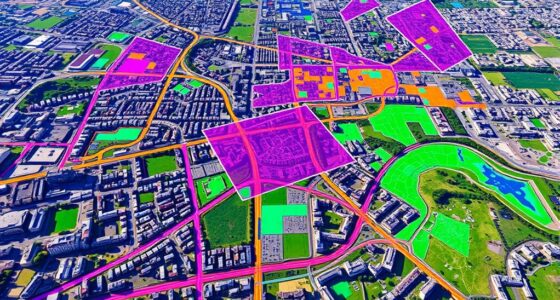

Algorithms decide the fastest path around obstacles by analyzing your environment, weighing possible routes for their distance, safety, and speed. They use methods like A* search or Dijkstra’s algorithm to explore options systematically, updating their assessments with sensor data in real time. By constructing maps and considering movement constraints, they find smooth, feasible paths that avoid hazards while minimizing travel time. If you keep exploring, you’ll discover how these techniques adapt dynamically to complex and changing environments.

Prime made for students and young adults
- Fast, free delivery for dorm and study essentials
- Prime Video and Amazon Music included
- Member-only deals
Key Takeaways
- Algorithms evaluate multiple potential routes using cost functions like distance, time, and risk to identify the fastest path.
- Pathfinding methods such as A* and Dijkstra’s systematically explore options, prioritizing routes with lower total costs.
- Environment maps, including obstacles and free spaces, guide the algorithms to generate feasible and smooth paths.
- Real-time sensor data updates allow dynamic recalculations, adapting routes to new obstacles or terrain changes.
- Adaptive algorithms analyze environmental changes continuously, balancing speed and safety for optimal navigation decisions.

When maneuvering through complex environments, finding the fastest path around obstacles is essential for efficiency and safety. Algorithms designed for path optimization analyze the environment to determine the most efficient route, guaranteeing you reach your destination quickly without unnecessary detours. These algorithms consider various factors such as the position of obstacles, the terrain, and the desired speed, enabling you to navigate smoothly and avoid potential hazards. Obstacle avoidance is central to this process, allowing you to adapt your path dynamically as new obstacles appear or existing ones shift.
Path optimization algorithms ensure safe, efficient navigation by dynamically adapting to obstacles and changing environments.
At the core of these algorithms are methods that evaluate possible routes, weighing the shortest distance against safety and speed. Techniques like A* search or Dijkstra’s algorithm systematically explore potential paths, ranking them based on cost functions that include distance, time, and risk. When you’re moving through an environment filled with obstacles, these algorithms continuously update their assessments, recalculating the optimal course to guarantee you don’t get stuck or slow down unnecessarily. They prioritize avoiding collisions while still aiming for the quickest route, balancing safety with efficiency.
To make this possible, the algorithms construct a map of the environment, often represented as a grid or graph, marking obstacles and free spaces. They then analyze this map to find the most promising paths. Path optimization involves not just finding a route that’s short but also smooth and feasible given the constraints of your movement. For example, if you’re navigating a robot or autonomous vehicle, the algorithm must account for turning radius and acceleration limits, making obstacle avoidance a dynamic process that adapts in real-time. Additionally, the integration of sensor data ensures the algorithms stay updated with the latest environmental information, which is crucial for maintaining accuracy in unpredictable settings.
Furthermore, these algorithms incorporate sensor data to refine their understanding of the environment. As you move, sensors detect new obstacles or changes in terrain, prompting the algorithm to recalculate paths on the fly. This real-time adjustment guarantees you maintain the most efficient and safe route possible, even in unpredictable settings. The goal is to minimize travel time and energy consumption while preventing collisions, which is vital in applications like robotics, autonomous driving, or even drone navigation. environmental mapping plays a vital role in providing the detailed spatial information necessary for effective path planning.
Incorporating adaptive algorithms allows these systems to better handle dynamic environments, ensuring continuous optimal performance. The algorithms serve as your digital co-pilots, constantly analyzing, predicting, and adjusting your course. They optimize your path by balancing the need for speed with obstacle avoidance, ensuring you reach your destination promptly and safely, no matter how complex the environment.
As an affiliate, we earn on qualifying purchases.
Frequently Asked Questions
How Do Algorithms Handle Dynamic or Moving Obstacles?
You can rely on algorithms to handle dynamic obstacles by continuously monitoring their movements and updating the route in real-time. They use adaptive rerouting techniques to quickly find alternative paths when obstacles move or appear unexpectedly. This process involves sensors and data analysis, allowing you to stay on the fastest route despite changing conditions. Overall, these algorithms guarantee smooth navigation by dynamically adjusting to obstacles that aren’t static.
Can Algorithms Optimize for Multiple Objectives Simultaneously?
Yes, algorithms can optimize for multiple objectives at once through multi-objective optimization. You’ll find that they balance trade-offs between competing goals, like minimizing time while saving energy or avoiding risks. These algorithms evaluate different solutions, compare trade-offs, and select the best compromise. By doing so, you get solutions tailored to your priorities, ensuring the most effective path considering all your objectives simultaneously.
What Are the Limitations of Current Pathfinding Algorithms?
You might notice that current pathfinding algorithms face limitations due to heuristic accuracy and computational complexity. When heuristics aren’t precise, your routes could be suboptimal or slow to compute. As obstacles grow more complex, algorithms struggle with higher computational demands, making real-time decisions difficult. These constraints mean you often trade off between speed and accuracy, limiting their effectiveness in dynamic or intricate environments.
How Do Algorithms Adapt to Changing Environments in Real-Time?
You see algorithms adapt to changing environments through environmental adaptability and real-time updates. They constantly monitor sensor data, detect new obstacles or changes, and quickly recalculate paths to optimize your route. By processing information instantly, these algorithms adjust their decisions, ensuring you stay on the fastest, safest path even as conditions evolve. This dynamic responsiveness helps navigation systems remain accurate and efficient, no matter how unpredictable the environment becomes.
Are There Algorithms That Prioritize Safety Over Speed?
Think of an algorithm as a cautious driver, always prioritizing safety over speed. Yes, many algorithms focus on safety prioritization by incorporating risk assessment. They analyze potential hazards and choose routes that minimize danger, even if it takes longer. These algorithms are designed to prevent accidents, ensuring safety comes first. They adapt to real-time changes, constantly evaluating risk levels to keep you safe, not just fastest.
autonomous vehicle obstacle avoidance
As an affiliate, we earn on qualifying purchases.
As an affiliate, we earn on qualifying purchases.
Conclusion
Remember, the journey of finding the fastest path isn’t just about avoiding obstacles but understanding how algorithms think. With each calculation, you’re steering a complex maze, much like life itself—sometimes, the best route isn’t the most obvious. As the saying goes, “Every cloud has a silver lining.” Embrace these algorithms’ insights, and you’ll see that even obstacles can guide you toward smarter, quicker solutions. Keep moving forward, and trust the process.
As an affiliate, we earn on qualifying purchases.
As an affiliate, we earn on qualifying purchases.
Fall Picks
fall essentials
As an affiliate, we earn on qualifying purchases.