
Convexity is essential in geometry software because it directly affects how quickly and accurately your shape analysis happens. Recognizing convex shapes helps the software process complex data efficiently and prevents slowdowns or crashes. Good algorithms and intuitive interfaces make it easy to identify convexity, boosting your productivity. When convexity is integrated seamlessly, it transforms shape analysis from a hassle into a smooth part of your workflow. Keep exploring to discover how this feature can make your projects easier and more reliable.
Key Takeaways
- Convexity detection speeds up shape analysis, crucial for handling complex geometries efficiently.
- Accurate convexity identification ensures reliable modeling and reduces errors in geometric computations.
- User-friendly algorithms and interfaces make convexity checks seamless, enhancing workflow productivity.
- Recognizing convexity helps optimize resource use, preventing software delays or crashes during analysis.
- Incorporating convexity features improves software usability, enabling users to focus on creative and analytical tasks.
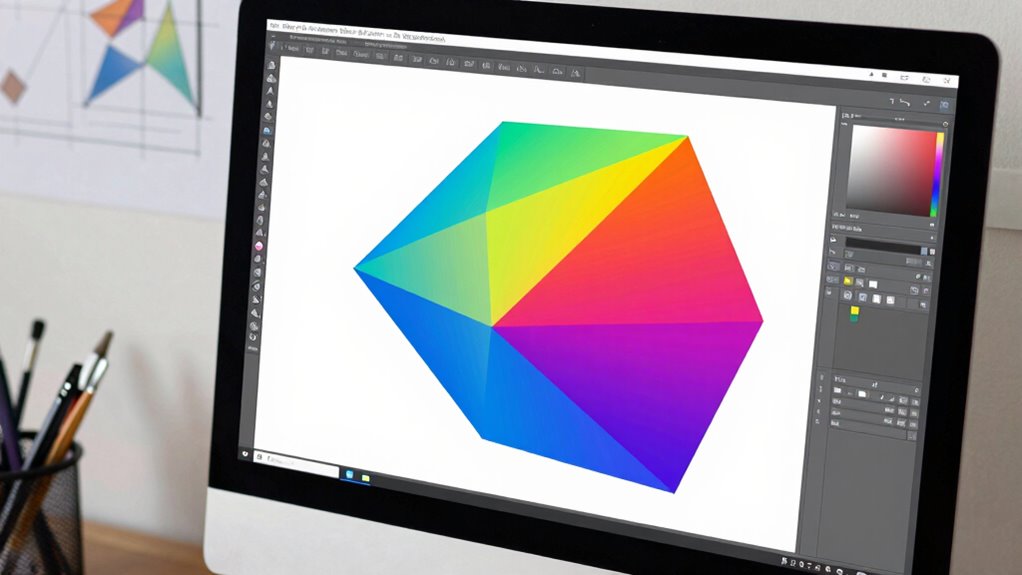
Have you ever wondered how geometry software determines whether a shape is convex? It might seem straightforward at first glance, but behind the scenes, the process relies on sophisticated algorithms designed for efficiency and accuracy. The way the software checks convexity impacts everything from how quickly it provides results to how easy it is for you to use. When you’re working with complex shapes or large data sets, the algorithm efficiency becomes vital. An optimized method can swiftly analyze the shape’s properties without taxing your computer’s resources. Conversely, a poorly designed algorithm may slow down your workflow, forcing you to wait longer or experience crashes, which diminishes your overall experience.
Efficient algorithms ensure quick, accurate convexity detection, enhancing your workflow and eliminating frustrating delays.
The user interface plays a significant role in how you interact with the convexity detection features. If the software’s interface is intuitive, you can easily find and apply tools that determine convexity, reducing the learning curve and making your task smoother. Good design means clear buttons, straightforward options, and helpful prompts that guide you through the process. When the interface integrates convexity checks seamlessly, you’re less likely to get frustrated or confused, enabling you to focus on your geometric analysis instead of wrestling with the software. The significance of this integration becomes even more evident when working on complex shapes, where clarity and ease of use can make the difference between a productive session and a tedious one.
Understanding why convexity matters more than it sounds hinges on how it influences your entire geometric workflow. For example, many algorithms for convexity testing are based on checking the angles or verifying the shape’s boundary points, but the efficiency of these algorithms determines whether the software can handle real-world, complex geometries. When the algorithms are optimized, they can rapidly identify convex shapes, allowing you to perform multiple analyses in less time. This speed is essential for tasks like modeling, design, or educational purposes, where quick feedback accelerates your progress. Additionally, the importance of algorithm efficiency is heightened by the fact that it directly impacts the software’s ability to process complex geometries quickly and accurately.
In essence, the combination of efficient algorithms and a user-friendly interface ensures that convexity detection becomes a natural part of your workflow, rather than a bottleneck. It’s not just about whether a shape is convex; it’s about how swiftly and effortlessly your software can tell you, empowering you to focus on your creative or analytical goals without technical frustrations. That’s why convexity, often overlooked, plays such a pivotal role in making geometry software a powerful, reliable tool for everyone.
geometry shape analysis software
As an affiliate, we earn on qualifying purchases.
As an affiliate, we earn on qualifying purchases.
Frequently Asked Questions
How Is Convexity Defined in Higher-Dimensional Geometry?
Convexity in higher-dimensional geometry means a set where, for any two points, the entire line segment connecting them lies within the set. You can think of it as a convex hull, the smallest convex set encompassing your shape. When working with convex sets, this property guarantees that all line segments between points remain inside, making calculations and visualizations more manageable in complex, multi-dimensional spaces.
Can Non-Convex Shapes Be Accurately Modeled in Geometry Software?
Yes, non-convex shapes can be accurately modeled in geometry software. You typically use techniques like shape decomposition, breaking the complex shape into simpler components, and convex hulls, which enclose non-convex parts efficiently. These methods help software process intricate forms, ensuring accurate representations. By combining convex hulls with decomposition, you can model even highly non-convex objects precisely, enabling detailed analysis and rendering in various applications.
What Are Common Challenges When Working With Convexity Algorithms?
When working with convexity algorithms, you often face challenges with accurately identifying and preserving convexity properties during shape simplification. These algorithms can struggle with complex or near-convex shapes, leading to inaccuracies or unintended distortions. You need to carefully balance shape simplification with maintaining convexity, ensuring the algorithms don’t over-simplify or misclassify shapes, which is essential for reliable geometric modeling and analysis.
How Does Convexity Affect Computational Efficiency?
Convexity dramatically influences computational efficiency by simplifying complex calculations like shape decomposition and convex hulls. When you work with convex shapes, algorithms run faster because they avoid unnecessary checks on indentations or holes. This efficiency means quicker processing times and less resource use, especially in real-time applications. By leveraging convexity, you streamline your geometric computations, making your software more responsive and capable of handling larger, more intricate datasets effortlessly.
Are There Tools to Visualize Convexity in Complex Geometries?
Yes, you can visualize convexity in complex geometries using specialized software tools. Visualization techniques like shading, color coding, and interactive 3D models help you identify convex and non-convex regions. However, be aware of software limitations; some tools may struggle with highly intricate shapes or large datasets. Selecting the right software and techniques guarantees clearer insights into convexity, enhancing your understanding of complex geometries.
As an affiliate, we earn on qualifying purchases.
Conclusion
So, remember, convexity isn’t just a fancy term—it’s the key to smoother, more reliable geometry software. When you choose or design tools that respect convex shapes, you avoid many headaches, much like how a well-placed compass kept explorers on the right course in olden times. Don’t overlook it; it’s what keeps your geometric adventures from turning into a wild goose chase. Embrace convexity, and your math journey will sail as smoothly as a ship on calm waters.
As an affiliate, we earn on qualifying purchases.
As an affiliate, we earn on qualifying purchases.