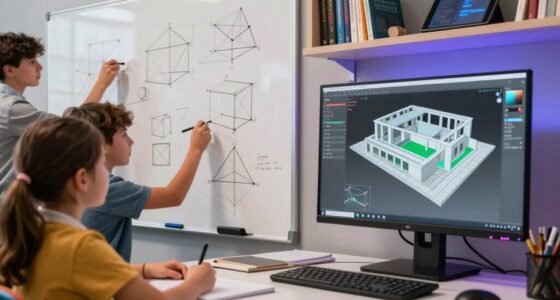

In UX, product design, and motion graphics careers, geometry helps you organize elements for visual harmony, balance, and ease of use. You’ll use principles like the golden ratio, grid systems, and alignment to create intuitive, attractive interfaces and engaging motion sequences. Geometry guides your choices in spacing, proportions, and balance, making designs both functional and aesthetically pleasing. Stay with us to discover how these principles shape your work and boost your creative skills.

Prime made for students and young adults
- Fast, free delivery for dorm and study essentials
- Prime Video and Amazon Music included
- Member-only deals
Key Takeaways
- Geometry guides element placement and visual hierarchy, enhancing usability and intuitive navigation in UX and product design.
- Designers use geometric principles like the golden ratio and grids to achieve balanced, aesthetically pleasing interfaces.
- Motion graphics rely on geometric transformations to create fluid, harmonious animations and visual consistency.
- Product designs incorporate geometric shapes and proportions to improve functionality and visual appeal.
- Understanding geometry helps designers anticipate user perception, balance complex visuals, and craft engaging, purposeful visuals.
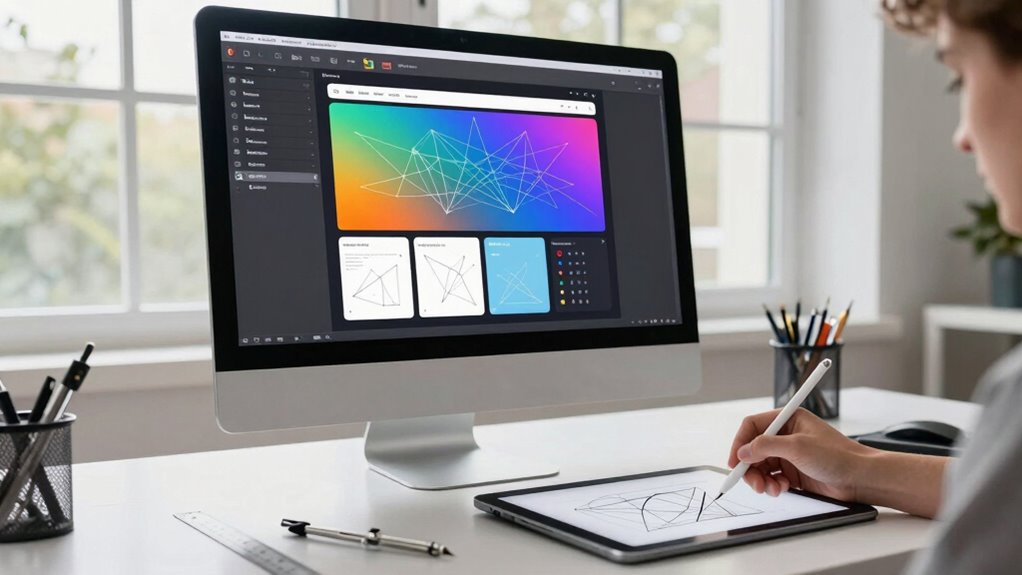
Have you ever wondered how geometric principles shape the way we experience digital interfaces, design visuals, and create motion graphics? It’s all rooted in the way you understand and apply spatial reasoning, which allows you to organize elements in space thoughtfully. When designing user interfaces, you instinctively think about the placement of buttons, menus, and visuals to guarantee users can navigate effortlessly. This isn’t random; it’s an application of spatial reasoning, where you visualize how different components relate to each other and how users will move through the digital environment. You use geometry to create visual harmony—an essential aspect that makes designs aesthetically pleasing and functionally effective. Patterns, symmetry, and proportion guide your choices, making sure that each element complements the whole without overwhelming the user. In motion graphics, this balance becomes even more vital, as you manipulate shapes, lines, and curves to direct attention or evoke emotion. The way objects move and transform relies on geometric principles to maintain visual consistency and fluidity. Recognizing spatial reasoning as a core skill enhances your ability to craft cohesive and engaging designs.
In product design, geometry influences every detail, from the curvature of a device to the layout of a dashboard. You recognize that harmonious proportions and geometric alignment can improve usability and appeal. When designing a mobile app, for example, you consider the size relationships between icons and text, employing the golden ratio or grid systems to create a sense of order and beauty. This mastery of visual harmony guides users naturally, making their interactions feel intuitive and satisfying. Your understanding of geometric concepts enables you to craft interfaces that feel balanced, where each element fits seamlessly into the overall structure. Additionally, visual hierarchy helps prioritize information, guiding users effortlessly through complex data or options. Whether you’re sketching wireframes, selecting color schemes, or animating sequences, geometry supports your creative process. It helps you balance complex visual elements and maintain clarity amid visual clutter. Your ability to think in terms of spatial reasoning allows you to anticipate how users will perceive and interact with your designs, leading to more engaging experiences. By applying geometric principles, you craft visuals that are not only beautiful but also purposeful, guiding users effortlessly through digital spaces. This blend of science and creativity lies at the heart of careers in UX, product design, and motion graphics—where geometry isn’t just a tool, but a foundation for impactful, user-centered design.
As an affiliate, we earn on qualifying purchases.
Frequently Asked Questions
How Can Geometry Improve Accessibility in Digital Interfaces?
You can improve accessibility by applying geometry to create clear, well-structured interfaces that consider color theory and user psychology. Use geometric shapes and layouts to guide users’ attention and make navigation intuitive. High-contrast color schemes based on color theory guarantee readability, while understanding user psychology helps you design for diverse needs. Precise geometric elements make interfaces more inclusive, helping users with visual or cognitive impairments interact confidently.
What Are Common Geometric Principles Used in Logo Design?
In logo design, you use symmetry and balance to create visual harmony that appeals to viewers. Shape hierarchy guides the eye toward the most important elements, ensuring your logo communicates its message effectively. You might incorporate geometric shapes like circles or triangles to evoke stability or movement. These principles help you craft logos that are memorable, aesthetically pleasing, and instantly recognizable by maintaining proportionality and visual order.
How Does Geometry Influence User Flow Optimization?
Geometry influences user flow optimization by guiding how users naturally navigate your interface. You analyze user behavior patterns, using geometric principles like symmetry and alignment to create intuitive pathways that reduce cognitive load. When elements are proportionate and well-organized, users find it easier to complete tasks. This strategic use of geometry guarantees a seamless experience, helping users stay engaged and minimizing frustration as they move through your product.
What Tools Assist in Applying Geometric Concepts to Motion Graphics?
Did you know that 90% of motion graphics artists rely on tools like Adobe After Effects? You can apply geometric concepts through vector transformations and geometric proportions to create smooth, dynamic animations. Tools like After Effects, Cinema 4D, and Blender help you manipulate these principles effortlessly. They enable you to craft complex motion graphics by precisely controlling shapes, angles, and proportions, making your animations more engaging and visually appealing.
Can Understanding Geometry Reduce Design Iteration Time?
Yes, understanding geometry can considerably reduce your design iteration time by enhancing your design precision and spatial reasoning skills. When you grasp geometric principles, you intuitively create balanced layouts and smooth motion paths, minimizing trial and error. This allows you to visualize solutions faster, make accurate adjustments, and streamline your workflow. Ultimately, mastering geometry helps you produce refined designs efficiently, saving you time and effort during the creative process.
As an affiliate, we earn on qualifying purchases.
Conclusion
Think of geometry as the compass guiding your creative voyage. Just as a skilled sailor reads the stars to navigate, you harness geometric principles to craft intuitive interfaces, mesmerizing designs, and fluid motion. When you embrace these shapes and angles, your work becomes a vessel that leads users effortlessly through your vision. Let geometry be your loyal compass—steadfast and precise—as you chart new territories in UX, product design, and motion graphics.
motion graphics animation software
As an affiliate, we earn on qualifying purchases.
As an affiliate, we earn on qualifying purchases.
As an affiliate, we earn on qualifying purchases.
Fall Picks
fall essentials
As an affiliate, we earn on qualifying purchases.