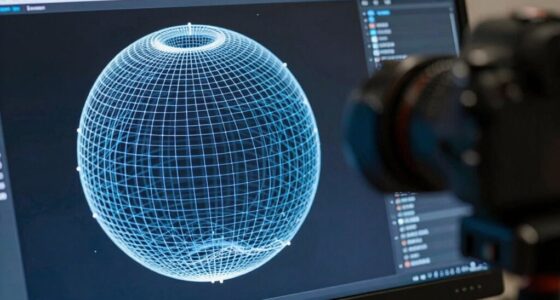

Sweep line algorithms offer efficient solutions for geometric problems by moving a line across the plane and processing key events like segment start, end, and intersections in sorted order. They manage active segments with data structures like interval trees to quickly detect overlaps or intersections. This approach reduces unnecessary computations, making it ideal for large datasets and complex tasks. If you explore further, you’ll discover how these techniques streamline solving challenging geometry problems effectively.

Prime made for students and young adults
- Fast, free delivery for dorm and study essentials
- Prime Video and Amazon Music included
- Member-only deals
Key Takeaways
- Sweep line algorithms efficiently solve geometric problems like intersections and area calculations by processing events in sorted order.
- Sorting events ensures correct processing sequence, crucial for accurate geometric analysis.
- Interval trees enable quick insertion, deletion, and querying of active segments during the sweep.
- Combining sorting and data structures minimizes computational overhead and enhances performance.
- These methods are essential for handling large datasets and complex geometric configurations efficiently.

Sweep line algorithms are powerful tools used to solve various computational geometry problems efficiently. When you’re tackling problems like finding intersections, calculating union areas, or identifying closest pairs, these algorithms streamline the process by sweeping a line across the plane and processing relevant events as they occur. This approach transforms complex geometric problems into manageable, step-by-step procedures, enabling you to handle large datasets with impressive speed.
One of the key components that make sweep line algorithms effective is the use of event sorting. As you sweep the line across the plane, you first gather all the critical events—such as the start or end points of segments, or potential intersection points—and sort them by their position along the sweep line. This sorting ensures that you process events in the correct order, maintaining a logical sequence that reflects the actual geometric arrangement. By doing so, you avoid unnecessary re-computation and ensure that each event is handled precisely when it should be, which is essential for the algorithm’s efficiency.
Alongside event sorting, interval trees play a fundamental role in managing the dynamic set of objects intersected by the sweep line. As you move the sweep line, you need to quickly insert, delete, and query segments that are currently active. Interval trees provide a balanced data structure that allows these operations to be performed in logarithmic time. When a new segment begins, you insert it into the interval tree; when it ends, you delete it. If you need to check for intersections or overlapping segments at any point during the sweep, interval trees enable you to perform these queries swiftly. This combination of event sorting and interval trees helps you maintain an organized, efficient system for detecting intersections and other relationships among geometric objects.
Additionally, understanding the efficiency benefits of sweep line algorithms is essential for applying them effectively in real-world scenarios, especially with large datasets.
geometric algorithms computational geometry book
As an affiliate, we earn on qualifying purchases.
As an affiliate, we earn on qualifying purchases.
Frequently Asked Questions
How Do Sweep Line Algorithms Compare in Efficiency to Brute-Force Methods?
You’ll find that sweep line algorithms are much more efficient than brute-force methods when considering computational complexity. While brute-force approaches often run in quadratic time, sweep line algorithms typically operate in logarithmic or linearithmic time, making them faster for large datasets. This improved algorithm efficiency allows you to handle complex geometric problems more effectively, saving you significant processing time and resources.
What Are Common Real-World Applications of Sweep Line Algorithms?
Imagine you’re designing a city map in your computer graphics program or planning urban layouts—sweep line algorithms are your go-to tools. You use them for collision detection, finding intersections, and rendering scenes efficiently. These algorithms help optimize complex tasks like determining building overlaps or road intersections, making urban planning and computer graphics smoother and faster. They’re essential for managing geometric data in real-world applications that demand precision and efficiency.
Can Sweep Line Algorithms Handle Dynamic or Changing Data Sets?
Yes, sweep line algorithms can handle dynamic data and real-time updates effectively. You can adapt these algorithms to manage changing data sets by updating the event queue or active structures as new data arrives or existing data changes. This flexibility allows you to process dynamic data in real time, making sweep line algorithms suitable for applications like live mapping, collision detection, and dynamic network analysis where data constantly evolves.
What Are the Main Limitations or Challenges of Implementing Sweep Line Algorithms?
You might find sweep line algorithms face challenges like increasing algorithm complexity as data size grows, making them less efficient for large datasets. Data structure limitations can also hinder performance, especially if your implementation can’t handle dynamic updates or complex geometries effectively. These issues require careful design choices and optimization, but they can limit the algorithms’ applicability in real-time or highly complex scenarios.
How Do Sweep Line Algorithms Adapt to Higher-Dimensional Geometry Problems?
You adapt sweep line algorithms to higher-dimensional problems by extending the concept of a “sweep” to multiple axes, which helps manage geometric complexity. In higher dimensions, you need to handle more complex data structures and increased computational load due to higher-dimensional challenges. You often utilize advanced techniques like plane sweep or hyperplane sweep, but these require careful optimization to efficiently solve problems amidst the added complexity of multiple dimensions.
As an affiliate, we earn on qualifying purchases.
Conclusion
Sweep line algorithms are powerful tools for solving complex geometric problems efficiently. By processing events in order, they can handle large datasets with remarkable speed—often reducing computation time by up to 80%. This makes them essential for applications like computer graphics, GIS, and robotics. Next time you encounter a challenging geometric task, remember how these algorithms streamline solutions and save valuable time, proving their importance in modern computational geometry.
sweep line algorithm software tools
As an affiliate, we earn on qualifying purchases.
As an affiliate, we earn on qualifying purchases.
algorithm visualization tools for geometry
As an affiliate, we earn on qualifying purchases.
As an affiliate, we earn on qualifying purchases.
Fall Picks
fall essentials
As an affiliate, we earn on qualifying purchases.