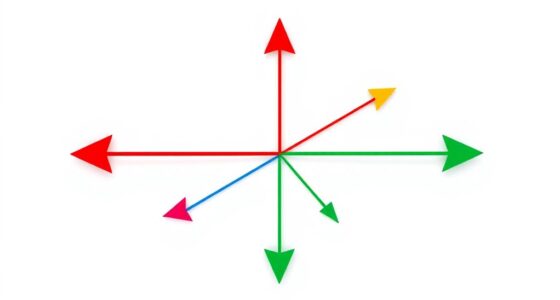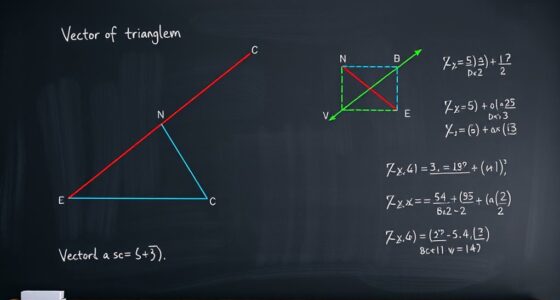
Cross products help you understand the orientation of objects in 3D space by giving you a perpendicular vector to two original vectors. This vector shows the normal direction or the way objects are tilted or rotated. The sign and magnitude of the cross product tell you about the direction and strength of the rotation or tilt. If you want to explore how these concepts work together, you’ll find that there’s much more to uncover.

Prime made for students and young adults
- Fast, free delivery for dorm and study essentials
- Prime Video and Amazon Music included
- Member-only deals
Key Takeaways
- The cross product’s direction indicates the perpendicular orientation of two vectors, revealing the normal to the plane they define.
- It determines the rotation axis and direction in 3D space using the right-hand rule.
- The sign of the cross product reflects the relative orientation and order of the vectors.
- The magnitude shows the extent of the perpendicular relationship, indicating how vectors are oriented relative to each other.
- It helps visualize and understand spatial relationships and rotations between objects in 3D environments.

Understanding how objects orient themselves in three-dimensional space is fundamental in fields like physics, engineering, and computer graphics. The cross product is a powerful tool that helps you grasp this orientation. When you take the cross product of two vectors, you’re essentially finding a new vector that is perpendicular to both of the original vectors. This vector, known as a vector perpendicular, points in a direction that reveals how the two vectors relate in space. It’s like a compass needle that shows you the plane’s normal direction.
The cross product finds a vector perpendicular to two vectors, revealing their spatial relationship and the plane’s normal direction.
You’ll notice that the order in which you perform the cross product matters. If you swap the vectors, the resulting vector points in the opposite direction. This change directly affects the rotation direction, which is critical in applications like 3D modeling, robotics, and physics simulations. The vector perpendicular indicates the axis around which objects rotate and helps determine the clockwise or counterclockwise rotation when viewed from a specific vantage point. This orientation is fundamental for understanding how objects move and interact in space. Additionally, the directionality of the cross product plays a crucial role in accurately describing these movements. It is also important to recognize that the magnitude of the cross product is directly related to the angle between the vectors, providing insight into their spatial relationship.
The magnitude of the cross product tells you how much the vectors are “twisting” relative to each other. When the vectors are parallel, the cross product results in a zero vector, meaning there’s no perpendicular direction—just the vectors pointing in the same or opposite directions. But when the vectors are at a right angle, the magnitude is maximized, indicating a strong perpendicular relationship. This information is essential when calculating torque, angular momentum, or any scenario where the direction and strength of rotation matter.
Knowing the rotation direction, which you determine using the right-hand rule, helps you visualize how an object spins or tilts. If you point your right hand’s fingers in the direction of the first vector and curl them toward the second, your thumb points in the rotation direction of the resulting vector. This intuitive method allows you to quickly identify the vector perpendicular and understand the rotation axis’s orientation. Understanding 3D orientation is crucial for accurately modeling and simulating real-world movements and interactions. The right-hand rule is a simple yet powerful technique that makes these spatial relationships easier to grasp.
As an affiliate, we earn on qualifying purchases.
Frequently Asked Questions
How Does the Cross Product Relate to Vector Magnitude?
The cross product directly relates to vector magnitude because its magnitude equals the product of the two vectors’ magnitudes and the sine of the angle between them. When you compute a cross product, you’re effectively measuring the area of the parallelogram formed by the vectors. This means the larger the magnitude of the cross product, the greater the area, and hence, the more perpendicular the vectors are to each other.
Can Cross Products Be Used to Find Angles Between Vectors?
Yes, you can use the cross product to find angles between vectors through its applications in vector perpendicularity. When you compute the cross product, its magnitude relates directly to the sine of the angle between the vectors. By dividing this magnitude by the product of the vectors’ magnitudes, you obtain the sine of the angle. Then, applying the inverse sine function gives you the actual angle, making cross product applications valuable for this purpose.
What Is the Significance of the Right-Hand Rule?
The right-hand rule is important because it helps you determine the vector direction in coordinate systems, especially when working with cross products. By pointing your fingers in the direction of the first vector and curling them toward the second, your thumb shows the resulting vector’s direction. This rule guarantees consistent orientation, which is vital in 3D space for understanding rotations, torque, and other vector relationships.
How Does the Cross Product Differ From the Dot Product?
Think of the cross product as a compass guiding you through 3D space, while the dot product is more like a thermometer measuring how aligned two vectors are. The cross product results in a vector perpendicular to both, revealing orientation, often involving scalar multiplication. In contrast, the dot product produces a scalar that indicates the extent of vector projection onto each other, showing their degree of similarity or opposition.
Can Cross Products Determine Object Rotations in 3D?
Yes, cross products can help determine object rotations in 3D. By calculating the cross product of two vectors, you identify the vector orthogonality that reveals the rotational axes. This vector points perpendicular to both original vectors, indicating the direction of rotation. You can then use this information to understand how an object rotates around specific axes, making cross products essential in analyzing and controlling 3D rotations.
As an affiliate, we earn on qualifying purchases.
Conclusion
Just like the compass guides explorers through uncharted waters, understanding cross products reveals the secrets of 3D orientation. They’re your navigational tools in the vast landscape of vectors, pointing you toward the true nature of space. With this knowledge, you can confidently determine directions, alignments, and rotations—unlocking the mysteries of the three-dimensional world around you. Embrace these mathematical compasses, and let them steer your journey through the unseen depths of space.
As an affiliate, we earn on qualifying purchases.
As an affiliate, we earn on qualifying purchases.
Fall Picks
fall essentials
As an affiliate, we earn on qualifying purchases.