
You can think of complex numbers as vectors in a 2D plane, where each number has a magnitude and an angle, giving it a clear geometric meaning. This visualization helps you see algebraic operations like addition and multiplication as vector operations, making concepts like phase relationships and signal interference more intuitive. Connecting algebra to geometry makes understanding complex numbers easier and more engaging. Keep exploring these links, and you’ll uncover even deeper insights into their behavior.
Key Takeaways
- Complex numbers can be represented as vectors in a 2D plane, with magnitude and direction corresponding to their real and imaginary parts.
- Algebraic operations like addition and multiplication align with geometric vector operations such as tip-to-tail addition and rotation.
- Phasor representation visualizes complex numbers as rotating vectors, linking algebraic form to geometric motion and oscillations.
- Phase differences between complex numbers correspond to angles between vectors, explaining constructive and destructive interference visually.
- This geometric perspective simplifies understanding complex number behavior and enhances intuition in applications like signal processing.

Complex numbers can be understood as vectors in a two-dimensional plane, where each number corresponds to a point defined by its real and imaginary parts. This perspective allows you to see complex numbers not just as algebraic entities, but as geometric objects that can be added, subtracted, and manipulated visually. One of the most useful tools in this geometric view is the phasor representation, which simplifies the handling of complex numbers, especially when dealing with oscillations and wave phenomena. In phasor form, a complex number is expressed as a magnitude and an angle, making it easier to visualize its behavior as a vector rotating in the plane.
Complex numbers as vectors simplify understanding oscillations and wave behavior through the phasor representation.
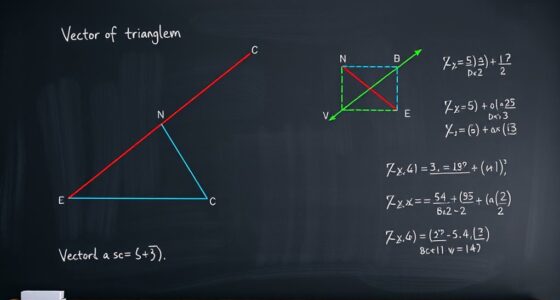
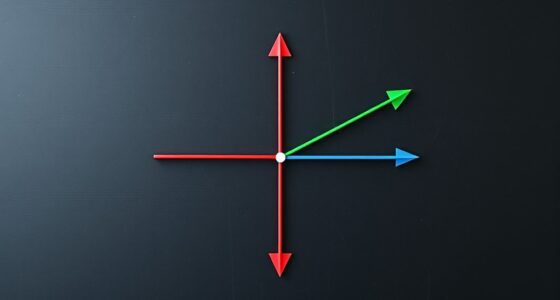
Using the phasor representation, you can think of complex numbers as arrows, or vectors, originating from the origin and pointing toward their respective points. The length of the arrow corresponds to the magnitude, and the angle it makes with the positive real axis indicates its phase. This visualization is particularly helpful when performing vector addition. Instead of dealing with algebraic formulas directly, you can add two complex numbers by placing their vectors tip-to-tail and then drawing the resultant vector from the origin to the tip of the second vector. This method mirrors the geometric process of vector addition, making the operation more intuitive.
When you add complex numbers as vectors, you’re essentially combining their magnitudes and directions. If both vectors are represented in phasor form, you can add them by simply summing their components — their real parts and imaginary parts — to get the resultant’s real and imaginary parts. Alternatively, you can perform the addition graphically: place the vectors head-to-tail and draw the resultant. This approach emphasizes the geometric nature of complex addition, illustrating how two oscillations or signals combine in real-world applications like electrical engineering or signal processing.
This geometric approach to complex numbers also enhances your understanding of how phase relationships influence the sum of signals. For example, if two vectors point in the same direction, their magnitudes add directly, leading to constructive interference. If they point in opposite directions, they partially cancel out, resulting in a smaller resultant vector. Through this lens, you see complex addition as a visual, tangible process, bridging the gap between algebra and geometry. Incorporating vector operations into your understanding further clarifies how signals combine and interact. This connection helps you grasp the underlying principles more deeply, especially in fields that rely heavily on wave and oscillation analysis. Ultimately, viewing complex numbers as vectors and using phasor representation simplifies complex calculations and provides a clearer, more intuitive understanding of their behavior in the plane.
Frequently Asked Questions
How Do Complex Numbers Relate to Other Types of Vectors?
You can think of complex numbers as vectors in a plane, where vector addition corresponds to adding their real and imaginary parts. The magnitude of a complex number is like a vector’s length, and the angle it makes with the real axis is its argument. This connection helps you visualize and manipulate complex numbers using geometric concepts, making operations like addition, subtraction, and multiplication more intuitive through the lens of vectors.
Can Complex Numbers Represent Three-Dimensional Vectors?
Oh, sure, complex numbers can magically represent three-dimensional vectors—if only they could. In reality, they exist in the complex plane, which is two-dimensional, making vector addition straightforward. To handle 3D vectors, you’d need quaternions or other advanced tools. So, while they’re perfect for 2D, complex numbers fall short in capturing the full three-dimensional space, proving their limits beyond the plane.
What Are the Limitations of Viewing Complex Numbers as Vectors?
You’ll face limitations when viewing complex numbers as vectors, mainly due to visualization challenges and dimensional constraints. Complex numbers naturally represent two-dimensional quantities, but trying to extend this to three or more dimensions isn’t straightforward. You might find it hard to visualize interactions beyond the plane, and the mathematical framework doesn’t easily support higher-dimensional vectors. These constraints make complex numbers ideal for 2D problems, but less practical for 3D or beyond.
How Does This Vector Perspective Aid in Solving Geometric Problems?
Think of complex numbers as a magic compass guiding your way through geometric problems. This vector perspective helps you visualize rotation transformations effortlessly by manipulating magnitude and angle. You can rotate points, scale figures, and find intersections with simple algebraic steps. By seeing complex numbers as vectors, you turn abstract shapes into concrete operations, making geometric challenges more intuitive and manageable—like wielding a powerful tool to unseal hidden patterns.
Are There Real-World Applications of This Complex Vector Interpretation?
Yes, there are real-world applications of this complex vector interpretation. In engineering applications, it helps you analyze and design systems like control systems and circuits more efficiently. In signal processing, you use it to simplify the manipulation of signals, especially when dealing with amplitude and phase. This perspective makes complex calculations more intuitive, allowing you to solve problems faster and with greater accuracy in various technical fields.
Conclusion
You now see how complex numbers cleverly connect algebra and geometry, creating a mesmerizing canvas of concepts. By viewing them as vectors, you bridge the beautiful boundary between numbers and shapes, making mathematics more meaningful. Mastering this method means you can manipulate, visualize, and maximize your understanding of complex calculations with confidence and clarity. Embrace this powerful perspective, and let it lead you to a deeper, dynamic discovery of the dazzling domain of complex numbers.