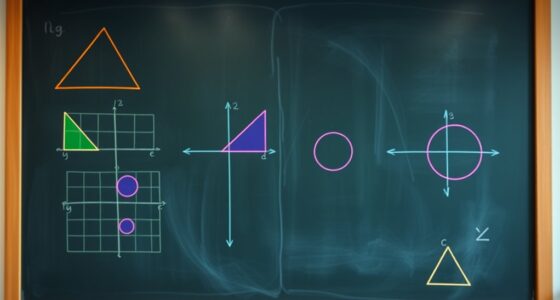

When you combine translations followed by rotations, you move a shape to a new position and then turn it around a fixed point. This process preserves the shape’s size, angles, and symmetry, making the transformations rigid and predictable. The order matters—translating first then rotating results in a different final position than doing it the other way. If you keep exploring, you’ll discover how these combined movements create complex, yet understandable, shape behaviors.
Key Takeaways
- Translating a shape first moves it across the plane without altering its size or angles.
- Following translation with rotation changes the shape’s position and orientation while preserving its size and internal angles.
- The combination of translation and rotation results in a rigid motion, maintaining the shape’s congruence and symmetry.
- The order of transformations affects the final placement; translation before rotation shifts the shape before turning it.
- Both transformations preserve internal angles and side lengths, ensuring the shape remains unchanged in form.
Have you ever wondered how shapes move across a plane? When you combine transformations like translations and rotations, the movement becomes more dynamic and interesting. Imagine sliding a shape to a new position and then turning it around a point. This sequence can produce complex results, but understanding the underlying principles helps you predict what will happen. One key aspect to consider is how these transformations interact, especially when it comes to properties like reflection symmetry and angle preservation. Reflection symmetry means that one half of a shape is a mirror image of the other, and when you apply transformations, this symmetry can be maintained or altered depending on the type of movement.
When you perform a translation first, you slide the shape across the plane without changing its size or angles. This movement preserves angles and distances, so the shape remains congruent to its original form. If the shape has reflection symmetry, translating it will shift that symmetry across the plane, but the overall symmetry remains intact since the shape’s internal angles and proportions stay the same. The translation does not distort the shape; it simply relocates it. Next, if you rotate the shape, the position changes again, but fundamentally, rotations preserve angles and distances from the center of rotation. This means the shape’s internal angles stay the same, and the size remains unchanged, ensuring that the shape’s reflection symmetry, if present, is also preserved during the rotation.
The order of these transformations matters. Performing a translation followed by a rotation typically results in a shape that maintains its original angles and reflection symmetry, but in a new position. The reflection symmetry might appear to shift or change, but the shape’s inherent symmetry properties are preserved because both transformations are rigid motions—they don’t alter size or shape. The combined effect shows how the shape’s features are maintained through each step, highlighting the importance of understanding how transformations interact.
Frequently Asked Questions
How Do Combined Transformations Affect Object Orientation?
When you combine transformations, the object’s orientation changes based on the matrix multiplication of each transformation. If you perform a translation first and then a rotation, the object rotates around a point relative to its new position. The transformation hierarchy determines the order, affecting the final orientation. You should carefully order your transformations because matrix multiplication is not commutative, meaning changing the order alters the result.
Can Multiple Transformations Be Applied Simultaneously?
Yes, you can apply multiple transformations simultaneously using transformation matrices within coordinate systems. You do this by multiplying the matrices together into a single composite matrix, which then transforms your object in one step. This approach simplifies complex transformations, ensuring your object undergoes translations, rotations, or scaling all at once. Just remember, the order of matrix multiplication matters, as it affects the final orientation and position of your object.
What Are the Practical Applications of Combined Transformations?
Imagine moving a piece on a chessboard, then spinning it around its center—that’s how combined transformations work. You use transformation matrices within coordinate systems to perform complex actions like animations, robot arm movements, or image editing. These practical applications allow precise control over objects, making animations smooth, robotic movements accurate, and graphic designs dynamic. By combining translations and rotations, you create seamless, realistic transformations in various technological and creative fields.
How Do Transformations Interact in Three-Dimensional Space?
In three-dimensional space, transformations interact through coordinate systems and transformation matrices. You apply these matrices to points or objects to move, rotate, or scale them. When you combine transformations, you multiply their matrices, which results in a single, complex transformation. This process enables precise control over object positioning and orientation in 3D space, essential for applications like computer graphics, robotics, and animation.
Are There Software Tools That Simplify Combined Transformations?
Yes, there are software tools that simplify combined transformations using coordinate systems and transformation matrices. Programs like Blender, MATLAB, and AutoCAD let you apply multiple transformations easily, often through intuitive interfaces or scripting. You can manipulate objects by adjusting transformation matrices directly or using built-in functions, making it simple to perform complex translations and rotations in three-dimensional space without manually calculating each step.
Conclusion
Just like Odysseus steering treacherous waters, combining translations and rotations lets you craft precise movements in space. Remember, these transformations are your compass and sail—guiding and propelling your figures with purpose. Mastering their interplay access endless creative possibilities, turning simple shapes into complex worlds. So, embrace this dance of shifts and spins, and let your imagination set sail—because, in the domain of transformations, you’re the hero charting your own course.