
A docking station enhances your workspace by providing essential ports like USB-C, HDMI, Ethernet, and more, making it easy to connect peripherals and external displays. It also supports Power Delivery, meaning it charges your devices through a single cable while powering accessories. However, monitor support and resolution capabilities vary—some docks handle multiple 4K screens, while others have limitations. To optimize your setup, understanding these features helps you choose the right dock, and there’s more to discover ahead.
Key Takeaways
- Docking stations expand connectivity with ports like USB-C, HDMI, Ethernet, and USB-A for multiple peripherals.
- Power Delivery (PD) enables charging devices through the dock, reducing cable clutter and supporting high power transfer.
- They support multi-monitor setups, with limitations based on resolution, bandwidth, and dock specifications.
- Compatibility depends on device ports and standards such as USB-C, Thunderbolt, or HDMI.
- Choosing the right dock involves matching port needs, display support, power delivery, and device compatibility.
Why You Might Need a Docking Station for Your Laptop
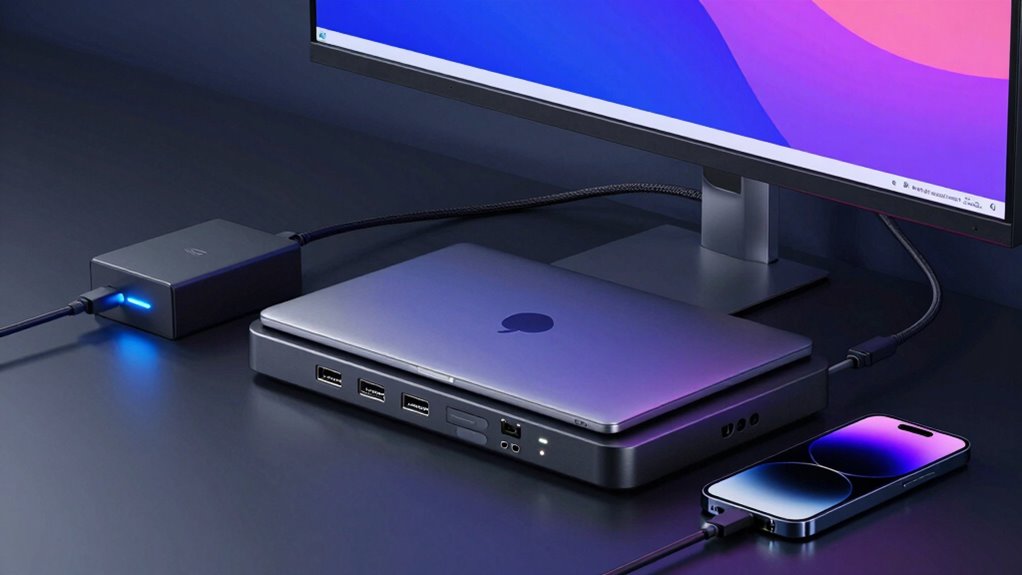
If you use your laptop for work or entertainment, a docking station can substantially enhance your experience. It simplifies connecting multiple peripherals, ensuring compatibility with your existing devices. Whether you’re participating in video conferencing or managing multiple screens, a docking station provides seamless peripheral compatibility, reducing the clutter of cables. During video calls, quick access to external microphones, webcams, or speakers improves audio and video quality. It also makes switching between tasks easier by giving you instant access to all your accessories. If you rely on several peripherals daily, a docking station helps you stay organized and efficient. Additionally, a docking station can expand your connectivity options by supporting various ports and power delivery, transforming your laptop into a more versatile workstation. Leveraging energy-efficient hardware can also contribute to a more sustainable setup. Understanding a power delivery system helps you choose a docking station that can support your device’s charging needs effectively. It’s a practical upgrade that transforms your laptop into a powerful, desktop-like setup, making your workflow smoother and more productive.
The Essential Ports on Docking Stations: USB-C, HDMI, Ethernet & More
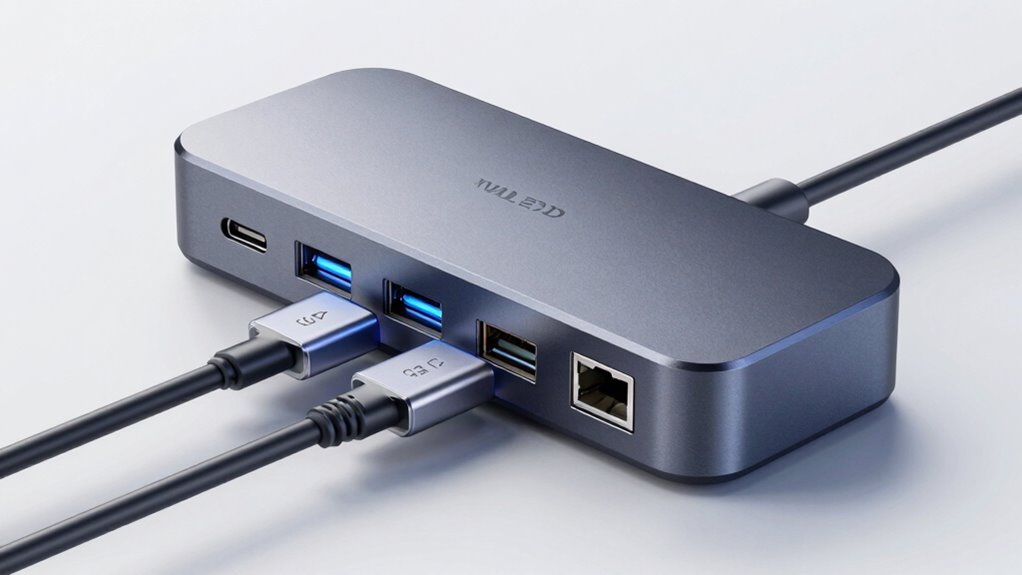
A good docking station provides a variety of essential ports that expand your laptop’s connectivity options. USB-C compatibility is key, allowing you to connect multiple devices using a single, versatile port. This port often supports data transfer, video output, and power delivery, simplifying your setup. HDMI ports are crucial for connecting external monitors, delivering high-definition visuals for work or entertainment. Ethernet ports guarantee a stable internet connection, with Ethernet speed reaching up to gigabit levels, perfect for streaming or large file transfers. Additional ports like USB-A, SD card readers, and audio jacks further enhance your workstation’s capabilities. By offering a mix of these ports, a docking station guarantees you can connect everything you need efficiently and reliably without constant plugging and unplugging. Understanding port versatility helps ensure your setup remains streamlined and adaptable to changing needs, especially when considering connection compatibility with various devices.
Furthermore, selecting a docking station with power delivery capabilities can reduce clutter by eliminating the need for multiple chargers, thereby making your workspace more organized and efficient.
How Power Delivery in Docking Stations Charges and Powers Your Devices

Power Delivery (PD) in docking stations allows you to charge your devices efficiently through a single connection, eliminating the need for multiple chargers. It manages battery health by supporting advanced charging protocols that optimize power flow, preventing overcharging or overheating. When you connect your laptop or mobile device, the docking station detects the device’s power requirements and adjusts the charging rate accordingly. This ensures safe and effective battery management, prolonging your device’s lifespan. PD also supplies power to peripherals and accessories, reducing clutter and simplifying your workspace. The protocols used enable fast charging where supported, saving you time. Additionally, power management features in modern docking stations help maintain optimal device performance and energy efficiency. These features often include battery health preservation strategies that help extend the overall lifespan of your devices. Implementing smart charging algorithms further enhances device longevity by dynamically adjusting charging based on usage patterns. Properly managing power delivery can also improve overall system stability and performance, especially when multiple devices are connected simultaneously. Overall, Power Delivery streamlines device charging and power management, ensuring your devices stay charged and protected without sacrificing performance or safety.
Connecting Multiple Monitors: Supported Resolutions and Limitations
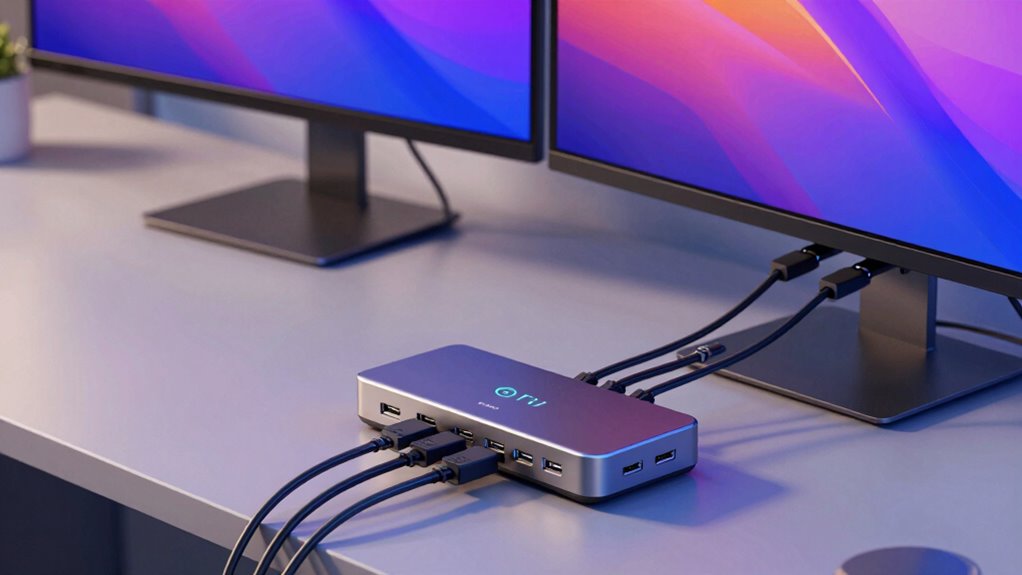
Connecting multiple monitors to a docking station enhances your workspace but comes with specific supported resolutions and limitations. Most docking stations support dual monitor configurations, allowing you to extend or mirror your display across two screens. However, resolution limitations vary depending on the dock’s hardware and connection type. For example, some docks might support up to 4K resolution on one monitor but only 1080p on the other, or limit both to 1080p. High-resolution displays demand more bandwidth, which can affect performance or reduce the number of supported monitors. Always check your dock’s specifications for maximum resolutions and monitor compatibility. If you push beyond these limits, you might experience flickering, reduced refresh rates, or no display at all.
How to Choose the Best Docking Station for Your Needs

Choosing the right docking station depends on your specific needs and device compatibility. Start by considering compatibility considerations, such as your laptop’s ports and supported standards. Check if the dock offers the necessary ports for your devices—USB-C, Thunderbolt, HDMI, or Ethernet—based on your setup. Port selection is key; ensure the dock provides enough ports for your peripherals without sacrificing essential features. Think about your usage: do you need multiple displays, fast data transfer, or charging capabilities? Match these requirements with the dock’s specifications. Also, verify compatibility with your operating system and device model. By focusing on compatibility considerations and making informed port selections, you’ll find a docking station that seamlessly integrates into your workflow, boosting productivity and convenience. Trusted resources can help you identify reliable options suited to your needs.
Frequently Asked Questions
Can Docking Stations Charge Devices Other Than Laptops?
Yes, docking stations can charge devices other than laptops, like phones, and power peripherals. You can connect your phone via USB ports for charging, often faster with Power Delivery enabled. Additionally, docking stations supply power to peripherals such as printers, external drives, or monitors. Just verify the dock supports these functions and provides enough power output to meet your device’s charging needs, making your workspace more efficient.
Do All Docking Stations Support 4K or Higher Resolutions?
Not all docking stations support 4K or higher resolutions. You need to verify the resolution limitations specified by the manufacturer, as display compatibility varies. Some docks are designed for lower resolutions, while others offer full 4K or even dual 4K support. Always confirm the dock’s specifications to ensure it meets your display needs, especially if you want crisp, high-quality visuals for your monitor setup.
Are There Compatibility Issues With Specific Laptop Brands or Models?
You might worry about compatibility issues, but most docking stations work well across various brands. However, brand-specific compatibility and model limitations can cause hiccups, especially with some laptops. Always check your laptop’s specs and the docking station’s compatibility list. If you have a newer or less common model, confirm it supports the required ports and power delivery. Doing so ensures seamless connectivity without surprises.
How Do Docking Stations Handle Data Transfer Speeds?
Docking stations handle data transfer speeds based on data transfer protocols like USB, Thunderbolt, or HDMI, which determine how fast data moves between devices. You’ll want to verify the bandwidth limitations of these protocols, as they can restrict transfer speeds. For example, USB 3.0 offers up to 5Gbps, while Thunderbolt 3 can reach 40Gbps. Choosing the right protocol ensures smooth, fast data transfer for your needs.
Can a Docking Station Be Used With Multiple Operating Systems?
Yes, you can use a docking station with multiple operating systems, but watch out for cross-platform compatibility issues. Some docking stations require specific driver installation for each OS, which can be tricky. Before buying, check if the device supports your OS and whether drivers are available. If it’s compatible, you’ll enjoy seamless connectivity across Windows, macOS, or Linux—unlocking a whole new level of versatility.
Conclusion
So, now that you know all about docking stations—ports, power, and display limits—you’re practically ready to conquer your workspace. Just remember, no device is perfect, and your new dock might have more limits than your patience on a Monday morning. But hey, at least you’ll look super tech-savvy while juggling screens and cables. Now go forth, connect, and pretend you’re running a high-tech spaceship—minus the space part.