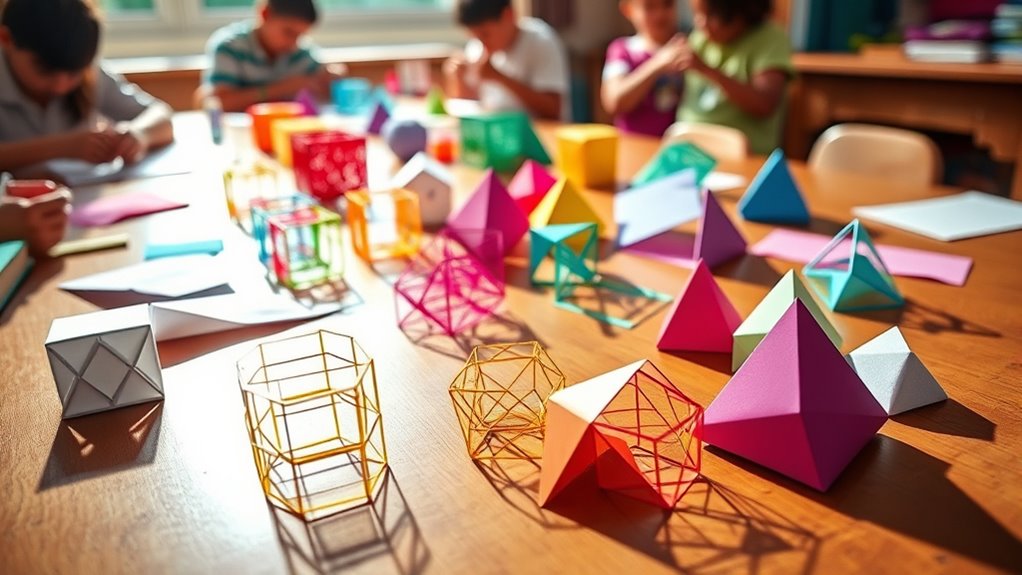

Constructing 3D shapes from 2D nets involves visualizing how flat patterns of faces fold along edges to form solid figures. You’ll need to identify the faces in the net and imagine how they come together, connecting along the edges to create corners and sides. This process enhances your spatial awareness and shape recognition skills. Keep exploring, and you’ll discover more about how these faces transform into complete 3D objects.
Key Takeaways
- Recognizing nets involves visualizing how flat faces fold to form edges, vertices, and the overall 3D shape.
- Folding along edges connects faces, transforming a 2D net into a three-dimensional object.
- Understanding spatial relationships between faces aids in accurately constructing the 3D shape from its net.
- Practicing with nets enhances mental visualization and develops skills to identify 3D objects from flat patterns.
- Nets serve as blueprints for assembling various shapes like cubes, pyramids, and cylinders in both educational and practical contexts.
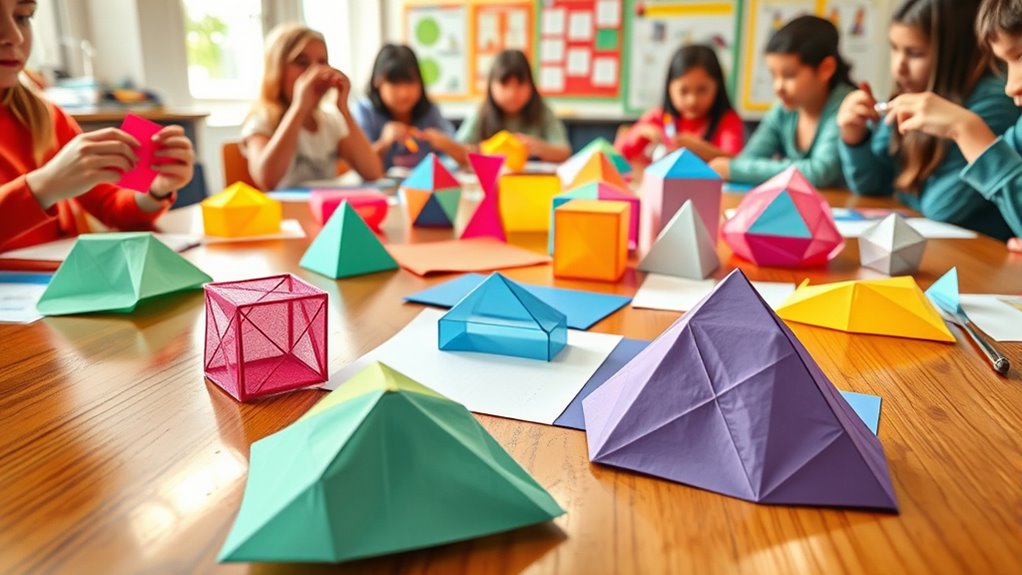
Have you ever wondered how a flat shape can turn into a three-dimensional object? It’s a fascinating process that involves understanding how 2D nets transform when folded. When you look at a net, you’re seeing a flat layout of all the faces that make up a 3D shape. Net folding is the key step that brings these faces together, creating a solid figure. Your ability to recognize the shape from its net depends on shape recognition skills—your capacity to visualize how the faces will come together and form the sides, edges, and vertices of the object. This process isn’t just about seeing a flat pattern; it’s about mentally simulating the folding to anticipate the final form.
As you work with nets, you begin to see how each face connects to another. You might notice that a net for a cube, for example, consists of six squares arranged in a particular pattern. When you fold along the edges, these squares come together, forming the cube’s corners and edges. Shape recognition plays a *vital* role here because you need to picture how each face will align and connect. This mental exercise helps you understand not only the shape itself but also the spatial relationships between its parts. It’s like solving a puzzle where each piece has to fit perfectly to create the final 3D object.
Connecting faces in nets helps you visualize and understand the final 3D shape better.
Practicing with nets sharpens your ability to visualize in three dimensions. As you manipulate the flat layout, you develop a mental model of the shape, which improves your spatial awareness and understanding of geometry. When you become skilled at this, you can quickly identify the 3D object represented by a net just by looking at its layout. This skill is useful in many areas, from geometry to engineering, where understanding how 2D diagrams translate into physical forms is essential. The more you experiment with different nets—such as those for cones, cylinders, or pyramids—the better you become at predicting how the folded shape will look.
In essence, constructing 3D shapes from 2D nets is about more than just folding paper; it’s about developing shape recognition and spatial visualization skills. It requires you to think about how flat faces can come together in space, which enhances your understanding of geometry at a fundamental level. With practice, you’ll find it easier to see the potential of a simple net and imagine the solid shape it can become. This combination of visualizing and folding transforms a simple piece of paper into a three-dimensional object, revealing the beauty of geometric construction.
Frequently Asked Questions
Can All 2D Nets Be Folded Into 3D Shapes?
Not all 2D nets can be folded into 3D shapes because net complexity and shape recognition are key factors. Some nets are incomplete or too complex, making folding impossible or resulting in non-compact shapes. You need to carefully analyze the net’s structure and visualize how the faces will align. With practice, you’ll improve your shape recognition skills, helping you determine which nets can form valid 3D objects.
What Tools Can Assist in Constructing 3D Shapes From Nets?
Imagine your hands as skilled architects guiding a symphony of shapes. Digital modeling tools like CAD software help you visualize and manipulate 3D forms from nets with precision. Folding templates, whether printable or digital, serve as your blueprint to fold and assemble. These tools transform flat patterns into tangible, three-dimensional structures, making the process both creative and accurate, like turning a simple sketch into a masterpiece.
How Do You Identify the Correct Edges to Fold?
To identify the correct edges to fold, you should look for matching edges and fold lines on the net. Match edges that align and fit together seamlessly, ensuring the shape forms correctly. Follow the fold lines carefully, as they guide where the shape bends. Pay attention to any markings or dotted lines on the net, which indicate where you should fold, helping you assemble the 3D shape accurately.
Are There Common Mistakes When Assembling 3D Shapes From Nets?
You might fall into common folding errors or misidentify the correct net parts, which can lead to a shape that doesn’t quite fit. Watch out for flipping flaps or folding along the wrong lines—these mistakes can be tricky to spot until you see the final shape. To avoid this, double-check your net’s labels and fold carefully, ensuring each piece aligns perfectly before making any creases.
How Can I Verify if the 3D Shape Is Correctly Constructed?
To verify if your 3D shape is correctly constructed, check the edge alignment to guarantee all edges meet perfectly without gaps or overlaps. Also, examine surface consistency; each face should align smoothly with adjacent faces, maintaining proper proportions. If everything fits together seamlessly and the shape matches the intended net, then you’ve built it correctly. Carefully inspect all connections to confirm accuracy before finalizing your model.
Conclusion
By mastering how to construct 3D shapes from 2D nets, you unveil a new way to visualize complex structures. Did you know that over 70% of students find hands-on activities like net folding improve their understanding of geometry? So, next time you see a net, realize you’re transforming flat shapes into solid figures, sharpening your spatial skills. Keep practicing, and you’ll find building 3D shapes becomes easier and more intuitive than ever before.