
Geometric puzzles like tangrams and pentominoes have intrigued people for centuries, blending art, mathematics, and culture. These puzzles challenge you to manipulate shapes through symmetry and spatial reasoning, helping improve visualization and problem-solving skills. They’ve evolved from ancient spiritual tools to modern intellectual pursuits, often reflecting cultural values and environmental consciousness. If you keep exploring, you’ll discover more about how these timeless puzzles continue to inspire innovation and creativity.
Key Takeaways
- Geometric puzzles like tangrams and pentominoes have deep cultural roots and historically symbolize intellectual and artistic achievement.
- They develop essential skills such as spatial reasoning, visual manipulation, and pattern recognition through shape arrangement challenges.
- Mastery involves visualization techniques, breaking shapes into manageable parts, and systematic approaches focusing on edges and corners.
- Modern designs emphasize sustainability and cultural respect, integrating environmental considerations into puzzle creation.
- Exploring beyond traditional puzzles includes tiling problems and symmetry challenges that enhance creative problem-solving abilities.
The Origins and Evolution of Shape-Shifting Puzzles

Shape-shifting puzzles have a rich history that dates back centuries, demonstrating humanity’s fascination with manipulating forms and spatial relationships. Their history overview reveals how different cultures created puzzles to challenge minds and showcase artistic ingenuity. For example, ancient Chinese tangrams were used not only for entertainment but also for storytelling and spiritual reflection, giving them deep cultural significance. Similarly, European puzzles like pentominoes emerged during the 19th century, reflecting a growing interest in mathematical pattern recognition. Over time, these puzzles evolved from simple recreational tools into symbols of intellectual mastery and cultural expression. Additionally, environmental considerations have influenced modern puzzle design, emphasizing sustainability and cultural respect. Today, their enduring appeal highlights their importance in both the history of recreational mathematics and the cultural significance of creative problem-solving across civilizations.
Exploring Different Types of Geometric Challenges
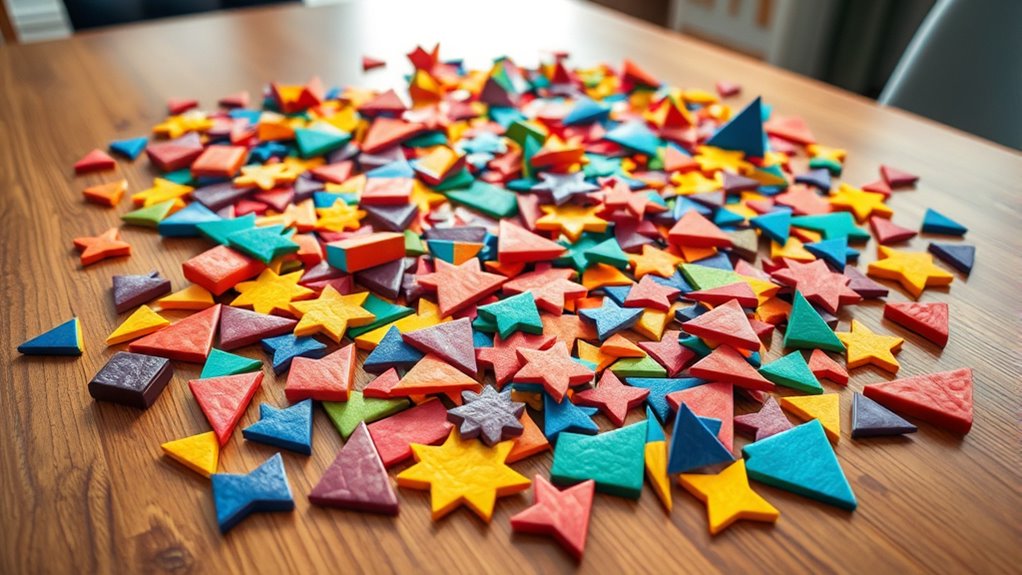
Geometric challenges come in many forms, each testing different aspects of spatial reasoning and problem-solving skills. Some puzzles emphasize symmetry principles, requiring you to recognize balanced patterns and mirror images to find solutions. Others focus on spatial visualization, demanding you to mentally manipulate shapes, rotate figures, or predict how pieces fit together. These challenges push you to think in multiple dimensions, honing your ability to see relationships between shapes and their positions. You might work with tangram puzzles, where symmetry guides your arrangement, or explore tiling problems that test your mental rotation skills. Engaging with these diverse types of geometric puzzles not only improves your visualization skills but also develops your capacity for creative problem-solving. By engaging with these diverse types of geometric puzzles, you develop a sharper understanding of how shapes relate in space, enhancing both your visual intuition and problem-solving abilities.
Strategies and Tips for Mastering Shape-Based Puzzles

Mastering shape-based puzzles requires more than just recognizing patterns; it calls for strategic approaches that simplify complex problems. Start by developing strong visualization techniques—mentally manipulating pieces to see how they fit together. Practice breaking down shapes into manageable parts, which enhances your spatial reasoning skills. Before moving pieces, take a moment to mentally picture their placement and how they interact with the surrounding shapes. Experiment with different orientations and arrangements, trusting your ability to envision multiple possibilities. Keep a systematic approach, focusing on the edges and corners first, then filling in the center. With consistent practice, your visualization and spatial reasoning will improve, making even the most challenging puzzles more approachable and enjoyable to solve.
Frequently Asked Questions
How Do Shape Puzzles Improve Spatial Reasoning Skills?
Shape puzzles boost your visual-spatial development by challenging you to mentally manipulate and fit pieces together, which enhances your problem-solving skills. As you work through these puzzles, you learn to visualize how shapes interconnect and move in space. This active engagement sharpens your ability to analyze spatial relationships, improving your overall spatial reasoning. You’ll find yourself better equipped to tackle complex problems that require understanding of spatial concepts.
Are There Digital Versions of Traditional Geometric Puzzles?
Yes, there are digital versions of traditional geometric puzzles. You can find virtual manipulatives and puzzle apps that let you explore shapes and spatial relationships on your device. These tools often mimic physical puzzles but add interactive features, making learning engaging and accessible anywhere. Whether you’re solving tangrams or pentominoes digitally, these options help you develop your spatial reasoning skills while enjoying modern convenience.
What Are Some Famous Geometric Puzzle Competitions Worldwide?
Did you know that the International Puzzle Party, founded in 1978, hosts some of the most prestigious geometric puzzle competitions worldwide? These events celebrate puzzle history and cultural significance, attracting enthusiasts from over 30 countries. Competitions like the World Puzzle Championship showcase skills in tangrams, pentominoes, and beyond, fostering global community and innovation in this timeless art. You can participate or simply enjoy the fascinating world of puzzle solving.
Can Shape Puzzles Aid in Early Childhood Education?
Shape puzzles can substantially aid your child’s early education by enhancing shape recognition skills and supporting cognitive development. As they manipulate pieces, they learn to identify different forms and understand spatial relationships. This hands-on activity encourages problem-solving, improves fine motor skills, and boosts creativity. Incorporating shape puzzles into their routine makes learning engaging and helps build a solid foundation for future mathematical and logical thinking skills.
How Do Geometric Puzzles Relate to Mathematical Concepts?
You see, geometric puzzles connect deeply with mathematical concepts like symmetry patterns and tessellation principles. When you manipulate shapes, you explore how they fit together, revealing how symmetry creates balance and tessellations form repeating patterns. These activities help you visualize abstract ideas, making math more tangible. By engaging with puzzles, you develop a strong foundation in understanding how shapes and patterns work, enriching your mathematical thinking.
Conclusion
You’ve explored the fascinating world of geometric puzzles, from tangrams to pentominoes. These challenges sharpen your problem-solving skills and boost creativity. Did you know that studies show puzzle enthusiasts improve their spatial reasoning by up to 30%? Keep practicing, and you’ll open new levels of mental agility. Whether you’re a beginner or a seasoned solver, these shape-shifting puzzles offer endless fun and learning. Immerse yourself and discover the joy of mastering geometric challenges!