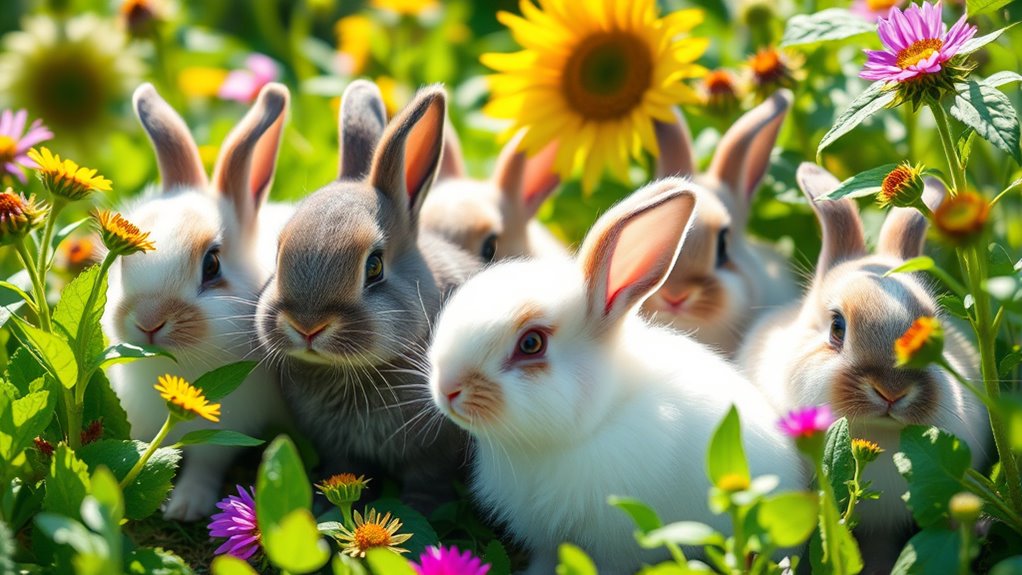

Fibonacci’s rabbit problem shows how a simple recurrence creates a fascinating sequence that models population growth, but it also reveals surprises in nature. You’ll see these numbers appear in sunflower seeds, pinecones, and spiral galaxies, demonstrating how the sequence connects to efficient natural patterns. By exploring Fibonacci’s fascinating world, you’ll uncover how this pattern shapes our universe in unexpected ways. Keep exploring to discover even more astonishing links between math and nature.

Prime made for students and young adults
- Fast, free delivery for dorm and study essentials
- Prime Video and Amazon Music included
- Member-only deals
Key Takeaways
- The Fibonacci sequence models rabbit population growth through a simple recurrence relation.
- Each number in the sequence represents the total rabbit pairs after a certain month.
- The sequence reveals surprising connections between natural patterns and mathematical recurrence.
- Fibonacci’s rabbit problem illustrates how recursive processes produce Fibonacci numbers.
- The growth pattern demonstrates how natural systems can be understood through mathematical surprises.

Have you ever wondered why the Fibonacci sequence appears everywhere from nature to art? It’s because this sequence is deeply connected to the Golden Ratio, a mathematical proportion that’s often associated with beauty and harmony. When you look around, you’ll notice that many nature patterns follow this ratio, creating a sense of balance that’s both pleasing and efficient. From the arrangement of sunflower seeds to the spiral shells of nautiluses, Fibonacci numbers guide the way nature organizes itself. These patterns aren’t just random—they’re the result of millions of years of evolution favoring structures that maximize resources and stability. Recognizing these patterns helps you see the world through a new lens, appreciating the underlying order in seemingly chaotic systems.
The Golden Ratio, approximately 1.618, is closely linked to Fibonacci numbers because the ratio of successive Fibonacci numbers tends to approach this value as the numbers grow larger. This isn’t a coincidence; it’s a mathematical bridge connecting the sequence with natural proportions. When you observe a sunflower’s seed arrangement, for example, the spirals often follow Fibonacci numbers like 21 and 34, which contribute to an ideal packing pattern. The same applies to pinecones, pineapples, and even galaxies—these nature patterns follow Fibonacci-inspired spirals that maximize space and resource distribution. This efficiency isn’t purely aesthetic; it’s a survival trait that helps plants and animals grow in a balanced way. Understanding this connection deepens your appreciation for how math underpins the natural world, revealing a hidden order that’s both functional and beautiful. Additionally, the self-similar structure of fractals in nature often echoes Fibonacci patterns, illustrating how these numbers influence complex systems beyond simple spirals.
You can also see Fibonacci’s influence in architecture and art, where the Golden Ratio is used to create pleasing compositions. Artists and designers incorporate these proportions to evoke harmony and balance, making their work more engaging. When you recognize Fibonacci-inspired patterns, you start seeing them everywhere—on the petals of flowers, in the arrangement of leaves, and even in the spiral galaxies that swirl across the universe. These recurring themes demonstrate how fundamental the Fibonacci sequence is to the structure of everything around you. By exploring these patterns, you gain insight into the natural principles that shape our world. The more you observe, the more you realize that Fibonacci isn’t just a sequence of numbers; it’s a universal language that describes the elegance and efficiency inherent in nature’s design.
Fibonacci sequence educational kit
As an affiliate, we earn on qualifying purchases.
As an affiliate, we earn on qualifying purchases.
Frequently Asked Questions
How Did Fibonacci Discover the Sequence’s Connection to Rabbits?
Fibonacci discovered the sequence’s connection to rabbits through a problem he posed in his book, exploring how rabbit populations grow. In the historical context of mathematical origins, he used this scenario to illustrate a recurrence relation, showing how each new generation depends on the previous ones. By observing rabbit pairs over time, Fibonacci identified the pattern now known as the Fibonacci sequence, highlighting its natural mathematical beauty and real-world relevance.
Are Fibonacci Numbers Used in Modern Technology or Nature?
You’ll find Fibonacci numbers everywhere in modern technology and nature. They’re used in digital encryption to create secure algorithms and in musical compositions to craft pleasing, harmonious patterns. Nature also displays these numbers in sunflower seeds, pinecones, and even galaxy spirals. By recognizing Fibonacci sequences, you can see how math influences both natural forms and advanced tech, highlighting the beauty and practicality of these numbers in everyday life.
Can Fibonacci Sequence Be Applied to Financial Markets or Investments?
Yes, you can apply the Fibonacci sequence to financial markets and investments. In market analysis, traders use Fibonacci retracement levels to identify potential support and resistance points. Incorporating these levels into your investment strategies helps you make informed decisions about entry and exit points. While not foolproof, leveraging Fibonacci tools can improve your understanding of market trends and enhance your overall trading approach.
What Are Some Surprising Patterns Hidden Within Fibonacci Numbers?
You’ll be surprised to find spiral patterns in nature and art that align with Fibonacci numbers, creating visually appealing designs. Additionally, some Fibonacci numbers are prime, which is unexpected given their recursive nature. These hidden patterns reveal how Fibonacci sequences influence natural phenomena, from galaxies to shells, and even human-made structures. Exploring these surprises helps you appreciate the deep mathematical harmony underlying the world around you.
How Does the Fibonacci Sequence Relate to the Golden Ratio?
Imagine the Fibonacci sequence as a journey where each step echoes the universe’s harmony. You see, the sequence ratios approach the golden ratio, a symbol of mathematical beauty. As numbers grow, their ratios reveal a timeless pattern, whispering secrets of nature’s design. This connection highlights how Fibonacci’s sequence embodies the elegant balance found in spirals, galaxies, and flowers—showing that math reflects the universe’s intrinsic order.
Fibonacci rabbit problem math book
As an affiliate, we earn on qualifying purchases.
As an affiliate, we earn on qualifying purchases.
Conclusion
So, as you’ve seen, Fibonacci’s sequence reveals surprises in nature and math alike. By exploring these patterns, you realize that patience and curiosity often lead to the greatest discoveries. Remember, “A journey of a thousand miles begins with a single step.” Keep exploring, questioning, and appreciating the beauty in numbers—you never know what wonders await just beyond the next Fibonacci number.
As an affiliate, we earn on qualifying purchases.
nature patterns Fibonacci poster
As an affiliate, we earn on qualifying purchases.
As an affiliate, we earn on qualifying purchases.
Fall Picks
fall essentials
As an affiliate, we earn on qualifying purchases.