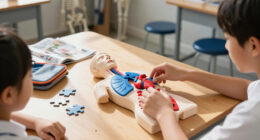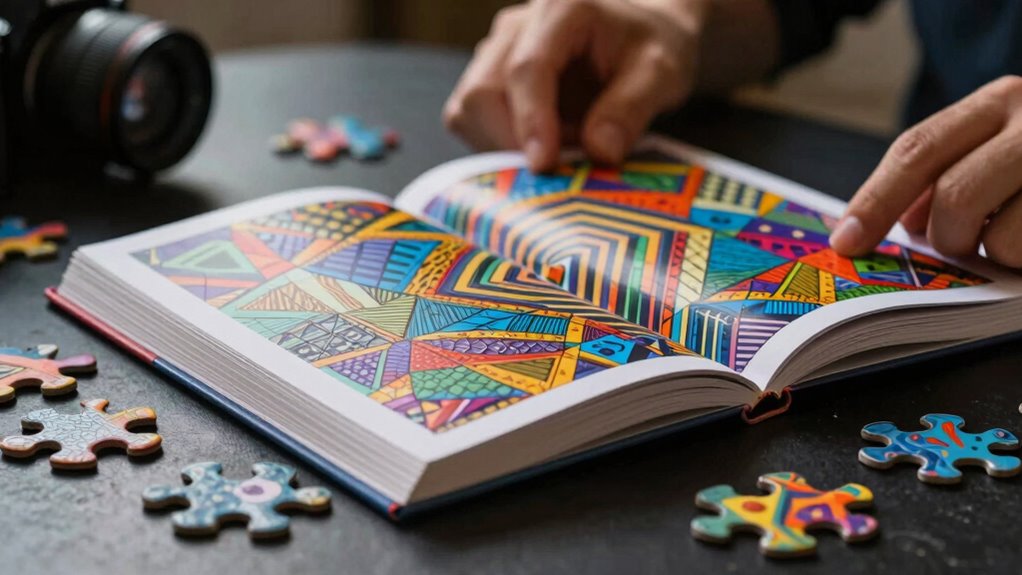

Puzzle books train your spatial reasoning more than you think by engaging you in activities that challenge three-dimensional thinking, shape visualization, and mental manipulation. These puzzles help you develop problem-solving strategies, boost working memory, and improve mental flexibility. By practicing diverse puzzle types, you strengthen neural pathways that support quick visualization and spatial awareness. Keep exploring, and you’ll discover even more ways these challenges can sharpen your mental agility and enhance your everyday thinking skills.

Prime made for students and young adults
- Fast, free delivery for dorm and study essentials
- Prime Video and Amazon Music included
- Member-only deals
Key Takeaways
- Puzzle books enhance spatial reasoning by requiring visualization and mental rotation of complex shapes and three-dimensional structures.
- They develop flexible problem-solving strategies applicable to real-world spatial challenges beyond the puzzles.
- Regular practice with diverse puzzles strengthens neural pathways associated with spatial visualization and mental manipulation.
- Puzzles improve working memory and pattern recognition, which are essential for understanding spatial relationships.
- Engaging with puzzle books fosters cognitive flexibility, enabling quicker adaptation to unfamiliar spatial problems.

Have you ever wondered how puzzle books can sharpen your spatial reasoning skills? You might think they’re just for passing time or entertaining yourself, but they actually play a significant role in your cognitive development. When you immerse yourself in puzzles, you’re engaging in activities that challenge your brain to think three-dimensionally, visualize shapes, and anticipate how pieces fit together—all vital aspects of spatial reasoning. These mental exercises help you build neural pathways that improve your ability to interpret and manipulate visual information, even outside the puzzle context.
What’s interesting is that puzzle books don’t just boost your spatial skills—they also enhance your overall problem-solving strategies. As you tackle different puzzles, you learn to approach problems from multiple angles, develop patience, and refine your ability to think critically. The process of figuring out how pieces connect or how to rotate objects mentally encourages flexible thinking. Over time, this flexibility becomes a natural part of your cognitive toolkit, allowing you to adapt quickly when faced with new or complex challenges. You start to see patterns, recognize solutions more efficiently, and develop a strategic mindset that transfers well beyond puzzles.
You may not realize it, but these books are training your brain in subtle yet powerful ways. Each puzzle requires you to hold multiple pieces or ideas in your mind simultaneously, pushing your working memory and visualization skills. For instance, when solving a jigsaw puzzle, you’re constantly predicting how pieces will look from different angles and fitting them into the overall picture. This mental exercise strengthens your ability to mentally manipulate objects, a core aspect of spatial reasoning. The more you practice, the more intuitive these skills become, often without you even noticing the improvement. Additionally, incorporating different puzzle types exposes you to various cognitive skills, which can further enhance your mental agility. Engaging with diverse puzzles can also boost your neural pathways, making your brain more adaptable and resilient.
Furthermore, puzzle books often introduce new types of challenges that force you to develop diverse problem-solving approaches. Whether it’s logic puzzles, pattern recognition, or spatial arrangement tasks, each type pushes your brain in different ways. This variety prevents stagnation and encourages versatile thinking—an essential component of cognitive development. You can also enhance your problem-solving flexibility by practicing a broad range of puzzles, which supports your ability to adapt to unfamiliar situations. As you become more adept at solving puzzles, you gain confidence in your ability to approach real-world problems with a strategic mindset. Essentially, puzzle books are more than just a pastime—they’re a powerful tool for sharpening your mental agility and spatial reasoning skills in ways you might not expect. Incorporating a variety of puzzle types can also promote cognitive flexibility, further enhancing your overall mental resilience.
As an affiliate, we earn on qualifying purchases.
Frequently Asked Questions
Can Puzzle Books Improve Spatial Reasoning in Children With Learning Disabilities?
Yes, puzzle books can improve visual spatial skills in children with learning disabilities. You’ll notice they engage children actively, helping them understand spatial relationships and enhance problem-solving. These books provide tailored challenges that boost confidence and develop key skills. As your child works through puzzles, they strengthen their ability to process spatial information, making learning easier and more engaging, even with learning disabilities.
How Long Does It Typically Take to See Improvements in Spatial Skills?
You can typically expect to see improvements in spatial skills within a few weeks of regular puzzle book practice. The timing expectations depend on consistency, effort, and the child’s starting point. As they engage in daily or weekly exercises, you’ll notice progress in visualization, problem-solving, and spatial awareness over a skill development timeline of about 4 to 8 weeks. Patience and persistence are key to meaningful growth.
Are Digital Puzzle Books as Effective as Physical Ones?
Digital vs. physical books both effectively boost your spatial reasoning skills. Digital puzzle books offer interactive features, instant feedback, and convenience, making them engaging and accessible. Physical books, on the other hand, provide tactile satisfaction and reduce screen time, which some find more focused. Your choice depends on your preferences; both formats can enhance your spatial skills if you consistently challenge yourself with puzzles.
What Age Is Best Suited to Start Using Puzzle Books for Spatial Training?
You should start using puzzle books for spatial training in early childhood, around ages three to five. During this critical period of cognitive development, children benefit most from engaging activities that challenge their spatial reasoning skills. Introducing puzzle books early helps boost problem-solving, eye-hand coordination, and mental flexibility, laying a strong foundation for future learning. Keep puzzles age-appropriate to make sure they remain fun and beneficial for your child’s growth.
Do Specific Puzzle Types Enhance Certain Aspects of Spatial Reasoning More?
Think of puzzle types as keys opening different doorways to your mind’s potential. Specific puzzles, like tangrams and 3D puzzles, hone your visual-spatial skills by challenging your ability to manipulate shapes and imagine spatial relationships. The more complex the puzzle, the deeper the mental workout. So, choosing puzzles with varying complexity and focusing on those that challenge your spatial visualization can greatly enhance your ability to navigate space effortlessly.
As an affiliate, we earn on qualifying purchases.
Conclusion
So, don’t underestimate the power of puzzle books. They’re more than just games—they’re gateways to sharper spatial reasoning, quietly sculpting your mind with every turn of the page. Like a master craftsman chiseling away at stone, each puzzle shapes your brain, revealing hidden skills you never knew you had. In this silent dance of thought, puzzle books prove that sometimes, the simplest tools *discover* the deepest potential—if you just give them a chance.
As an affiliate, we earn on qualifying purchases.
As an affiliate, we earn on qualifying purchases.
Halloween Picks
halloween
As an affiliate, we earn on qualifying purchases.