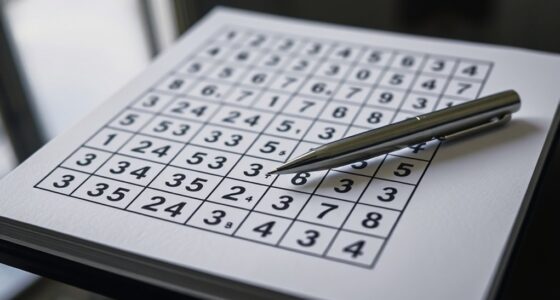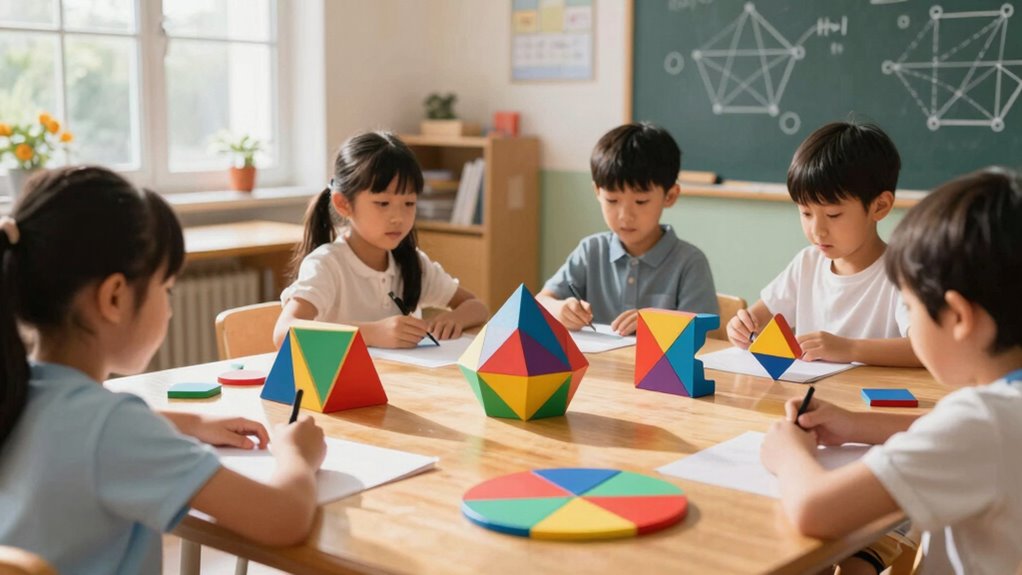

Many great math games depend on geometry because understanding shapes, angles, and spatial relationships is key to solving puzzles. By recognizing how objects fit, move, and change, you develop visualization skills and grasp geometric transformations like rotations, reflections, and translations. These concepts help boost your strategic thinking and spatial reasoning. As you explore these games, you’ll see how geometry makes complex problems easier and more fun—continue on to discover even more ways these skills come to life.

Prime made for students and young adults
- Fast, free delivery for dorm and study essentials
- Prime Video and Amazon Music included
- Member-only deals
Key Takeaways
- Geometry principles like shapes and angles are fundamental to designing engaging and challenging math game mechanics.
- Transformations such as rotations and reflections enable dynamic puzzle-solving and shape manipulation.
- Spatial reasoning skills developed through geometry enhance strategic thinking in gameplay.
- Understanding geometric concepts supports higher-level math skills and real-world problem-solving.
- Incorporating geometry fosters intuitive learning and makes complex concepts accessible and fun.

Many math games rely on geometry because understanding shapes, angles, and spatial relationships is essential to solving puzzles and challenges. When you play these games, you develop the ability to visualize how objects fit together, move, and change within space. This process, called spatial reasoning, is fundamental to many mathematical concepts and skills. Whether you’re rotating a shape, flipping it, or shifting it across a grid, you’re engaging in geometric transformations. These transformations—such as translations, rotations, reflections, and dilations—are the building blocks of many puzzles and game mechanics.
In these games, you often have to manipulate shapes and figures to match a pattern or reach a goal. By doing so, you’re practicing how geometric transformations alter an object’s position, size, or orientation without changing its fundamental properties. For instance, when you rotate a piece to fit into a puzzle, you’re applying rotational symmetry, a key concept in geometry. Similarly, flipping shapes to match a specific configuration tests your understanding of reflections and symmetry. This hands-on experience helps you internalize the rules of geometric transformations, making complex problems more approachable.
Furthermore, spatial reasoning is at the heart of many strategic decisions in math games. You learn to anticipate how moving one piece will affect the overall picture, which is vital in games involving spatial visualization or 3D thinking. You start recognizing patterns and relationships between different shapes and their transformations. This ability to mentally manipulate objects in space not only enhances your geometric understanding but also boosts problem-solving skills across various mathematical areas, including coordinate geometry and trigonometry. Developing these skills through gameplay also fosters a visualization of spatial relationships, which is a key component of geometric thinking. Recognizing how different transformations interact can deepen your understanding of geometric symmetry, making it easier to predict how shapes will behave during gameplay.
By actively engaging with these principles, players often improve their capacity to think in three dimensions, which is crucial in higher-level mathematics and real-world applications. Many popular math games incorporate these principles seamlessly, challenging you to think in terms of geometric transformations and spatial relationships. As you progress, you become more comfortable identifying how shapes can be rotated, reflected, or translated to achieve specific objectives. This active engagement with geometry helps you develop a more intuitive grasp of spatial reasoning, which carries over into real-world applications—from architecture to engineering. Ultimately, these games show that mastering geometry isn’t just about memorizing formulas; it’s about developing a visual and transformational mindset that makes complex problems more manageable and fun to solve.
As an affiliate, we earn on qualifying purchases.
Frequently Asked Questions
How Does Geometry Enhance Problem-Solving Skills in Math Games?
Geometry enhances your problem-solving skills in math games by sharpening your visual pattern recognition and logical deduction. When you analyze shapes, angles, and spatial relationships, you learn to spot patterns quickly and make connections more easily. This improves your ability to think critically and strategize efficiently, helping you solve complex puzzles faster. As you practice, your geometric reasoning becomes a powerful tool for tackling diverse math challenges with confidence and creativity.
Are There Specific Geometric Concepts Most Commonly Used in Math Games?
You’ll often encounter geometric transformations and symmetry patterns in math games. These concepts help you recognize patterns, solve puzzles, and visualize shapes more effectively. Geometric transformations like rotations, reflections, and translations challenge your understanding of shape properties, while symmetry patterns improve your ability to predict outcomes and find solutions faster. Mastering these concepts enhances your problem-solving skills and makes gameplay more engaging and intuitive.
Can Geometry-Based Math Games Improve Spatial Reasoning?
Imagine building a bridge with each carefully placed piece—that’s how geometry-based math games boost your spatial reasoning. They enhance your visual-spatial skills and develop geometric intuition, helping you see patterns, shapes, and relationships more clearly. By engaging with geometric puzzles and challenges, you train your brain to navigate complex spaces more confidently, turning abstract concepts into tangible understanding. These games truly sharpen your mind’s eye and spatial awareness.
How Do Game Designers Incorporate Geometry Into Educational Tools?
Game designers incorporate geometry into educational tools by focusing on visual design and game mechanics that make geometric concepts engaging. They use appealing visuals to illustrate shapes, angles, and spatial relationships, while interactive mechanics like puzzles or building tasks reinforce understanding. By integrating geometric principles seamlessly into gameplay, they create immersive experiences that help learners grasp complex spatial ideas intuitively and enjoyably.
What Age Groups Benefit Most From Geometry-Focused Math Games?
You’ll find that geometry-focused math games benefit children aged 6 to 12 the most. During this time, their visual learning skills and cognitive development are rapidly evolving, making geometry concepts easier to grasp through hands-on play. These games help solidify spatial reasoning and problem-solving, giving young learners a leg up in understanding math fundamentals. It’s the perfect storm for fostering a love for math early on.
As an affiliate, we earn on qualifying purchases.
Conclusion
Just like a compass guides a traveler through uncharted territory, geometry steers many of the best math games. Its shapes, patterns, and spatial logic make learning exciting and engaging. When you play these games, you’re not just having fun—you’re sharpening your mind and discovering new ways to see the world. So, embrace the geometric adventures ahead, and remember, they’re as essential to math as a lighthouse is to a sailor steering through the dark.
geometric transformation puzzles
As an affiliate, we earn on qualifying purchases.
As an affiliate, we earn on qualifying purchases.
As an affiliate, we earn on qualifying purchases.
Fall Picks
fall essentials
As an affiliate, we earn on qualifying purchases.