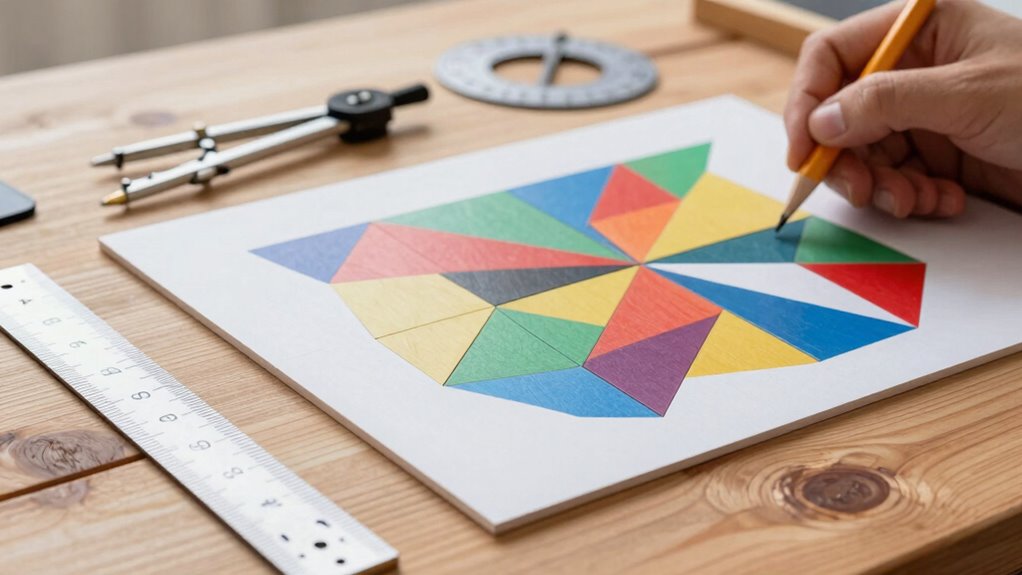

To approach a geometry puzzle without guessing, analyze the figures carefully, noting labels, angles, and measurements. Use a structured method like assigning coordinates to simplify calculations, turning visual details into algebraic expressions. Recognize familiar shapes and apply relevant theorems to narrow options. Break complex parts into smaller segments to clarify relationships. Keep your reasoning organized and verify each step. If you’re curious about more detailed strategies, you’ll find useful tips as you explore these techniques further.
Key Takeaways
- Analyze figures carefully, noting all labels, measurements, and relationships before making assumptions.
- Assign coordinates strategically to convert geometric problems into algebraic equations.
- Identify familiar shapes and apply relevant theorems to guide logical deductions.
- Break complex parts into smaller, manageable problems for systematic reasoning.
- Maintain organized notes of assumptions, steps, and calculations to ensure clarity and accuracy.
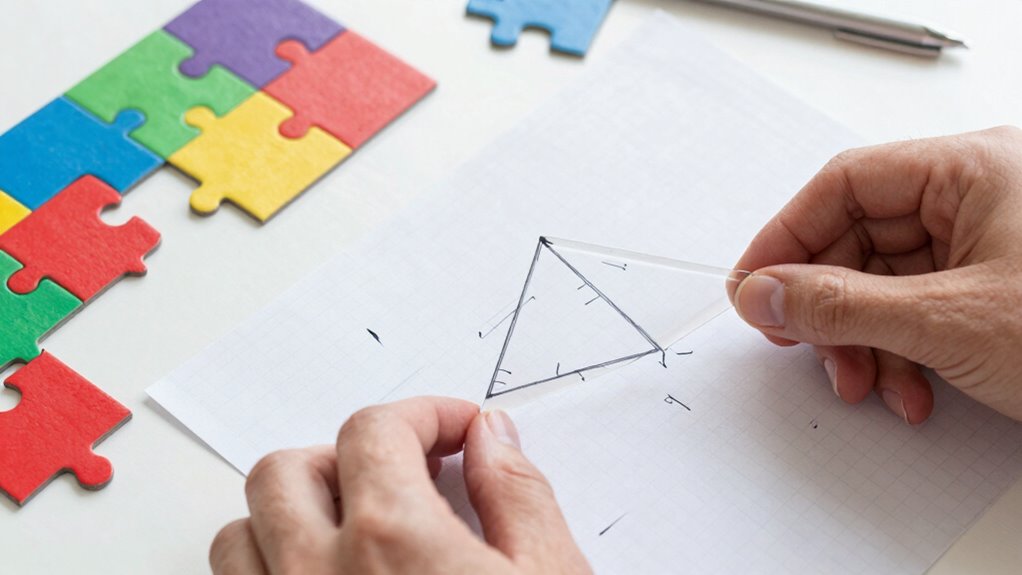
When faced with a geometry puzzle, the key is to approach it systematically rather than rushing to a solution. Instead of jumping straight to guesses, you should start by carefully examining the problem. Look at the given figures, labels, and any measurements provided. Your first step is to develop a clear mental picture or, better yet, create a diagram if one isn’t already provided. This diagram analysis helps you visualize the relationships between different elements, making it easier to identify what’s relevant and what’s not. Recognizing the importance of geometric properties early on can guide your reasoning and prevent unnecessary guesses.
Next, consider coordinate strategies that can simplify complex figures. Assign coordinate axes to your diagram if possible, placing key points at convenient positions. This technique allows you to translate geometric problems into algebraic equations, making them more manageable. For example, if you’re working with triangles or circles, placing points at known coordinates helps you calculate distances, midpoints, or angles with greater accuracy. Using coordinate strategies effectively reduces guesswork by transforming visual puzzles into solvable algebraic problems. Additionally, exploring different coordinate strategies can sometimes reveal hidden relationships that aren’t immediately apparent. Developing a systematic approach ensures you stay organized and methodical throughout your problem-solving process.
Using coordinate axes simplifies geometric problems into algebraic equations, making calculations more precise and reducing guesswork.
As you analyze the diagram, look for familiar shapes or properties—parallel lines, congruent angles, similar triangles—that can serve as clues. Recognizing these elements allows you to apply known theorems and properties, guiding your reasoning process. This structured approach avoids random attempts and keeps your focus on logical deductions. Remember, every geometric figure has a set of properties rooted in definitions and theorems; identifying these early on is crucial for solving the puzzle efficiently.
When you encounter a tricky part, break it down into smaller, manageable pieces. Use your diagram analysis to isolate specific segments or angles. Write down what you know explicitly—such as lengths, angles, or relationships—and see how they connect. This step-by-step approach helps prevent confusion and keeps your reasoning clear. If you get stuck, revisit your coordinate strategy; sometimes shifting your perspective or redefining your axes can reveal new insights.
Throughout the process, stay organized. Keep track of your assumptions, calculations, and reasoning steps. This discipline helps you verify your work, catch mistakes, and avoid random guessing. By systematically analyzing the diagram, applying coordinate strategies, and leveraging known properties, you transform a confusing puzzle into a series of logical steps. Ultimately, patience and methodical thinking lead to solutions you can trust, rather than relying on chance.
As an affiliate, we earn on qualifying purchases.
Frequently Asked Questions
What Tools Can Help Visualize Geometric Problems Effectively?
You can use tools like coordinate plotting to accurately represent points and lines, making complex problems easier to understand. Dynamic diagrams, such as interactive geometric software, allow you to manipulate shapes and see real-time changes. These tools help you visualize relationships and properties clearly, enabling you to explore solutions systematically rather than guessing. Combining coordinate plotting with dynamic diagrams enhances your ability to analyze geometry problems effectively.
How Do I Identify Key Geometric Properties Quickly?
You can identify key geometric properties quickly by spotting geometric shortcuts and property patterns. Focus on angles, side lengths, and symmetry—these often reveal essential clues. Look for familiar shapes like triangles or rectangles, and note relationships such as parallel lines or equal segments. Recognizing these patterns saves time and guides your reasoning, making it easier to solve problems confidently without guesswork. Practice these skills regularly to improve your speed and accuracy.
Are There Common Mistakes to Avoid in Geometry Puzzles?
You should watch out for common pitfalls like jumping to misleading assumptions or overlooking key details. Don’t assume shapes are regular unless confirmed, and avoid rushing into conclusions without verifying your facts. Misleading diagrams or overlooked properties can lead you astray. Instead, double-check your reasoning, stay methodical, and rely on proven geometric principles. This careful approach helps you avoid mistakes and find the correct solution confidently.
How Can I Improve My Spatial Reasoning Skills?
To improve your spatial reasoning skills, practice visualization techniques like mentally rotating shapes and imagining how they fit together. Use pattern recognition to identify recurring geometric configurations and relationships, which helps you solve puzzles more efficiently. Challenge yourself with puzzles and 3D models regularly, and try drawing diagrams to better understand spatial relationships. Over time, these methods sharpen your ability to analyze and solve complex geometry problems confidently.
What Strategies Work Best for Complex Geometry Problems?
Tackle complex geometry problems like unraveling a tangled ball of yarn by first mapping out your key pieces. Focus on geometric conjectures and use angle chasing to reveal hidden relationships. Break the problem into smaller parts, and don’t hesitate to draw auxiliary lines or diagrams. Stay patient and methodical—each step is like turning over a stone, revealing clues that lead you to the solution without guesswork.
coordinate geometry ruler and protractor set
As an affiliate, we earn on qualifying purchases.
As an affiliate, we earn on qualifying purchases.
Conclusion
Remember, patience and practice propel progress. By carefully considering clues, confidently calculating, and calmly constructing your approach, you’ll conquer complex conundrums. Don’t plunge into dilemmas blindly—deliberate, decode, and develop your deductions. With consistent curiosity and cleverness, you’ll crack challenging geometry puzzles without guesswork. So stay steadfast, stay sharp, and let your logical lens lead you to luminous, lasting solutions. Success, after all, favors the focused and fearless solver!

The Cartoon Guide to Geometry: A Humorous Mathematics Study Guide on Plane Geometry and Visual Proofs
As an affiliate, we earn on qualifying purchases.
As an affiliate, we earn on qualifying purchases.
As an affiliate, we earn on qualifying purchases.