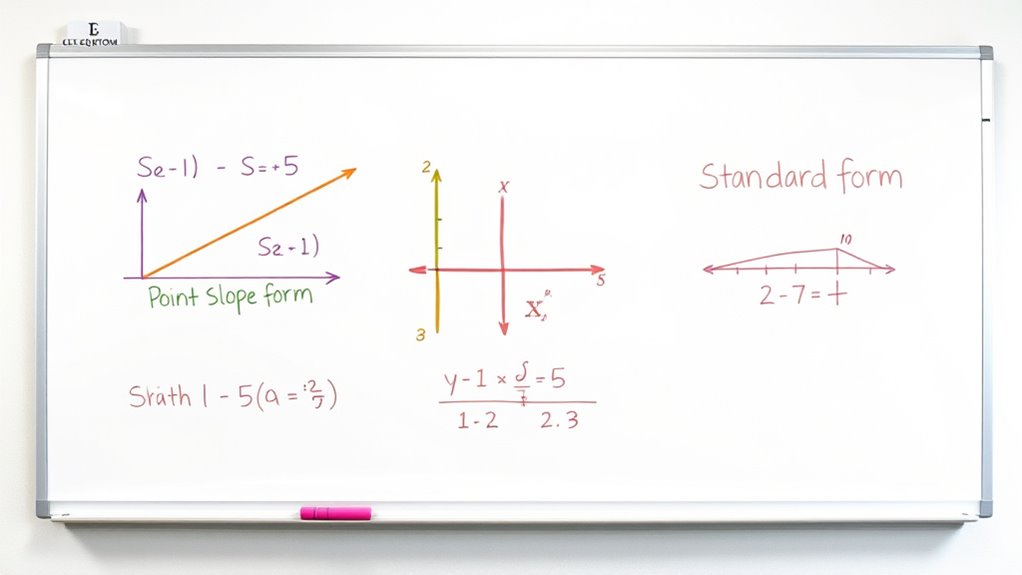

To find the equation of a line, you can use different forms based on what you know. The point-slope form (y – y₁ = m(x – x₁)) is handy when you have a point and slope. The slope-intercept form (y = mx + b) shows the slope and y-intercept clearly, making graphing easy. Standard form (Ax + By = C) is versatile for algebra and geometry. Exploring these options helps in understanding and applying line equations effectively.

Get school and study supplies delivered free — and shop member deals
- Fast, free delivery on millions of items
- Access to Prime Big Deal Days deals on October 6–7
- Prime Video, Amazon Music and more included
Key Takeaways
- The point-slope form is ( y – y₁ = m(x – x₁) ), using a known point and slope.
- The slope-intercept form is ( y = mx + b ), highlighting slope (m) and y-intercept (b).
- To find the slope-intercept form, substitute a point and slope into ( y = mx + b ) and solve for b.
- The standard form is ( Ax + By = C ), useful for solving systems and geometric analysis.
- Conversion among forms (point-slope, slope-intercept, standard) is possible depending on available data.

Have you ever wondered how to find the exact straight line that passes through two points on a graph? In coordinate geometry, this is a fundamental skill because it allows you to understand relationships between points and predict values along that line. The key tool here is linear equations, which describe straight lines mathematically. When you want to determine a line’s equation, you typically need two pieces of information: the slope of the line and a point it passes through. This leads us to different forms of linear equations, each useful in various contexts.
Discover how to find the line passing through two points using different forms of linear equations.
The point-slope form is especially handy when you know a specific point and the slope. It’s written as ( y – y_1 = m(x – x_1) ), where ( (x_1, y_1) ) is a known point on the line, and ( m ) is the slope. This form directly connects your known point with the slope, making it straightforward to write the equation once you have these two pieces. For instance, if you know the line passes through ( (2, 3) ) and has a slope of 4, you can write the equation as ( y – 3 = 4(x – 2) ). From here, you can expand and rearrange it into other forms or graph it directly.
The slope-intercept form simplifies things further by expressing the equation as ( y = mx + b ), where ( m ) is again the slope, and ( b ) is the y-intercept—where the line crosses the y-axis. This form is particularly useful when you want to quickly identify the slope and y-intercept, making graphing or analyzing the line easier. To find ( b ), you can substitute the known point into the equation once you know the slope. For example, if the line passes through ( (3, 2) ) and has a slope of 1, plugging these values into ( y = mx + b ) gives ( 2 = 1 times 3 + b ), so ( b = -1 ).
The standard form, written as ( Ax + By = C ), is more general and often used in algebra and coordinate geometry for solving systems of equations or analyzing geometric figures. You can convert between all these forms depending on what information you have and what you need to find. Understanding these different equations gives you versatile tools to describe any line on a graph precisely and efficiently. Mastering the point-slope, slope-intercept, and standard forms means you can easily analyze, graph, and interpret linear relationships in coordinate geometry.
graphing calculator for students
As an affiliate, we earn on qualifying purchases.
As an affiliate, we earn on qualifying purchases.
Frequently Asked Questions
How Do I Convert Between Different Line Equations?
To convert between different line equations in coordinate geometry, start by identifying the slope and intercepts or points on the line. For example, from point-slope form, you can expand or rearrange to slope-intercept form by solving for y. To get standard form, rearrange the slope-intercept form into ax + by = c. Practice these steps to smoothly switch between linear equations, making it easier to analyze and graph your lines.
What Is the Most Useful Form for Graphing?
The slope-intercept form is the most useful for graphing because it clearly shows the slope and y-intercept, making it easy to plot points quickly. In coordinate geometry, you can easily identify how the line behaves. You just need to perform simple algebraic manipulation if your equation isn’t in this form. This straightforward approach helps you visualize the line accurately and efficiently.
How Can I Find the Equation of a Line From Two Points?
To find the equation of a line from two points, first calculate the slope using the distance formula to find the difference in y-values divided by the difference in x-values. Then, choose one point and apply the point-slope form. You can also find the midpoint if needed for further analysis. This method helps you quickly derive the line’s equation based on the two points provided.
What Does the Slope Represent Physically?
Oh, the slope, that charming little number, is your line’s way of showing off its physical interpretation: the rate of change. It tells you how steeply the line rises or falls, much like a roller coaster’s thrill level. In real life, it’s how fast your speed changes over time or how quickly temperature shifts. fundamentally, the slope is your line’s way of saying, “Hey, I’m all about change!”
How Do I Determine if Two Lines Are Parallel or Perpendicular?
You determine if two lines are parallel or perpendicular by comparing their slopes. If the slopes are equal, the lines are parallel, meaning they never intersect. If the slopes are negative reciprocals (their product is -1), the lines are perpendicular, forming right angles. So, check the slopes of both lines: equal slopes indicate parallel lines, while negative reciprocal slopes show perpendicular lines.
As an affiliate, we earn on qualifying purchases.
Conclusion
Now that you’ve mastered the equations of a line—point-slope, slope-intercept, and standard forms—you’re all set to navigate graphing like a pro. Just remember, understanding these equations is your key to solving real-world problems faster than a smartphone in a café. Think of it as your own digital scroll, guiding you through the maze of coordinates and slopes. Keep practicing, and soon you’ll be sketching lines with the ease of a Renaissance painter.
linear equation practice workbook
As an affiliate, we earn on qualifying purchases.
As an affiliate, we earn on qualifying purchases.
As an affiliate, we earn on qualifying purchases.
Halloween Picks
halloween
As an affiliate, we earn on qualifying purchases.






![Competitive Programmer's Handbook (2018) [Pdf]](https://geometr.info/wp-content/uploads/2026/10/competitive-programmer-s-handbook-2018-pdf-featured-260x140.jpg)